Mirror Review
June 08, 2026
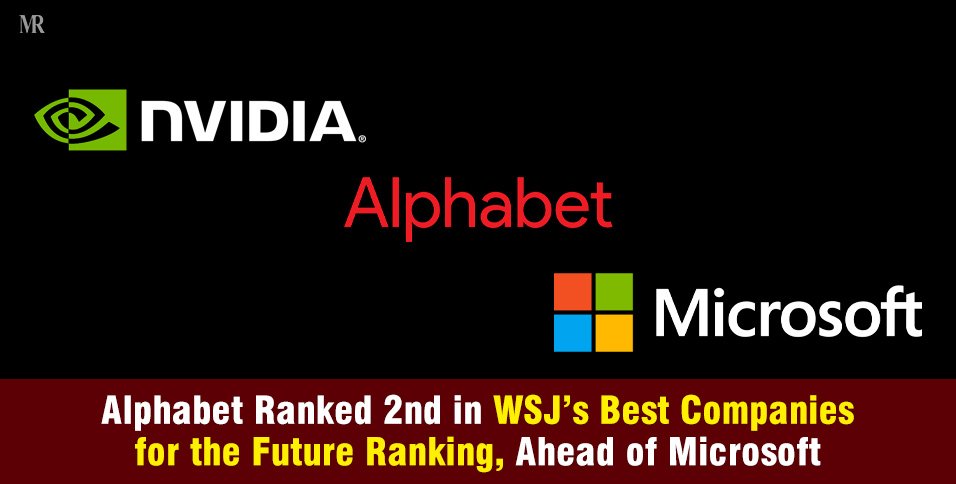
The Wall Street Journal released its Best Companies for the Future ranking, and Alphabet secured the second spot, finishing ahead of tech rival Microsoft. Chipmaker Nvidia grabbed the number one spot on the index. The newly introduced corporate leaderboard evaluates how well major corporations can navigate rapid technological shifts and market chaos.
WSJ’s Best Companies for the Future Ranking aims to find companies that meet the current fast-moving historical moment. The index measures long-term viability rather than short-term market hype. Tech giants dominate the upper tier of the index because of their massive infrastructure investments and modern organizational structures.
Behind the Best Companies for the Future List
The WSJ Leadership Institute created the Best Companies for the Future ranking to analyze S&P 500 corporations. Traditional business metrics often fail to capture a corporation’s long-term viability during massive technological changes. To solve this, researchers built an evaluation model that focuses on structural elasticity and future potential.
The system grades corporations across six distinct operational pillars:
- AI Readiness: The deep incorporation of machine learning into core systems.
- Innovation: The continuous development of fresh patents, systems, and ideas.
- Talent Readiness: Building a workforce that possesses modern technical skills.
- Financial Fitness: Balance sheet health and capital distribution efficiency.
- Resilience: The power to withstand macroeconomic shocks and supply chain issues.
- Agility: The corporate speed to pivot when market conditions change instantly.
The final placement relies on 30 core metrics compiled from 20 external data providers. This comprehensive data pool removes subjective opinions from the scoring process.
Why Alphabet Outmatched Microsoft on the Index
Alphabet earned its second-place position on the List of the Best Companies for the Future by demonstrating widespread operational strength across the six assessment pillars. While Microsoft remains a powerful force in corporate computing, Alphabet achieved slightly better numbers in key operational categories.
1. Unmatched Technical Ecosystem
Alphabet operates a massive product footprint that serves billions of global users daily. This massive reach gives the corporation a massive advantage in data collection and user feedback loops. The integration of AI Overviews into its core search product increased user interaction and boosted advertiser returns.
2. Financial Diversity
The company maintains diverse revenue paths across search ads, subscriptions, hardware, and enterprise cloud systems. YouTube generated over $60 billion in annual revenue for 2025 across advertising and premium subscriptions. Alphabet also runs forward-looking operations like its autonomous driving project, Waymo, which hit a valuation of $126 billion.
3. Enterprise Cloud Expansion
Google Cloud recorded a 63% year-over-year revenue growth rate in its latest quarter. More importantly, its business backlog nearly doubled quarter-over-quarter to reach a massive $460 billion. This financial stability ensures Alphabet can fund multi-year compute infrastructure expansions without hurting its core profitability.
Comparing the Top Performers on WSJ’s Ranking
The top of the inaugural Best Companies for the Future ranking contains a concentrated group of tech leaders. These businesses hold an advantage because they build the hardware and software systems that every other industry requires to run.
| Company Rank | Primary Reason for Success |
| 1. Nvidia | Hardware infrastructure dominance |
| 2. Alphabet | Full-stack AI and massive product footprint |
| 3. Microsoft | Enterprise cloud and agentic computing |
| 4. Meta Platforms | Open-source model deployment |
| 5. Cisco Systems | Enterprise networking hardware |
Nvidia secured the top spot because it placed first or second in five of the ranking’s six main categories. This is because the semiconductor specialist posted a record-breaking $81.6 billion in revenue for its first fiscal quarter, driven by a 92% spike in data center sales.
Microsoft remains a close competitor in third place. The Redmond-based firm reported a total revenue of $82.9 billion for its third fiscal quarter, marking an 18% growth. Microsoft CEO Satya Nadella detailed the company’s focus during this shift:
“We are focused on delivering cloud and AI infrastructure and solutions that empower every business to maximize their outcomes in the agentic computing era.”
Microsoft reported that its specialized AI business segment reached an annual run rate of $37 billion, which is a 123% increase compared to the prior year. Despite these strong numbers, continuous infrastructure spending slightly compressed Microsoft Cloud’s gross margin percentage to 66%.
Why is Corporate Longevity Judged Differently Today
For decades, the primary goal of a corporation was to build stability. Large enterprises constructed protective walls around their markets to ensure predictability. However, rapid technological shifts have disrupted this traditional business strategy. Today, maintaining the status quo leads to obsolescence.
Because software and hardware systems change continuously, corporations must change how they handle talent and capital.
The Best Companies for the Future list proves that long-term corporate value no longer belongs to companies that merely protect their market share. Instead, it belongs to firms that can transform their operations continuously.
Future Outlook for Corporate Leaders
The results from the Best Companies for the Future ranking indicate that the gap between tech-fluent organizations and slow-moving enterprises will widen.
Alphabet, Nvidia, and Microsoft are investing billions of dollars into data center operations, custom silicon chips, and advanced developer tools. These capital investments create a high barrier to entry for smaller market players.
However, maintaining a top spot on this leaderboard requires consistency. Consumer expectations shift quickly, and regulatory scrutiny over data usage and computing power continues to intensify. Businesses must balance aggressive experimentation with strict financial discipline to avoid overextending their balance sheets.
End Note
The Wall Street Journal’s Best Companies for the Future 2026 ranking clarifies which business organizations possess the structural properties to survive long-term disruptions.
Alphabet’s second-place finish, right behind Nvidia and ahead of Microsoft, shows the value of its full-stack technological ecosystem and disciplined financial management.
As advanced software applications reshape standard workflows, the metrics tracked in this index will likely determine the next generation of industry leaders.
Maria Isabel Rodrigues