Every year, millions of tons of agricultural residues, forestry waste, food scraps, and other organic materials are discarded. Instead of ending up in landfills, much of this waste can be converted into electricity, heat, and renewable fuels through biomass energy.
As countries look to strengthen energy security and reduce greenhouse gas emissions, biomass has become an important part of the global renewable energy mix. Unlike solar energy companies and wind energy companies, biomass can generate power on demand while also helping manage organic waste and supporting circular economy initiatives.
Behind this transition are companies developing biomass power plants, producing biofuels, and converting waste into valuable energy resources. From global utilities to specialized bioenergy firms, these businesses are expanding the role of biomass in the clean energy sector.
This article highlights the top 10 biomass energy companies leading the industry in 2026, their core businesses, and the contributions they are making to renewable power and sustainable energy.
How Do Biomass Energy Companies Work?
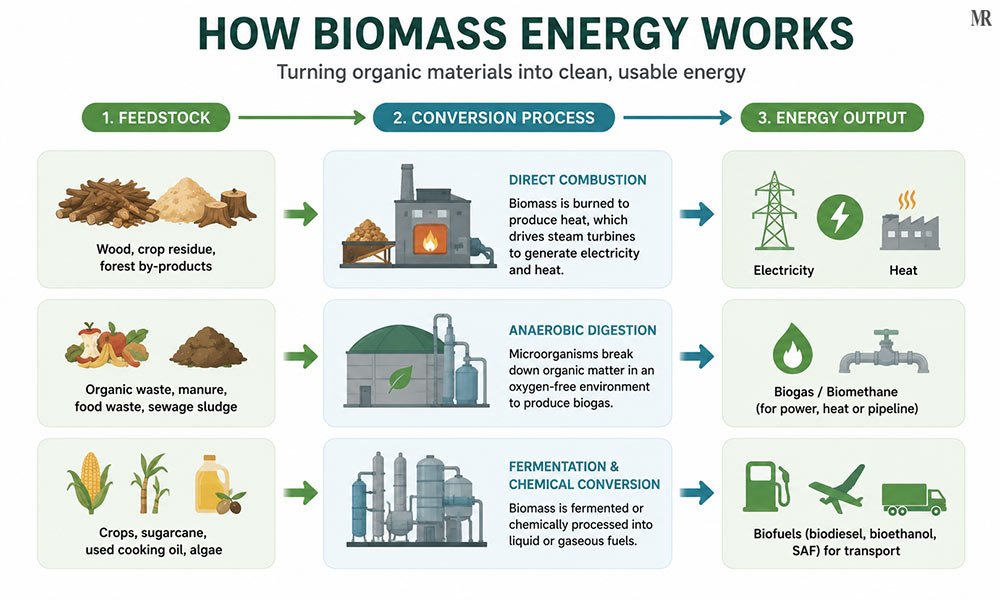
Biomass energy is power, heat, or fuel made from organic material like wood residue, crop leftovers, animal manure, food waste, or landfill gas, rather than fossil fuels.
Biomass vs. Biofuel: What’s the Difference?
Biomass and biofuel are used a lot interchangeably, but they’re not quite the same thing.
- Biomass is the raw organic material itself. Think wood, crop residue, manure, algae, municipal waste that hasn’t been processed yet.
- Biofuel is what you get after that biomass has been converted into a usable liquid or gaseous fuel, such as biodiesel, bioethanol, biomethane, or sustainable aviation fuel.
Put simply, all biofuels come from biomass, but not all biomass ends up as biofuel.
Drax, burning wood pellets for electricity, is a biomass power company; Verbio, turning corn and rapeseed into biodiesel, is a biofuel producer. Several companies on this list, like Aemetis and Gevo, straddle both categories by running biomass power or RNG operations alongside dedicated biofuel production lines.
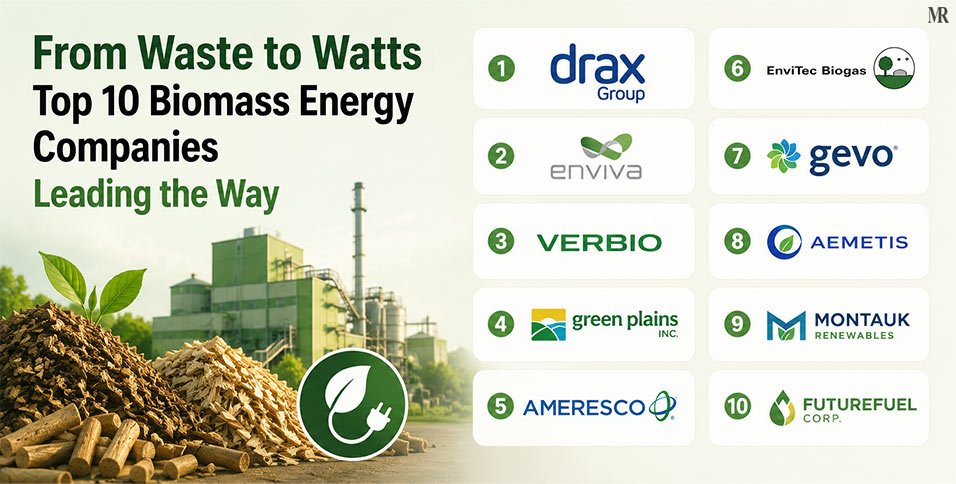
List of the Top 10 Biomass Energy Companies in 2026
The ranking of these Top 10 Biomass Energy Companies blends company scale, 2025/2026 financial performance, and how central biomass or bioenergy is to the business.
| Company | Headquarters | Key 2025/2026 metric |
| 1. Drax Group plc | Selby, UK | £5.39B 2025 revenue; largest single-site biomass power plant |
| 2. Enviva | Bethesda, Maryland, US | World’s largest industrial wood pellet producer by volume |
| 3. Verbio SE | Leipzig, Germany | €1.58B FY2024/25 revenue; 1.19M tonnes biodiesel/bioethanol |
| 4. Green Plains Inc. | Omaha, Nebraska, US | ~1.1B gal/yr ethanol capacity across 9 biorefineries |
| 5. Ameresco, Inc. | Framingham, Massachusetts, US | $1.93B 2025 revenue; 9th RNG facility placed in service |
| 6. EnviTec Biogas AG | Lohne, Germany | €312.6M 2025 revenue; ~90 owned biogas plants |
| 7. Gevo, Inc. | Englewood, Colorado, US | $161M FY2025 revenue; Net-Zero 1 SAF project in development |
| 8. Aemetis, Inc. | Cupertino, California, US | $53.7M Q4 2025 revenue; dairy RNG platform scaling fast |
| 9. Montauk Renewables, Inc. | Pittsburgh, Pennsylvania, US | $176.4M 2025 revenue; 12 RNG + 3 electricity projects |
| 10. FutureFuel Corp. | Batesville, Arkansas, US | 59M gal/yr biodiesel capacity; production restarted Dec 2025 |
1. Drax Group plc
Drax runs the UK’s Drax Power Station, the world’s largest single-site converting biomass to electricity, backed by a global wood-pellet supply chain. It’s the clearest example of a biomass power company operating at true utility scale.
Total group revenue hit £5.39 billion in 2025, and produced a record 15.0 TWh of renewable generation for the year.
Drax runs 18 pellet plants across the US and Canada with a nameplate capacity of around 5.4 million tonnes, and it locked in a new UK government Contract for Difference through March 2031 covering all four biomass units at its North Yorkshire site.
2. Enviva
Enviva is a US-based producer of industrial wood pellets and has long been the world’s largest supplier of biomass fuel to power utilities in Europe and Asia that co-fire or run entirely on wood pellets instead of coal.
The company emerged from Chapter 11 bankruptcy restructuring in December 2024 with a stronger balance sheet, a $250 million equity raise, and no near-term debt maturities, putting it back on a solid footing to defend its market-leading pellet volumes.
Its 11th production plant, in Epes, Alabama, is ramping toward roughly 1 million tonnes of annual output, adding to a network of Southeastern US plants that ship wood pellets overseas by the millions of tonnes every year.
3. Verbio SE
Verbio is a German biofuels group and the only European producer running biodiesel, bioethanol, and biomethane at an industrial scale under one roof, making it one of the more diversified bioenergy companies on this list.
Group revenue reached €1.58 billion in fiscal year 2024/25, with production of over 1.2 million tonnes of combined biodiesel and bioethanol plus a record 1,190 GWh of biomethane.
Verbio’s US biorefinery in Nevada, Iowa, came fully online during the year, helping push nine-month FY2025/26 biomethane output up 20% year-on-year, with revenue for that period reaching €1.34 billion.
4. Green Plains Inc.
Green Plains is a US ethanol producer shifting from a commodity fuel business into a lower-carbon platform built around carbon capture and high-protein co-products, rather than exiting biomass processing altogether.
The company runs nine biorefineries across the Midwest with roughly 1.1 billion gallons of annual ethanol capacity, keeping it among the largest biomass-to-fuel processors in North America.
Green Plains hit a record 101% capacity utilization in the third quarter of 2025 and began carbon-capture operations at all three of its Nebraska facilities by December 2025, unlocking valuable 45Z tax credits tied to low-carbon ethanol.
5. Ameresco, Inc.
Ameresco is a US energy infrastructure company that designs, builds, and operates renewable natural gas plants and other biomass-linked energy assets for governments, utilities, and industrial customers.
The company reported $1.93 billion in 2025 revenue, up 9% year over year, and placed 121 MWe of new energy assets into service, including its ninth RNG facility built with landfill operator Republic Services.
Its project backlog topped $5 billion at year-end 2025, and Ameresco is guiding toward two additional RNG plants entering service in 2026 as part of a broader $10 billion long-term revenue pipeline.
6. EnviTec Biogas AG
EnviTec Biogas is a German biogas specialist covering the entire value chain of planning, building, and operating biogas and biomethane plants, plus bio-LNG and food-grade liquid CO2 production.
The company operates roughly 90 of its own biogas plants and posted 2025 revenue of €312.6 million, keeping it one of Germany’s largest biogas producers, with projects spanning 18 countries worldwide.
Its Own Plant Operation segment, the company’s largest, kept delivering steady growth even as a change to EU greenhouse-gas quota rules squeezed margins in its bio-LNG business during 2025.
7. Gevo, Inc.
Gevo is a US renewable fuels company built around alcohol-to-jet (ATJ) technology, which converts corn-based ethanol into sustainable aviation fuel (SAF) and other low-carbon hydrocarbons.
Full-year 2025 revenue came in at $161 million, boosted by the closed acquisition of Red Trail Energy, now branded Gevo North Dakota, which produced a record 69 million gallons of low-carbon ethanol.
Its flagship Net-Zero 1 SAF project in Lake Preston, South Dakota, is designed to produce around 60 million gallons of SAF a year once built out.
8. Aemetis, Inc.
Aemetis is a California-based renewable fuels company running an ethanol plant, a growing network of dairy-farm biogas digesters that produce RNG, and a biodiesel plant in India.
Its dairy RNG platform kept scaling through 2025, with quarterly revenue climbing to $53.7 million by the fourth quarter, while the India biodiesel plant added $29.7 million for the full year.
Aemetis is also developing a sustainable aviation fuel and renewable diesel biorefinery on a former US Army ammunition site in Riverbank, California, targeted at roughly 78 million gallons of SAF capacity a year.
9. Montauk Renewables, Inc.
Montauk Renewables is a US landfill-gas specialist that captures methane escaping from landfills and farms and converts it into RNG and renewable electricity, a textbook waste-to-energy business model.
The company reported 2025 revenue of $176.4 million, roughly flat year over year, generated across 12 RNG projects and three renewable-electricity projects spread over several states.
Montauk produced about 5.6 million MMBtu of RNG in 2025 and is developing a new agricultural RNG project in North Carolina, backed by an initial investment of $180 to $220 million.
10. FutureFuel Corp.
FutureFuel is an Arkansas-based manufacturer that pairs a specialty chemicals business with a 59-million-gallon-per-year biodiesel plant in Batesville, one of the mid-sized biodiesel producers still standing in a tough market.
The company restarted biodiesel production in December 2025 after regulatory uncertainty around the federal 45Z clean-fuel credit forced a mid-year shutdown, setting up what management expects to be a stronger 2026.
Full-year 2025 revenue fell 61% to $95.7 million as biodiesel output slid to just 9 million gallons, but clearer 45Z rules and higher 2026-27 Renewable Fuel Standard volumes are reviving the segment.
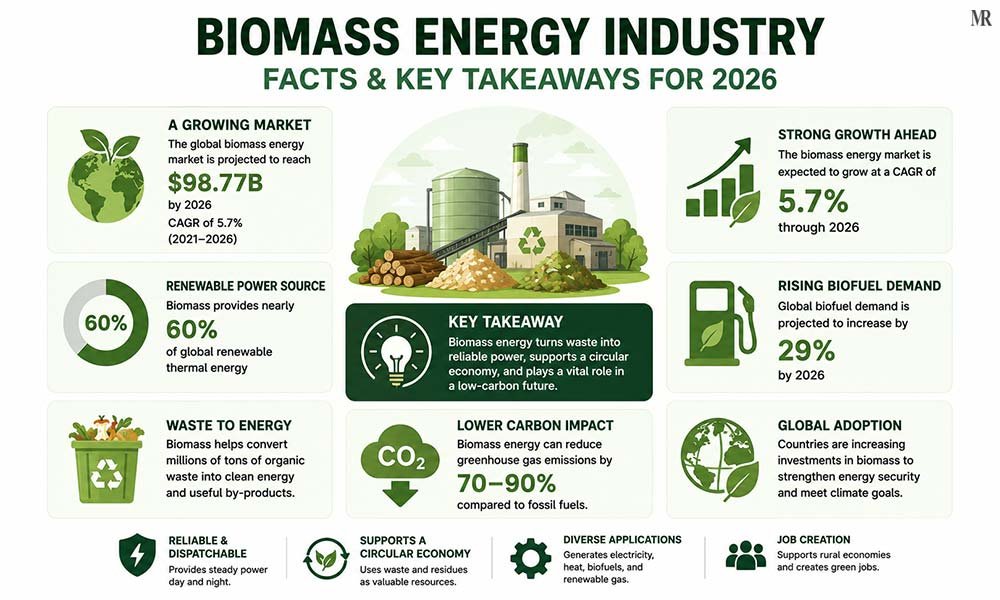
Biomass Energy Industry Facts and Key Takeaways for 2026
Fun fact: On TIME and Statista’s 2026 ranking of the world’s top greentech companies renewable energy companies made up 34% of the full list.
Final Word
Biomass energy is proving that renewable power doesn’t have to rely solely on the sun or the wind. By converting agricultural residues, forestry by-products, municipal waste, and other organic materials into electricity, heat, and renewable fuels, it helps address both energy demand and waste management.
The biomass energy companies featured in this list are advancing that transition through new technologies, large-scale bioenergy projects, and investments in sustainable fuel production.
As countries continue to diversify their renewable energy mix and pursue decarbonization goals, these companies are expected to play an increasingly important role in delivering reliable, low-carbon energy for industries, businesses, and communities worldwide.
Maria Isabel Rodrigues