Mirror Review
April 30, 2026
Alphabet Inc. announced its financial results for the first quarter of 2026, reporting a 22% increase in consolidated revenues to $109.9 billion.
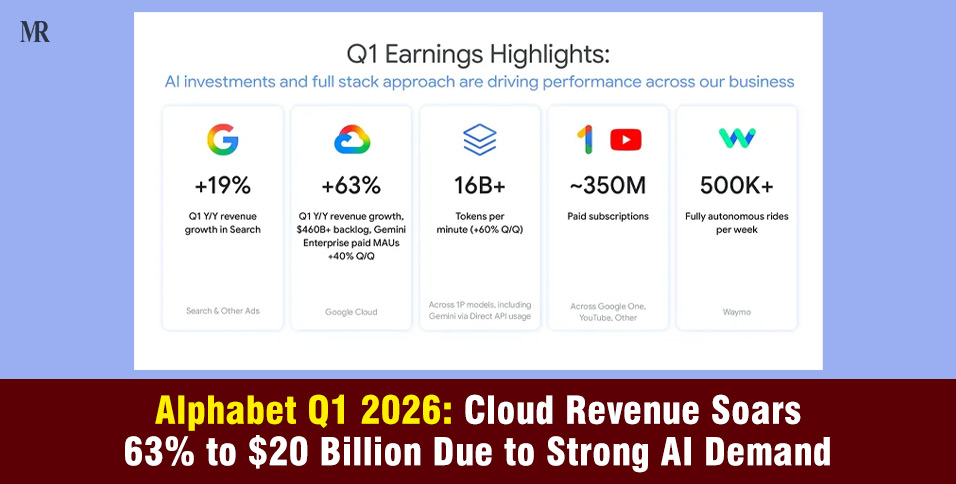
The standout performer was Google Cloud, which saw revenue surge 63% to reach $20 billion for the first time.
This growth was primarily fueled by intense demand for enterprise AI solutions and infrastructure.
With operating income rising 30% to $39.7 billion, Alphabet Q1 2026 results demonstrated that its heavy investments in artificial intelligence are now translating into financial gains.
Google Cloud Performance Reaches New Heights
The latest Alphabet Q1 earnings 2026 report highlights a historic milestone in the company’s business model.
For the first time, enterprise AI solutions served as the primary growth driver for the cloud division.
Revenue from products built on generative AI models grew nearly 800% compared to the previous year.
| Metric | Q1 2025 | Q1 2026 | Growth |
| Google Cloud Revenue | $12.26 Billion | $20.03 Billion | 63% |
| Cloud Operating Income | $2.18 Billion | $6.60 Billion | 203% |
| Total Alphabet Revenue | $90.23 Billion | $109.90 Billion | 22% |
| Net Income | $34.54 Billion | $62.58 Billion | 81% |
This acceleration in the cloud sector outperformed analyst expectations, which had estimated a 50.1% increase from Google’s Q1 2025. The unit’s backlog also nearly doubled quarter-on-quarter, reaching over $460 billion.
New Changes in AI Infrastructure and Sales
During the Google earnings call, CEO Sundar Pichai revealed a major change in how the company handles its custom hardware.
For years, Google reserved its Tensor Processing Units (TPUs) for internal use. Now, the company has started selling these chips directly to a select group of customers for use in their own data centers.
“Our AI investments and full-stack approach are lighting up every part of the business,” said Sundar Pichai, CEO of Alphabet and Google.
Alphabet also introduced its eighth-generation TPUs, which offer significantly better performance for training and serving large-scale AI models.
Specifically, the TPU 8t provides three times the processing power of previous versions, while the TPU 8i offers 80% better performance per dollar for inference tasks.
Massive Increase in Google Capex
To support this rapid growth, Alphabet is significantly raising its spending on physical infrastructure.
Google capex for the first quarter more than doubled year-over-year to $35.67 billion. Looking ahead, the company updated its 2026 forecast for capital expenditures to between $180 billion and $190 billion. This represents a $5 billion increase from earlier projections.
Alphabet plans to maintain this aggressive investment pace into 2027 to meet the demand for AI processing power. While these costs are high, analysts note that the quality of revenue growth justifies the spending.
Search and Advertising Momentum
While Cloud stole the headlines in Alphabet Q1 2026 results, the core search business remained highly profitable. Google profits were supported by a 19% growth in Search & Other advertising revenue.
- AI Overviews and AI Mode are driving higher user engagement.
- Search latency has been reduced by 35% over five years despite adding complex AI features.
- The cost of delivering core AI responses fell by more than 30% after upgrading to Gemini 3.
YouTube also showed strength, with U.S. viewers watching over 200 million hours of content daily on television screens. The platform reached a milestone of 10 million channels publishing Shorts every day.
Consumer and Enterprise AI Adoption
The Alphabet Q1 earnings report showed that AI is being adopted rapidly by both individuals and businesses.
- Paid Subscriptions: Total paid subscriptions reached 350 million across YouTube, Google One, and Gemini.
- Gemini Enterprise: Paid monthly active users for the enterprise AI suite grew 40% quarter-over-quarter.
- API Usage: First-party AI models are now processing 16 billion tokens per minute, a 60% increase from the last quarter.
Alphabet also successfully integrated its recent acquisition of Wiz, a cloud security platform. The company is using this technology to offer “agentic defense,” which uses AI to automatically detect and fix cybersecurity threats in real-time.
Waymo and Other Bets
The “Other Bets” segment, while still operating at a loss of $2.1 billion, saw significant operational progress.
Waymo, Alphabet’s autonomous driving unit, surpassed 500,000 fully autonomous rides per week. This volume doubled in less than a year as the service expanded to Nashville and other major U.S. cities.
Market Reaction and Google Stock
Following the announcement of Alphabet Q1 2026 results, google stock (GOOGL) rose more than 6% in extended trading. Investors reacted positively to the evidence that AI is driving real revenue rather than just increasing costs. The company also increased its quarterly dividend by 5% to $0.22 per share.
The Alphabet Q1 2026 forecast looks positive as the company prepares for its upcoming I/O developer conference. With a massive backlog in the cloud division and a “full-stack” approach to AI that includes everything from custom chips to consumer apps, Alphabet has positioned itself as a leader in the next era of computing.
End Note
The Alphabet Q1 2026 financial results mark a turning point where artificial intelligence is no longer just an experiment but a massive financial engine.
By reaching $20 billion in quarterly cloud revenue and nearly doubling its backlog, the company has answered concerns about the return on its heavy infrastructure spending.
As Alphabet continues to scale its AI models and hardware, the focus remains on maintaining this momentum across search, cloud, and its emerging autonomous technologies.
(For a deeper look at what drove last year’s performance, read our analysis of the key factors behind the complete Alphabet 2025 earnings.)
Maria Isabel Rodrigues