Offshore wind is one of the fastest-growing corners of the renewable energy business, and offshore wind companies are racing to claim a share of it.
Global installed offshore wind capacity reached 92.5 gigawatts (GW) by the end of 2025, up 16% in a single year, and the market is valued at an estimated $57.51 billion in 2026, on its way to more than $208 billion by 2035.
Governments across Europe, China, and North America are pouring billions into new projects, and floating turbine technology is now opening deep-water sites that fixed foundations could never reach.
This guide breaks down what offshore wind actually is, why it matters for global energy security, and which offshore wind companies are leading the industry in 2026.
What Are Offshore Wind Companies?
Offshore wind companies are the businesses that build, own, operate, or supply the hardware behind wind farms located in oceans, seas, and other large bodies of water.
The sector splits into two main groups:
- Developers, who lease the seabed, finance projects, and run wind farms once they start producing power
- Manufacturers, who design and build the turbines, blades, and foundations that make offshore power generation possible.
A handful of large utilities, including Ørsted and RWE, do both.
What Is Offshore Wind?
Offshore wind is electricity generated by turbines mounted in open water instead of on land. Ocean winds blow stronger and steadier than onshore winds, so offshore turbines run at higher capacity factors and generate more power per unit than land-based ones. Turbines sit on fixed foundations, such as monopiles and jackets, in shallow water, or on floating platforms anchored to the seabed in deeper water where fixed foundations aren’t practical. The power then travels through subsea cables to an offshore substation before reaching the onshore grid.
How Offshore Wind Works
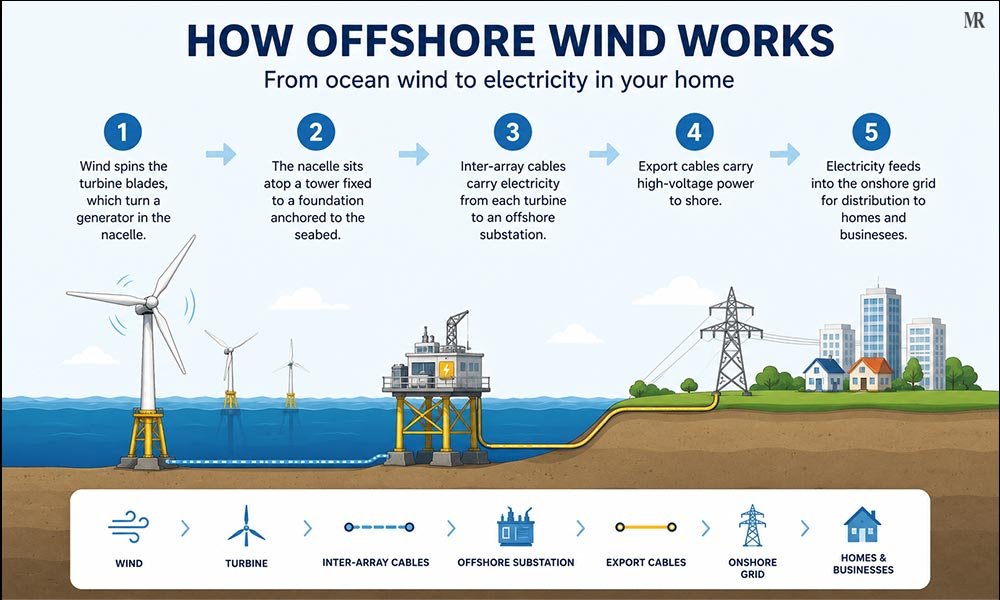
Turning ocean wind into grid power follows a fixed sequence, from turbine to transmission line:
Offshore Wind vs. Onshore Wind
Offshore wind farms and onshore wind farms use the same basic technology, but the differences in scale, cost, and siting are significant. Many of the world’s leading wind energy companies operate across both segments.
| Factor | Offshore Wind | Onshore Wind |
| Wind speed & consistency | Higher and steadier | Lower and more variable |
| Typical turbine size | 10–20+ MW | 2–6 MW |
| Installation cost | Much higher per MW | Lower per MW |
| Capacity factor | 40–55%+ | 25–35% |
| Grid connection | Subsea cables & offshore substations | Overhead or underground lines |
| Best suited for | Coastal nations with strong sea winds | Most open land |
Offshore Wind Companies at a Glance
Here’s a quick snapshot of how these offshore wind companies stack up on their headline 2026 metric.
| Company | Type | Country | Key 2026 Metric |
| Ørsted A/S | Developer | Denmark | 10.2 GW installed, 8.1 GW under construction |
| Equinor ASA | Developer | Norway | ~47% of global floating wind capacity |
| RWE AG | Developer | Germany | ~7 GW won in UK AR7 auction |
| China Three Gorges Corp. | Developer | China | 16 MW record floating turbine installed |
| Iberdrola S.A. / Avangrid | Developer | Spain | ~2.6 GW installed, +3.5 GW by 2028 |
| Vattenfall AB | Developer | Sweden | ~6.7 GW combined wind capacity |
| Siemens Gamesa (Siemens Energy) | Manufacturer | Germany/Spain | No. 1 offshore turbine supplier, 2025 |
| GE Vernova | Manufacturer | United States | 277 Haliade-X turbines at Dogger Bank |
| Vestas Wind Systems | Manufacturer | Denmark | 2.76 GW order from RWE in 2026 |
| Mingyang Smart Energy | Manufacturer | China | OceanX floating platform, EU expansion |
| Envision Energy | Manufacturer | China | 20.9 GW installed globally in 2025 |
| Goldwind | Manufacturer | China | 29.3 GW installed, 100+ GW cumulative |
Top Global Offshore Wind Developers
These offshore wind companies invest in, own, and operate wind farms at sea, taking on the leasing, financing, and long-term operations that turn a patch of ocean into a power plant.
1. Ørsted A/S
Ørsted is the world’s largest offshore wind developer by operating capacity, with 10.2 GW of installed offshore capacity and another 8.1 GW under construction as of 2026. The Danish company built the world’s first offshore wind farm, Vindeby, in 1991, and now runs about 90% of its operating capacity in Europe, enough to power around 22 million Europeans. Ørsted was a signatory to the 2026 North Sea Investment Pact and remains the benchmark developer other offshore wind companies are measured against.
2. Equinor ASA
Equinor is Norway’s state-backed energy major and the clear leader in floating offshore wind, operating close to half the world’s floating wind generating capacity. Its Hywind Scotland project, commissioned in 2017, was the world’s first floating wind farm, and Hywind Tampen, the world’s largest floating wind farm at roughly 88 MW, has posted capacity factors above 51% while powering North Sea oil and gas platforms directly. Equinor also co-owns Dogger Bank, set to become the world’s largest fixed-bottom offshore wind farm at 3.6 GW.
3. RWE AG
RWE, a German utility founded in 1898, is one of the most aggressive offshore wind companies in the UK market right now. It secured almost 7 GW of capacity in the UK’s Allocation Round 7 auction in January 2026, the largest single haul in that record-breaking 8.4 GW auction, covering projects like Norfolk Vanguard East and West and Dogger Bank South. RWE is targeting 10 GW of global offshore capacity by 2030 and plans roughly €35 billion in net investment across its generation portfolio between 2026 and 2031.
4. China Three Gorges Corporation (CTG)
CTG is China’s largest state-owned renewable energy company and a central player in the country’s offshore build-out along Guangdong’s coast. In May 2026, CTG installed the Sanxia Linghang, a 16 MW single-unit floating wind turbine described as the world’s largest floating platform by capacity and rotor diameter, built to withstand typhoon-force winds above 160 mph. CTG has also grid-connected a 20 MW offshore turbine developed with Goldwind, the first turbine of that size installed at sea anywhere in the world.
5. Iberdrola S.A. (via Avangrid)
Iberdrola, the Spanish utility giant, held about 2.6 GW of installed offshore wind capacity at the start of 2026 and is investing roughly €8 billion to add 3.5 GW more by 2028. Through its US subsidiary Avangrid, Iberdrola developed Vineyard Wind 1, one of the first utility-scale offshore projects in America, with a planned capacity of about 806 MW. The company is also planning Spain’s first industrial-scale floating offshore wind farm off the Spanish coast.
6. Vattenfall AB
Vattenfall, the Swedish state-owned utility, operates more than 1,400 wind turbines with roughly 6.7 GW of combined onshore and offshore capacity across five European countries. The company has been a fixture of North Sea offshore development for years, with major projects such as Hollandse Kust Zuid in the Netherlands, one of the largest offshore wind farms built without subsidies. Vattenfall continues to pair new offshore capacity with battery storage to help balance grid output from variable wind generation.
Top Offshore Wind Turbine Manufacturers
These engineering firms design, build, and supply the massive turbines, blades, and drivetrains that convert ocean wind into electricity.
1. Siemens Gamesa Renewable Energy (Siemens Energy)
Siemens Gamesa, the wind unit of Germany’s Siemens Energy, topped the global offshore turbine market for the second year running in 2025, according to BloombergNEF, narrowly ahead of China’s Goldwind. The Spanish-German manufacturer supplied turbines for landmark projects including Ørsted and Siemens Gamesa’s joint deployment of Hornsea 2, and its offshore platform remains one of the most widely used in European waters.
2. GE Vernova
GE Vernova builds the Haliade-X, the turbine platform powering Dogger Bank, the world’s largest offshore wind farm at 3.6 GW once complete. The Haliade-X launched at 12 MW and has since been uprated to 13 and 14 MW versions, with 277 units total planned across Dogger Bank’s three phases. The US manufacturer’s turbines also feature in American projects like Vineyard Wind 1 and Ocean Wind, making GE Vernova a key supplier on both sides of the Atlantic.
3. Vestas Wind Systems A/S
Vestas, the Danish turbine giant, dominates both onshore and offshore markets and secured a 390 MW offshore order in South Korea in late 2025 for its V236-15.0 MW turbines. In 2026, RWE placed a firm order with Vestas for 2.76 GW of turbines across its Vanguard East and West projects in the UK, one of the largest single offshore turbine orders of the year. Vestas’ offshore platform is engineered for the harsh, high-wind conditions of open-sea installations.
4. Mingyang Smart Energy Group Co., Ltd.
Mingyang is China’s leading floating wind specialist and the manufacturer behind OceanX, a dual-turbine floating platform that has already operated at commercial scale. In May 2026, Ming Yang Europe joined Norwegian Offshore Wind, extending a European push that began with membership in Germany’s offshore wind association in 2025. The company still faces exclusions from some UK and German projects amid scrutiny of Chinese energy technology, even as it expands its footprint elsewhere.
5. Envision Energy
Envision is one of the world’s largest wind turbine makers, with more than 12,500 turbines deployed globally and R&D centers spanning Denmark, Germany, and the United States. BloombergNEF ranked Envision the world’s second-largest overall wind turbine supplier in 2025, installing 20.9 GW, with roughly a quarter of that capacity outside mainland China. The company holds the largest market share in low-wind-speed turbines in China and continues expanding its offshore engineering capabilities.
6. Goldwind (Xinjiang Goldwind Science & Technology Co., Ltd.)
Goldwind was the world’s leading wind turbine supplier by volume in 2025, installing 29.3 GW and becoming the first Chinese manufacturer to pass 100 GW of cumulative global installed capacity. Working with China Three Gorges Corporation, Goldwind co-developed the 16 MW Sanxia Linghang floating turbine, a record-setting deployment for single-unit floating capacity. Goldwind’s GW6S offshore platform, launched with three new turbine models, shows the company pushing hard into deeper-water offshore projects.
Why Offshore Wind Is Growing: Industry Outlook for 2026
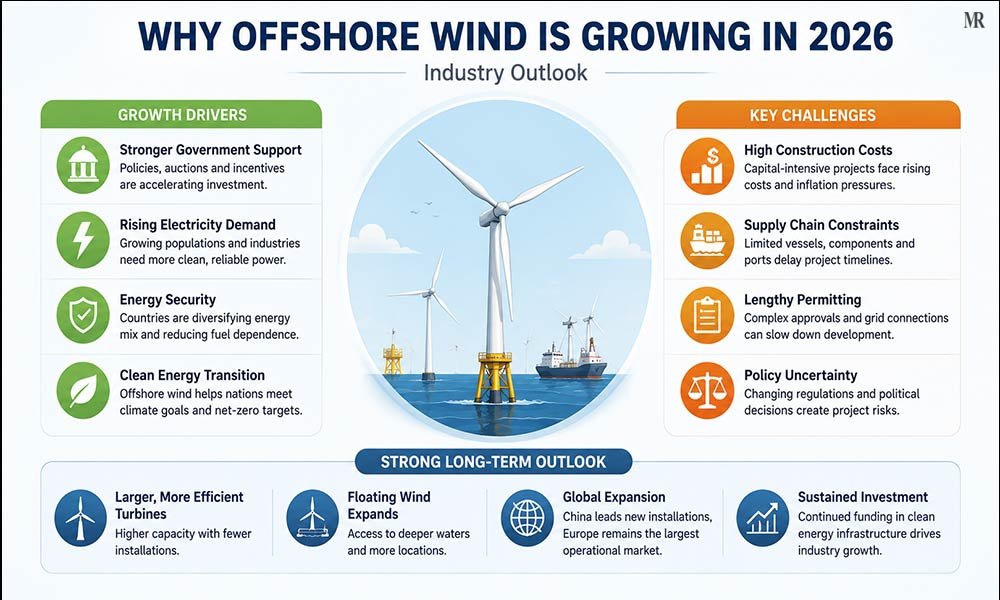
Offshore wind is entering a new phase of global expansion, driven by stronger government support, rising electricity demand, and the need for greater energy security. Countries are investing in offshore wind to diversify their energy mix while reducing dependence on fossil fuels and imported fuels.
China continues to lead new offshore wind installations, while Europe remains the largest market for operational offshore wind farms. Emerging markets in Asia-Pacific and North America are also accelerating project development through new auctions and long-term renewable energy targets.
Technology is advancing just as quickly. Turbine manufacturers are developing larger, more efficient offshore turbines capable of generating more electricity with fewer installations, while floating wind technology is opening deeper coastal waters that were previously unsuitable for fixed-bottom foundations.
The industry also faces several challenges. Rising construction costs, supply chain constraints, lengthy permitting processes, and evolving government policies continue to affect project timelines. In the United States, for example, recent federal actions like Trump’s Temporary Withdrawal have created uncertainty for new offshore wind developments, while European countries continue to expand investment in North Sea projects.
Despite these challenges, offshore wind remains one of the fastest-growing segments of the renewable energy industry. As technology improves and governments continue investing in clean energy infrastructure, leading offshore wind companies are expected to expand their global project pipelines and help meet growing electricity demand over the coming decade.
Conclusion
Offshore wind has moved from a niche renewable technology to a core piece of the global energy mix, and the offshore wind companies profiled here, from Ørsted’s record installed capacity to Goldwind’s turbine volumes, are the ones setting the pace.
With Europe locking in a 300 GW target, China adding capacity every year under its new five-year plan, and floating technology unlocking deeper water, the next few years will likely bring even faster growth across developers and manufacturers alike.
Maria Isabel Rodrigues
FAQs
- Who is the largest offshore wind company?
Ørsted is the largest offshore wind developer by operating capacity, with 10.2 GW installed and 8.1 GW under construction as of 2026. On the manufacturing side, Goldwind installed the most turbine capacity worldwide in 2025.
- Which country leads in offshore wind?
China leads global offshore wind, having added the most new capacity for eight consecutive years and reaching roughly 48.4 GW of cumulative installed capacity by the end of 2025.
- What is floating offshore wind?
Floating offshore wind uses turbines mounted on platforms anchored to the seabed by mooring lines instead of fixed foundations, allowing turbines to operate in deep water that fixed-bottom structures can’t reach.
- Why is offshore wind more expensive?
Offshore wind costs more than onshore wind because of specialized installation vessels, subsea cabling, offshore substations, and the engineering needed for foundations that withstand ocean conditions, though costs continue to fall as turbines and supply chains scale up.