Mirror Review
May 21, 2026
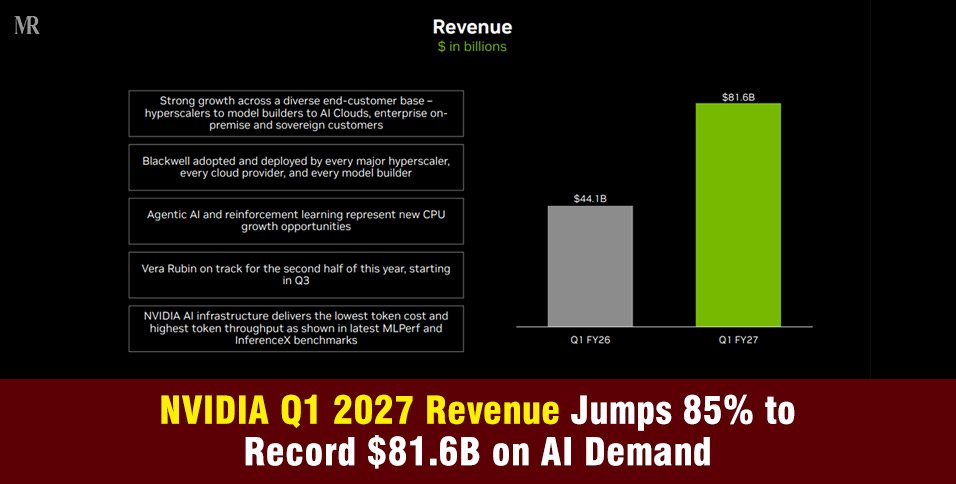
NVIDIA reported record-breaking revenue of $81.6 billion for the first quarter of fiscal 2027, marking an 85% increase from the previous year. This massive growth is due to the skyrocketing demand for AI infrastructure, as companies rapidly build out data centers to support generative and agentic artificial intelligence.
Key Financial Takeaways from the NVIDIA Earnings Report
The latest NVIDIA earnings report outlines an exceptional financial performance that comfortably outpaced prior quarters. Net income reached $58.3 billion under GAAP standards, showing a 211% jump compared to Q1 2026. NVIDIA also maintained strong profit margins despite expanding its operations and increasing production.
The table below breaks down the financial metrics for NVIDIA Q1 fiscal 2027:
| Financial Metric | GAAP Value | Year-over-Year Change |
| Revenue | $81.6 billion | Up 85% |
| Gross Margin | 74.9% | Up ~14 percentage points |
| Operating Income | $53.5 billion | Up 147% |
| Net Income | $58.3 billion | Up 211% (GAAP) |
| Diluted EPS | $2.39 | Up 214% (GAAP) |
NVIDIA’s Returns to Shareholders
Following these strong NVIDIA Q1 2027 results, management authorized capital allocation programs to reward investors.
- Share Repurchases: The Board of Directors approved an additional $80.0 billion share repurchase authorization. This adds to the $38.5 billion that remained at the end of the first quarter.
- Dividend Increase: The company raised its quarterly cash dividend from $0.01 per share to $0.25 per share. The business will pay this dividend on June 26, 2026, to stockholders of record as of June 4, 2026.
NVIDIA’s Data Center Growth
The Data Center division remains a major contributor, driving NVIDIA earnings. First-quarter Data Center revenue hit a record $75.2 billion, up 92% from the same period last year.
Chief Financial Officer Colette Kress noted that the ramp-up of Blackwell 300 products fueled this momentum.
Strong enterprise demand for specialized networking architectures like InfiniBand and Spectrum-X Ethernet also boosted sales.
NVIDIA’s New Architecture
To better represent the NVIDIA business model, the company transitioned to a simplified reporting framework consisting of two main segments:
- Data Center: This platform splits into Hyperscale and ACIE (AI Clouds, Industrial, and Enterprise). Hyperscale represents large public cloud providers and consumer internet giants, making up roughly 50% of data center sales. ACIE focuses on purpose-built private facilities and regional AI factories.
- Edge Computing: This segment covers localized processing devices, including personal computers, workstations, gaming consoles, robotics, and automotive technology.
During the NVIDIA earnings call, CEO Jensen Huang emphasized how agentic AI is already creating real enterprise value at scale:
“The buildout of AI factories — the largest infrastructure expansion in human history — is accelerating at extraordinary speed. Agentic AI has arrived, doing productive work, generating real value and scaling rapidly across companies and industries.”
He also added:
“NVIDIA is uniquely positioned at the center of this transformation as the only platform that runs in every cloud, powers every frontier and open source model, and scales everywhere AI is produced — from hyperscale data centers to the edge.”
Expanding the Product Lineup and Edge Computing
The newly defined Edge Computing platform generated $6.4 billion in revenue for the quarter. This represents a 29% increase year-over-year, driven by robust sales of Blackwell workstations. However, slower consumer PC demand tempered some of this growth due to elevated memory and system prices.
Architectural and Software Milestones
Several products were introduced during the NVIDIA Q1 2027 quarter to expand its market reach:
- The Vera Rubin Platform: This architecture includes the Vera CPU, which is the first processor purpose-built for agentic AI. It also features the BlueField-4 STX storage infrastructure.
- Dynamo 1.0 Software: This open-source tool boosts generative and agentic inference on Blackwell GPUs by up to 7x.
- Autonomous Agents Platforms: The company launched NemoClaw, OpenShell, and the Agent Toolkit to help enterprises deploy secure, autonomous software systems.
- DLSS 5 Graphics: For edge devices, the firm introduced DLSS 4.5 and previewed DLSS 5, which introduces 3D-guided neural rendering models for gaming and workstations.
Automotive and Communication Partnerships
NVIDIA’s edge computing division secured multiple automotive agreements. Hyundai, Kia, BYD, and Nissan are utilizing the DRIVE Hyperion platform to develop level 4-ready autonomous cars. Uber also partnered with the company to deploy a fleet powered by full-stack DRIVE AV software.
In telecommunications, collaborations with T-Mobile and Nokia aim to integrate physical AI applications directly into 6G wireless infrastructure.
Competitive Risks and Market Pressures
Despite outstanding NVIDIA Q1 2027 financial metrics, the top semiconductor company faces evolving competition. In its quarterly 10-Q filing, management acknowledged that some of its largest buyers are becoming direct rivals.
1. The Rise of Custom Chips
Major cloud hyperscalers like Google, Amazon, Meta, and Microsoft are actively designing custom application-specific integrated circuits (ASICs). These tailored chips optimize specific workloads and do not require the full feature sets of standard NVIDIA systems.
This shift creates two potential problems for the company:
- Market Share Competition: Cloud providers might prioritize their own hardware or offer cloud services that directly challenge existing AI cloud architectures.
- Supply Chain Constraints: As tech giants design their own chips, they compete for limited global foundry manufacturing capacity and scarce raw materials, which could constrain production.
2. Targets in the Central Processing Unit Market
To counter these pressures, the enterprise is expanding beyond graphics processors into the traditional CPU space, which Intel and Advanced Micro Devices currently dominate.
Chief Financial Officer Colette Kress indicated that the Vera CPU opens a massive new revenue door, with major system makers already preparing deployments. Moreover, the company expects to generate $20 billion in total CPU revenue this fiscal year.
Market Reactions To The Nvidia Earnings Report
The financial markets reacted cautiously following the publication of the Q1 results. Although the numbers beat consensus estimates, the NVDA stock experienced a minor decline during late-hour trading.
The NVIDIA after-hours stock price dropped by $2.81, representing a 1.26% decline to sit at $220.66. Market analysts attribute this slight dip to profit-taking and investor anxiety regarding export restrictions, as the company reported zero shipments of Data Center Hopper products to China during the quarter.
NVIDIA’s Official Guidance for Q2 Fiscal 2027
The firm issued a positive financial outlook for the upcoming quarter, indicating that demand remains stable.
- Projected NVIDIA Revenue: Expected to reach $91.0 billion, plus or minus 2%.
- Geographic Assumptions: The guidance assumes zero Data Center compute revenue from the Chinese market.
- Gross Margins: Projected to hold steady at 74.9% on a GAAP basis and 75.0% on a Non-GAAP basis.
- Operating Expenses: Estimated at approximately $8.5 billion for GAAP and $8.3 billion for Non-GAAP.
End Note
The historic NVIDIA Q1 2027 performance proves that the infrastructure buildout for artificial intelligence shows no signs of slowing down.
By shifting toward a platform model centered on Data Centers and Edge Computing, the business is leading across global cloud networks, automotive industries, and software ecosystems.
While custom chip development by major hyperscalers presents long-term competition, the introduction of the Vera CPU and Blackwell architectures positions NVIDIA to protect its market dominance through continuous technical innovation.
Maria Isabel Rodrigues