Mirror Review
June 01, 2026
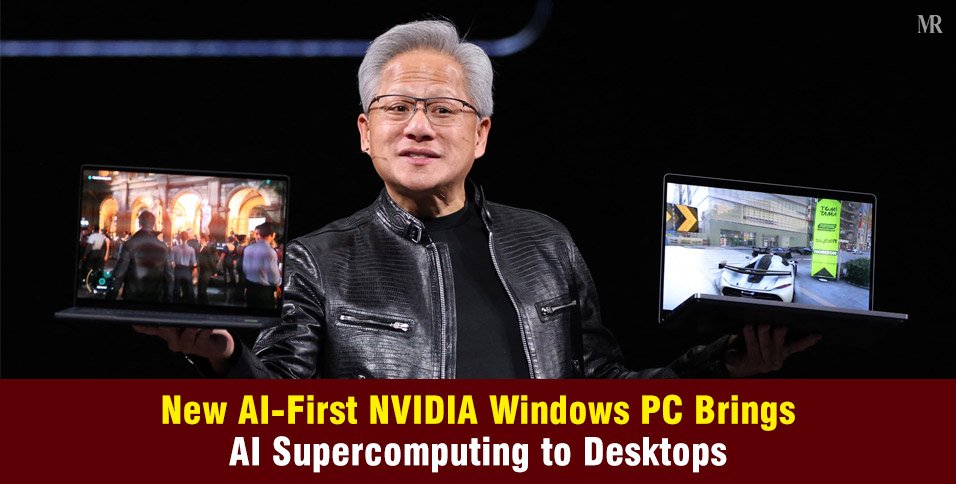
NVIDIA has officially announced the DGX Station for Windows, a powerful desktop AI supercomputer that fits right next to your desk. Arriving later this year, this system lets engineers and developers run massive AI models directly from their workspaces instead of relying on distant data centers.
For decades, heavy AI work required specialized Linux systems, while everyday office applications ran on Windows. This launch bridges that gap completely. The NVIDIA Windows PC brings the immense power of an AI supercomputer straight to the everyday corporate desktop.
“The PC is being reinvented. For forty years, you launched apps. Click. Type. With RTX Spark and Microsoft Windows, you ask, and the PC does the work,” said Jensen Huang, Founder and CEO of NVIDIA.
Moving From Data Centers to Enterprise Desks
For years, intense AI workloads like training and large-scale inference lived almost exclusively on Linux-based data center clusters. Meanwhile, the vast majority of Fortune 500 companies run their daily operations, design workflows, and engineering applications on Windows.
The introduction of the new deskside supercomputer solves this friction point.
Enterprise teams can now build, fine-tune, and deploy complex AI models without moving sensitive data off-site. By keeping compute local, businesses can satisfy strict compliance regulations and data boundary requirements while reducing their reliance on cloud infrastructure.
Hardware Specifications of the New Supercomputer
The desktop system packs massive hardware capabilities into a form factor that fits right next to a desk.
- Processor: The NVIDIA GB300 Grace Blackwell Ultra Desktop Superchip combines a Blackwell Ultra GPU with a 72-core NVIDIA Grace CPU. They connect through the high-speed NVLink-C2C interconnect.
- Memory: Up to 748GB of coherent memory eliminates traditional data transfer bottlenecks during massive data ingestion.
- Performance: The system delivers up to 20 petaflops of FP4 processing power.
- Networking: The integrated NVIDIA ConnectX-8 SuperNIC supports data transfer speeds up to 800Gb/s for high-speed clustering.
- Physical AI Expansion: Users can pair the superchip with an additional NVIDIA RTX PRO 6000 Blackwell Workstation GPU to run complex ray-traced simulations alongside frontier AI tasks.
Secure Infrastructure for Autonomous Agents
As enterprise AI transitions from basic chatbots to autonomous agents that execute multi-app tasks, security remains a top priority. NVIDIA and Microsoft designed this hardware to serve as dedicated agent infrastructure.
To protect corporate data, the platform introduces NVIDIA OpenShell, an open-source runtime built on new Windows security and containment primitives. OpenShell creates an isolated sandbox for each running agent. This design isolates application-layer operations from system-level security policies, ensuring that autonomous agents cannot leak credentials or override company data boundaries.
The Microsoft NVIDIA Partnership: Optimizing the Architecture
This NVIDIA Windows PC breakthrough required a sharp engineering collaboration to align advanced silicon with the enterprise operating system.
Through the long-standing Microsoft NVIDIA partnership, Windows 11 has been fundamentally tuned to unlock the maximum performance of local Blackwell infrastructure.
Microsoft introduced advanced memory management optimizations that upgrade how the operating system handles shared memory regions. This update increases the maximum amount of total system memory accessible directly by the GPU, giving the system the flexibility to load massive local AI models without performance drops.
Additionally, enterprise IT teams can manage these desktop superchip deployments using the exact same Windows security, compliance, and fleet management tools they already rely on. Linux-based developer toolchains also receive full support through enhanced integration with the Windows Subsystem for Linux.
Extending AI-First Architecture to Personal Devices
While the DGX Station anchors the heavy enterprise workstation market, NVIDIA is also expanding its presence into personal devices.
The company unveiled the Arm-based RTX Spark superchip, driving a new category of highly efficient personal computers. This processor delivers 1 petaflop of local AI performance for slim laptops and compact desktop form factors, which means the chip can perform one quadrillion mathematical calculations every single second. This allows professionals to run highly capable local language models and complex multi-modal workflows on portable devices without routing data to the cloud.
The NVIDIA Microsoft Arm alliance ensures these personal devices benefit from the same robust security principles as the larger workstations. Software providers like Adobe are already optimizing flagship applications like Photoshop and Premiere to run natively on this architecture, leveraging NVIDIA TensorRT, which reportedly delivers twice the AI processing speed for professional workflows.
Enterprise Workstation Rollout and Ecosystem Adoption
Global hardware manufacturers are actively building localized enterprise infrastructure around this architecture. The desktop systems and premium personal workstations are scheduled to roll out from leading OEMs starting in Q4 of this year.
Organizations will be able to deploy these systems through established enterprise partners, including:
- ASUS
- Dell Technologies
- GIGABYTE
- HP
- Lenovo
- Microsoft Surface
- MSI
- Supermicro
These configurations allow companies to deploy dedicated AI supercomputers for individual developers or utilize them as shared local compute nodes for entire engineering and data science teams.
Driving Personal and Enterprise AI Forward
The arrival of the NVIDIA Windows PC ecosystem is a new era for corporate computing. By placing data-center-grade Blackwell silicon directly into desktop workstations, NVIDIA and Microsoft have successfully brought unmetered, always-available AI supercomputing to local business environments.
With DGX Station for Windows, NVIDIA and Microsoft are transforming AI infrastructure from a cloud-only resource into a locally accessible enterprise platform.
Maria Isabel Rodrigues