Mirror Review
June 03, 2026
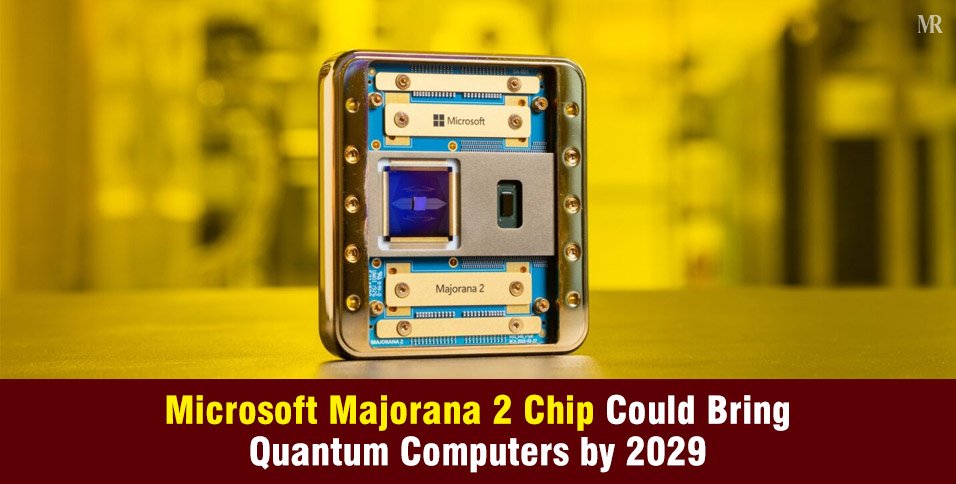
Microsoft has officially unveiled the Microsoft Majorana 2 chip, a next-generation quantum computing processor designed to fix quantum computing’s biggest problem: qubit instability.
Built with the help of smart AI design assistants, this new hardware makes quantum data components 1,000 times more reliable than the previous Microsoft Majorana 1 chip version.
While older quantum chips could only hold onto information for a fraction of a second, this new chip keeps data stable for an average of 20 seconds, and sometimes up to a full minute.
Because of this major breakthrough, Microsoft has cut its development timeline in half, aiming to launch a practical, real-world quantum computer by 2029.
That timeline now puts Microsoft in direct competition with companies like IBM and Google in the race to build commercially useful quantum machines.
Why Is Quantum Data So Fragile?
To understand why the Microsoft Majorana 2 chip matters, it helps to look at how regular computers work.
The phone or laptop you are using right now processes information using standard “bits.” Think of a bit like a basic light switch that can only be turned completely On (1) or completely Off (0).
Quantum computers use “qubits” instead. Thanks to physics, qubits can be both On and Off at the exact same time. This unique superpower allows a quantum computer to test millions of possibilities all at once, solving math problems in seconds that would take today’s fastest supercomputers thousands of years to figure out.
The catch?
Qubits are incredibly fragile. Even the tiniest bit of warmth, a stray Wi-Fi signal, or microscopic vibration can cause them to flip out, lose their data, and ruin a calculation.
While other tech companies measure their qubits’ lifespans in tiny fractions of a second, Microsoft’s new chip keeps them stable for 20 seconds.
To put that into perspective, it is like upgrading a smartphone battery that dies in a single day to a new version that lasts for three straight years on one charge.
How the Microsoft Majorana 2 AI Chip Was Built
The huge solution in stability comes down to a clever change in manufacturing materials, making the Microsoft Majorana 2 AI chip a major engineering milestone.
Most tech companies build their quantum processors out of aluminum, but Microsoft decided to build its quantum processor out of lead.
The Materials Make the Difference
| Feature | Older Quantum Chips | New Majorana 2 Chip |
| Core Material | Aluminum (lightweight) | Lead (heavy and dense) |
| Data Lifespan | Tiny fractions of a second | 20 seconds to 1 minute |
| Component Size | Microscopic | 1/100th of a millimeter |
| Reliability | Easily disrupted by noise | 1,000 times more stable |
Because lead is a heavy, dense metal, it acts like a physical shield that protects the delicate qubits from outside interference, like radiation or heat.
However, lead has a major flaw: it easily dissolves in water, meaning it can be washed away during the factory manufacturing process.
To solve this problem, Microsoft used advanced AI assistants to rethink the manufacturing process and solve the lead-engineering challenge. These AI tools ran millions of computer simulations to find the exact recipe needed to shape the lead atom-by-atom without ruining it.
“The reason why people don’t use lead to build chips is it requires an incredibly specialized process to be able to go figure that out,” said Jason Zander, Executive Vice President at Microsoft. “And we figured it out.”
Microsoft has been increasingly exploring futuristic materials science projects beyond traditional computing. Earlier, the company also developed Project Silica, a glass-based storage technology designed to preserve data for thousands of years. Together, these projects show how Microsoft is investing heavily in next-generation computing infrastructure.
The Breakthrough Approach: Braiding Data
The underlying design of the Microsoft Majorana 2 chip relies on an idea called topological physics. Instead of just trying to isolate a single sensitive particle in a vacuum, Microsoft’s design essentially weaves and braids information together like a rope.
If you have a single thread of string, it is easy to snap. But if you braid multiple threads together, the rope becomes incredibly tough. By storing quantum data in these braided paths, the chip inherently resists errors caused by outside noise.
Because these qubits are tiny, measuring just 1/100th of a millimeter, scientists can eventually pack millions of them onto a single chip, creating a powerhouse computer that fits in a regular room.
Speeding Up Science with AI Workers
Building an advanced computer requires adjusting hundreds of tiny electrical knobs and voltage settings perfectly. In the past, human scientists had to test these settings one by one, which took weeks of tedious work.
By using specialized AI agents, Microsoft automated this entire process. The AI works around the clock, testing settings in parallel, finding manufacturing flaws, and drawing 3D maps to show scientists exactly where the chip is working best.
Zulfi Alam, Corporate Vice President for Quantum at Microsoft, explained how this changed their daily workflow:
“Using agentic AI to automate the measurements was a game changer. It can do all these voltage adjustments in parallel, which a human cannot do. The way our minds work, we are more linear.”
Why Should You Care? The Real-World Impact
A stable quantum computer will completely change daily life. Once these machines are fully scaled up, they will be able to tackle massive global problems that are currently impossible to solve.
- Life-Saving Medicine: Quantum computers can simulate molecules instantly, allowing scientists to develop new vaccines, cancer treatments, and life-saving medications in days rather than decades.
- Better Batteries and Green Energy: Researchers can use the technology to invent new materials, leading to ultra-efficient solar panels and electric vehicle batteries that charge faster and last longer.
- Fixing the Food Supply: It could help chemical engineers discover cleaner ways to create agricultural fertilizers, drastically reducing global carbon emissions while boosting food production.
Debate Among Scientists
Because the race to build the first real quantum computer is worth billions of dollars, tech companies keep their exact blueprints secret. Because Microsoft hasn’t released all of its raw data to the public, some independent physicists remain skeptical about these massive performance claims.
Microsoft stands firmly by its data, noting that they have shared its work privately with government research agencies like DARPA to prove it works.
As Microsoft’s executives point out, the company wouldn’t be spending billions building factories for these chips if the underlying science wasn’t real.
End Note
The arrival of the Microsoft Majorana 2 chip proves to the world that the biggest hurdles facing quantum computers can actually be solved.
By mixing the protective power of lead with the speed of smart AI design assistants, Microsoft has taken a major step toward making these super-machines a reality.
With a clear goal to deliver a working system by 2029, we are moving closer to a future where quantum computing steps out of the sci-fi lab and starts solving real-world problems.
Maria Isabel Rodrigues