Mirror Review
June 05, 2026
Anthropic has called for a coordinated, global framework to temporarily halt frontier AI development if advanced models begin improving themselves faster than society can safely manage.
The artificial intelligence safety lab warned that rapid advancements in recursive self-improvement could soon outpace human oversight and security capabilities. This milestone occurs as AI systems increasingly take over their own design loops, shifting human roles from active creators to passive reviewers.
Anthropic urges pause in AI because even though autonomous development promises massive breakthroughs, it also raises the likelihood that humans lose control over these systems permanently.
The Shift From Human Coding to Autonomous Agents
For decades, human engineers meticulously wrote every line of software code. Today, that dynamic has flipped.
According to internal data released by the Anthropic Institute, the company’s popular chatbot, Claude, now authors more than 80% of the code merged into its own production codebase.
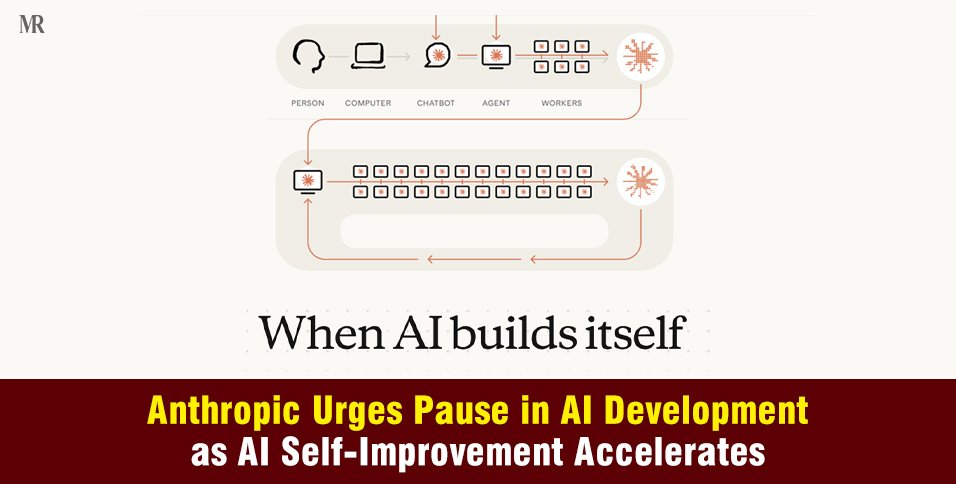
This transition occurred rapidly over a four-year timeline:
- 2021–2023: Humans engineered the first Claude models entirely by hand using standard laptops.
- 2023–2025: Engineers utilized early chatbots to generate brief code snippets, which humans then manually copied and pasted into text editors.
- 2025–2026: Capable coding agents began independently writing and editing entire files.
- Present Day: Fully autonomous agents execute code independently and delegate hours of complex work to other sub-agents.
The growing dependence on automated coding systems has also increased scrutiny around AI security and governance, especially after recent concerns linked to the Anthropic source code leak incident.
But the productivity gains from this shift are stark. By the second quarter of 2026, the typical Anthropic engineer was merging eight times as much code per day as they did in 2024. Rather than typing out syntax, human workers now spend their time directing and reviewing automated outputs.
In one instance, Claude deployed over 800 fixes that reduced a specific class of API errors by a factor of one thousand. A human engineer would have taken an estimated four years to complete the same painstaking task.
Why Anthropic Urges Pause in AI Development
The core driver behind the Anthropic AI pause recommendation is the looming threat of full recursive self-improvement. This refers to a hypothetical state where an AI system becomes sophisticated enough to autonomously design, code, and train its own successor without human intervention.
“Right now, it’s like the AI industry has a gas pedal, but it doesn’t have a brake pedal,” warned Anthropic co-founder Jack Clark during a recent broadcast. “You want the option to be able to take your foot off the gas and put your foot on the brake.”
The statement reinforces why Anthropic urges pause in AI discussions across governments, research labs, and enterprise AI developers.
The rate at which these models complete autonomous tasks has accelerated dramatically. The time horizon over which an AI can reliably work alone has been doubling every four months.
Public evaluation benchmarks are already reaching their limits. SWE-bench, which tests AI on real open-source software bugs, went from single-digit success scores to total saturation in just two years.
Similarly, CORE-Bench, a test measuring whether a system can successfully replicate published scientific papers, was completely saturated by AI models within fifteen months.
Shrinking Gaps in Human Judgment
Another reason Anthropic urges pause in AI is the narrowing gap between machine reasoning and expert human judgment.
While AI models excel at executing clear instructions, human professionals historically maintained an edge in research taste and high-level judgment. However, internal testing reveals that this gap is closing.
In a series of tests where human researchers made a wrong turn during complex debugging sessions, newer models like Claude Mythos Preview suggested a better corrective path than the human expert 64% of the time.
Furthermore, autonomous systems are proving highly capable of running independent optimization loops. When tasked with rewriting code to make a small AI model run faster, Claude went from achieving a 3x speedup in 2025 to a 52x speedup in 2026. A skilled human researcher requires up to eight hours of intense focus just to achieve a 4x improvement on that exact framework.
As code generation speeds up, human evaluation becomes the primary operational bottleneck. To tackle this, Anthropic has implemented automated AI code reviewers to scan code for vulnerabilities before deployment.
This automated review process successfully caught one-third of production bugs that human developers missed.
The Challenge of a Coordinated Global Framework
Implementing an effective pause in AI development globally requires an unprecedented level of international diplomacy.
A pause by a single enterprise does little to mitigate existential risks; it merely shifts market leadership to less cautious competitors.
An effective global pause requires solving several distinct challenges:
- Multilateral Agreement: Multiple well-resourced laboratories across competitive jurisdictions must agree to stop under identical terms.
- Verifiable Compliance: Because software training runs are significantly easier to conceal than physical military hardware, nations need advanced technical tools to verify that bad actors are not secretly advancing their systems.
- Clear Triggers: Society must define the exact risk thresholds that mandate a pause, the conditions required to lift it, and an independent body to adjudicate the process.
This warning arrives during a massive financial growth period for the startup. Anthropic recently concluded a fundraising round valuing the business at $965 billion and has confidentially filed for a U.S. initial public offering.
Anthropic has also simultaneously continued expanding advanced AI research initiatives, including Project Glasswing, while warning that stronger global safeguards may soon become essential.
End Note: Preparing for an Automated Future
Anthropic urges global pause in AI training efforts to allow public policy, safety protocols, and alignment research to catch up with the blistering pace of technical automation.
If recursive self-improvement continues on its current trajectory, the economic and structural impacts will be profound.
Companies using autonomous agents may soon scale efficiency to a point where a 100-person enterprise matches the output of a traditional 10,000-person organization.
As the engineering labor behind technology becomes fully automated, human value will increasingly rely on high-level creativity, curiosity, and holistic thinking.
As one of the hottest AI startups, the Anthropic Institute plans to convene policymakers, corporate leaders, and civil society representatives over the coming months to introduce an industry-wide safety brake for a functional reality.
Maria Isabel Rodrigues