Clean energy companies develop, own, operate, or manufacture technology for power generated from renewable or low-emission sources like solar, wind, hydro, and battery storage.
Some of these clean energy developers build and run power plants directly, earning revenue from long-term electricity contracts. Others manufacture the turbines, panels, and inverters that plant owners buy. Together, these two groups form the backbone of the global clean energy industry.
This list breaks down the top clean energy companies driving that growth in 2026, split into two groups: the power producers who own and run the assets, and the technology makers who build the equipment that makes clean power possible.
Who Are the Top Clean Energy Companies in 2026?
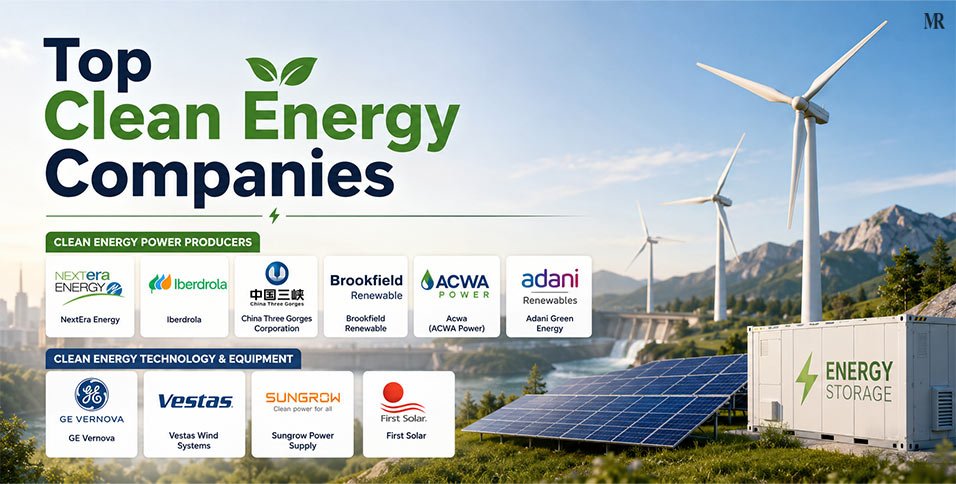
The leading clean energy companies in 2026 include NextEra Energy, Iberdrola, China Three Gorges Corporation, Brookfield Renewable, Acwa (formerly ACWA Power), Adani Green Energy, GE Vernova, Vestas Wind Systems, Sungrow Power Supply, and First Solar. This mix spans power producers running tens of gigawatts of solar, wind, and hydro assets, plus clean energy manufacturers building the turbines, inverters, and grid equipment behind them.
Together, they represent the regions leading the global energy transition right now, i.e., the US, Europe, China, the Middle East, and India.
Leading Clean Energy Companies at a Glance
| Company | Country | Category | Known For |
| NextEra Energy | United States | Power Producer | World’s largest generator of wind and solar power |
| Iberdrola | Spain | Power Producer | Europe’s largest electricity utility, offshore wind leader |
| China Three Gorges Corporation | China | Power Producer | World’s largest hydropower operator |
| Brookfield Renewable | Canada/Bermuda | Power Producer | 47 GW global portfolio, largest renewable pipeline |
| Acwa (ACWA Power) | Saudi Arabia | Power Producer | Largest private desalination company, Vision 2030 renewables |
| Adani Green Energy | India | Power Producer | India’s largest pure-play renewable company |
| GE Vernova | United States | Technology & Equipment | Gas turbines, wind turbines, and grid equipment |
| Vestas Wind Systems | Denmark | Technology & Equipment | World’s largest wind turbine installer |
| Sungrow Power Supply | China | Technology & Equipment | World’s top solar inverter and storage manufacturer |
| First Solar | United States | Technology & Equipment | Largest thin-film solar module maker in the West |
List of Top Clean Energy Power Producers
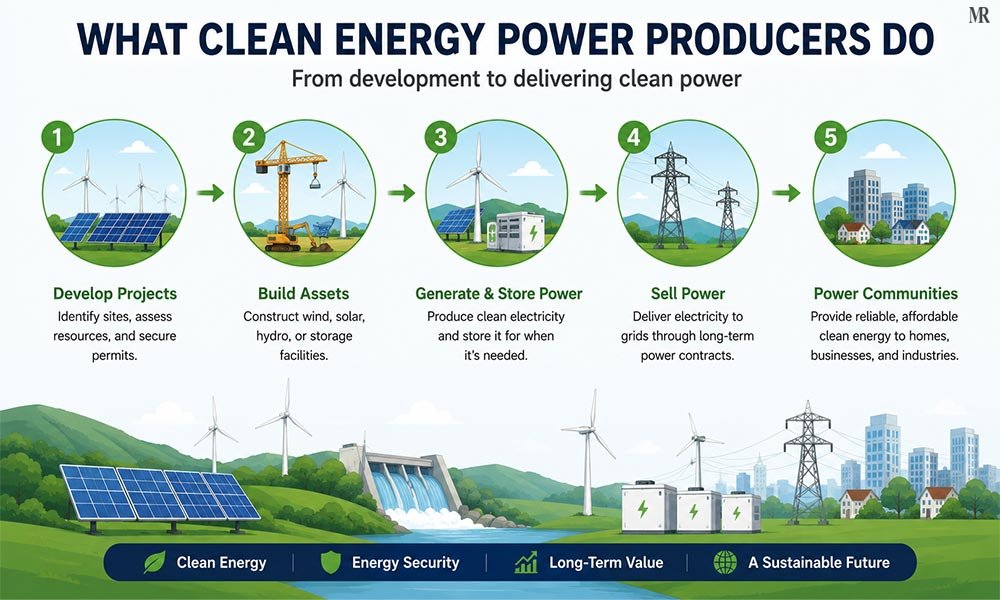
Clean Energy Power Producers develop, own, and operate renewable energy assets, earning revenue directly from selling electricity, water, or storage capacity. This category includes some of the largest clean energy companies by installed capacity anywhere in the world.
1. NextEra Energy
NextEra Energy is the world’s largest generator of renewable energy from wind and sun, and it’s usually the first name that comes up in any list of leading clean energy companies. Through its subsidiaries Florida Power & Light and NextEra Energy Resources, the company runs roughly 76 GW of renewable capacity as of late 2025, including over 6 GW of solar in Florida alone, making it the largest utility-scale solar owner in the US. NextEra plans to add another 76.6 to 107.6 GW of renewable generation between 2026 and 2032, backed by one of the largest development backlogs in the industry. The company has also cut power-sector carbon emissions by more than 30% since 2005, even as customer demand kept climbing. With a market valuation north of $190 billion, NextEra remains the benchmark for scale in North American clean power.
2. Iberdrola
Iberdrola is Europe’s largest electricity utility and one of the top 10 offshore wind companies, with a market capitalization of nearly €135 billion. The Spanish company’s total installed generation capacity crossed 58,000 MW by early 2026, of which more than 46,000 MW comes from renewables like onshore wind, offshore wind, hydroelectric, and solar. Offshore wind is Iberdrola’s fastest-growing segment, up 16% year-on-year to over 2,600 MW, thanks to projects like the East Anglia Hub in the UK and the German Baltic Sea hub. Since 2001, Iberdrola has invested more than €175 billion in renewable energy, storage, and grid networks across Spain, the UK, the US, and Brazil. Its Strategic Plan 2025-2028 earmarks €21 billion for renewables, with 38% going to offshore wind alone.
3. China Three Gorges Corporation
China Three Gorges Corporation (CTG) is the world’s largest hydropower developer and operator, and by extension one of the biggest clean energy companies on the planet. Its controllable installed capacity reached 158 million kilowatts (158 GW) in 2024, with clean energy making up 96% of that total. CTG owns the six cascade hydropower stations along the Yangtze River, including the Three Gorges Dam itself, that together form the world’s largest clean energy corridor, spanning 1,800 kilometers with a combined capacity of 71.7 GW. Beyond hydropower, CTG has expanded aggressively into wind and solar, both domestically and abroad, with projects across nearly 20 countries in Africa, Latin America, Europe, and Southeast Asia. The company’s renewables arm, CTG Renewables, is targeting 70 GW of installed capacity by the end of 2026.
4. Brookfield Renewable
Brookfield Renewable operates roughly 47 GW of renewable and sustainable power capacity spread across 35 power markets and 25 countries, with renewables making up more than 96% of that portfolio. As of Q1 2026, the company posted an annualized long-term average generation of about 122,000 GWh, and it holds a development pipeline exceeding 200 GW, one of the largest in the industry. Brookfield delivered a record 8,000 MW of new capacity last year and is targeting an annual development run rate above 10,000 MW by 2027. Its customer base includes major technology firms like Microsoft and Google, many of which sign long-term power agreements tied to inflation. In 2026, Brookfield also moved to acquire Boralex, a Canadian renewable platform with 3.8 GW of operating capacity, further expanding its North American footprint.
5. Acwa (formerly ACWA Power)
Acwa, the Saudi Arabia-based developer that rebranded from ACWA Power in January 2026, has grown into a global infrastructure platform managing over $115 billion in assets across 15 countries. Its gross power generation capacity stood at 95.7 GW as of Q1 2026, including 52.3 GW of renewable capacity, which is nearly 55% of the total portfolio. Acwa is also the world’s largest private water desalination company, producing 9.7 million cubic meters of desalinated water daily. As the key enabler of Saudi Arabia’s Vision 2030 energy transition, Acwa has been mandated to develop 70% of the kingdom’s renewable energy target capacity. The company’s flagship project, the NEOM Green Hydrogen facility, is the world’s largest utility-scale green hydrogen plant and is expected to reach commercial operation later in 2026. Acwa aims to double its assets under management to $250 billion by 2030.
6. Adani Green Energy
Adani Green Energy (AGEL) is India’s largest pure-play renewable energy company, and it just became the first Indian clean energy firm to reach 20 GW of operational capacity in July 2026, almost entirely through greenfield development. The company added a record 5,051 MW in FY26 alone, the highest annual renewable capacity addition by any company outside China. AGEL’s portfolio breaks down into roughly 14.2 GW of solar, 2.7 GW of wind, and 3.3 GW of wind-solar hybrid capacity, plus 3.55 GWh of battery storage, which is one of the largest single-location battery deployments in the world. The centerpiece of its growth is the Khavda renewable energy park in Gujarat, a 30 GW project spread across 538 square kilometers, nearly five times the size of Paris. AGEL is targeting 50 GW of total capacity by 2030 and already generates over 52 billion units of clean electricity a year, enough to power more than 9 million households.
List of Top Clean Energy Technology & Equipment Companies
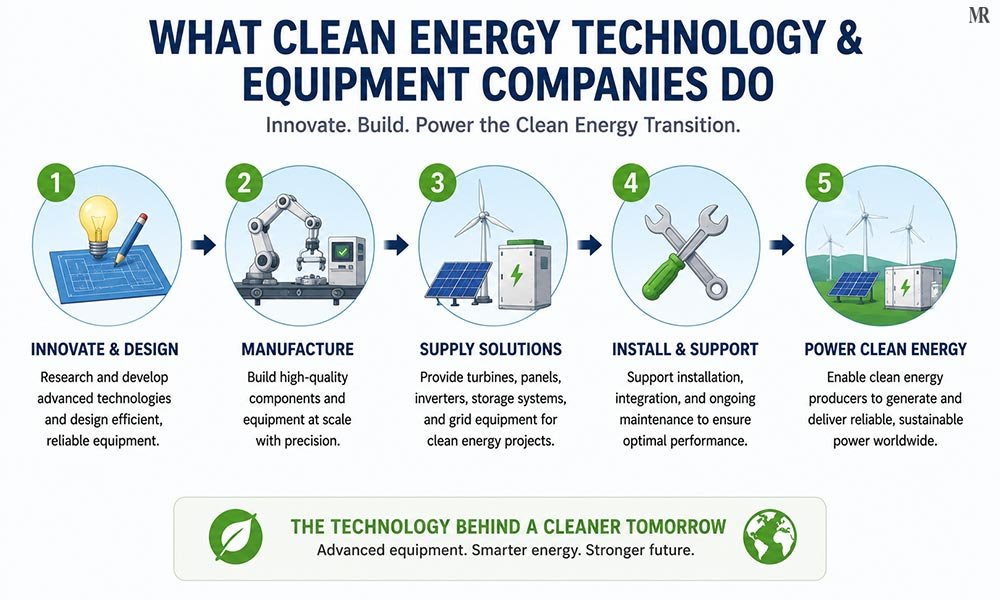
Clean Energy Technology & Equipment companies manufacture the turbines, panels, inverters, and grid technologies that make renewable power generation possible. Without them, the power producers above would have nothing to build with.
1. GE Vernova
GE Vernova is a major supplier of wind turbines, gas power equipment, and electrical grid technology, and 2026 has been a breakout year for its grid and electrification business. In Q1 2026, the company posted revenue of $9.3 billion, up 16% year-on-year, with orders jumping to $18.3 billion, a 71% organic increase. Much of that growth came from data-center-driven demand: its Electrification segment alone booked $2.4 billion in equipment orders in a single quarter, more than all of 2025 combined. GE Vernova raised its full-year 2026 revenue guidance to between $44.5 billion and $45.5 billion, and its backlog swelled to $163 billion. While its Wind segment has struggled with falling onshore turbine deliveries, the company’s Power and Electrification units, like serving gas turbines, nuclear services, and grid equipment, have more than picked up the slack, positioning GE Vernova as a broader energy-transition player rather than a pure wind energy company.
2. Vestas Wind Systems
Vestas is the world’s largest wind turbine company, with more than 201 GW of installed wind power across 88 countries, more than any other manufacturer on the planet. In Q1 2026, Vestas reported order intake of 4.5 GW, a 44% increase year-on-year, driven by strong offshore wind orders in the UK and steady onshore demand across all regions. Revenue for the quarter came in at €4 billion, up 14%, with an EBIT margin of 3.2%, the company’s best first-quarter margin since 2018. Vestas’ combined backlog of wind turbine orders and service agreements reached a record €76.1 billion. The company also services more than 161 GW of turbines worldwide, giving it a recurring revenue stream that few competitors can match. Vestas holds roughly a quarter of the global wind turbine market outside China, well ahead of rivals like Siemens Gamesa and GE.
3. Sungrow Power Supply
Sungrow is the world’s leading solar inverter manufacturer and a fast-growing force in battery storage. In 2025, the company’s revenue reached CNY 89.2 billion (about $12.95 billion), up nearly 15% year-on-year, with net profit climbing close to 22%. Sungrow shipped 198 GW of PV inverters globally, holding an estimated 30% market share, while its energy storage business grew even faster, up 49% to CNY 37.3 billion in revenue, with 43 GWh of storage shipped worldwide. Overseas markets now account for over 60% of Sungrow’s total revenue. Wood Mackenzie’s 2026 Global Solar Inverter Manufacturer Ranking placed Sungrow at the top spot for the second year running, alongside Huawei. The company’s technology now powers megaprojects from NEOM in Saudi Arabia to grid-scale storage deployments across Europe and the US.
4. First Solar
First Solar is the largest thin-film solar module manufacturer in the world and the biggest PV module maker in the Western Hemisphere. Unlike most competitors, First Solar’s cadmium telluride (CdTe) technology doesn’t rely on Chinese crystalline silicon supply chains, which has made it a favored supplier amid ongoing US trade restrictions on solar imports. The company posted record Q1 2026 net sales, shipping 3.8 GW of modules and hitting a 96% utilization rate at its US factories. Net income for the quarter rose to $347 million, up from $210 million a year earlier, with gross margin climbing to 47%. First Solar expects to reach a global manufacturing capacity of around 25 GW by the end of 2026, supported by five operational US factories in Ohio, Alabama, and Louisiana, plus a sixth plant announced for 2026. Its module backlog, driven largely by US utility-scale demand, remains one of the strongest in the industry.
(Depending on further research, First Solar and LONGi are close competitors for this final spot. LONGi leads on global module shipment volume, while First Solar leads on US-based, tariff-protected manufacturing capacity.)
Clean Energy Industry Outlook for 2026
A few forces are reshaping the clean energy sector heading into the rest of 2026, and they explain why the companies above are positioned the way they are.
1. AI-driven electricity demand
Data centers are now a major driver of new power demand, and companies like GE Vernova and Brookfield Renewable are seeing direct order growth from tech companies signing long-term clean power contracts. Global electricity demand has more than doubled since 2000 and is projected to rise another 29% by 2035.
2. Grid modernization
As renewable penetration rises, expanding and upgrading transmission networks has become just as urgent as adding generation capacity. Grid investment reached $483 billion globally in 2025, and GE Vernova’s electrification backlog alone hit $38.6 billion in Q1 2026, a sign of how tight grid capacity has become.
3. Energy storage integration
Battery storage is set to jump 17-fold globally, from 223 GW in 2025 to 3.8 TW by 2035, according to BloombergNEF’s New Energy Outlook 2026. Sungrow, Adani Green, and Acwa are all racing to add gigawatt-hour-scale storage to their portfolios to make renewable output more dispatchable.
4. Electrification
Solar is expected to become the world’s largest source of electricity by 2032, and countries are electrifying their economies at different speeds thanks to solar energy companies. China’s coal share in power generation is projected to fall from 54% in 2025 to 19% by 2035, while Europe reaches electricity dominance by 2043 and the US by 2047.
5. Government investment
Policy remains a swing factor. The IEA lowered its 2025-2030 renewable growth forecast by 5% globally, largely due to US policy changes, including the earlier phase-out of federal tax credits, even as India, the EU, and the Middle East saw upward revisions. Solar PV still accounts for nearly 80% of expected renewable capacity growth through 2030.
6. Energy security
Successive shocks like the pandemic, the war in Ukraine, and the 2025 Iran conflict have pushed governments to treat clean energy as a security issue, not just a climate one. Countries with high fossil fuel import bills are accelerating renewable deployment specifically to reduce that exposure, a theme running through nearly every company profiled above.
Conclusion
The clean energy sector in 2026 looks less like a single industry and more like two closely linked ones: companies that build and own power plants, and companies that manufacture the equipment those plants run on.
NextEra, Iberdrola, China Three Gorges, Brookfield, Acwa, and Adani Green are racing to add gigawatts as fast as permitting and financing allow, while GE Vernova, Vestas, Sungrow, and First Solar are scaling factories to meet that demand, and increasingly, demand from AI data centers and grid operators too.
What’s changed most in 2026 isn’t the technology itself, but the reason countries are investing in it: energy security has caught up with climate policy as the primary driver.
That shift is likely to keep capital flowing into clean energy companies regardless of how the political winds move on climate, specifically, which is worth watching for anyone trying to understand where this sector goes next.
Maria Isabel Rodrigues
FAQs
- Who is the largest clean energy company?
By installed capacity, China Three Gorges Corporation is the largest, with a controllable capacity of about 158 GW, of which 96% is clean energy. By market value, NextEra Energy is the largest publicly traded pure clean energy utility, valued at over $190 billion.
- What is the difference between renewable energy and clean energy?
Renewable energy comes specifically from sources that naturally replenish, like solar, wind, and hydro. Clean energy is a broader term that also includes low-emission sources like nuclear power, which isn’t technically renewable but produces minimal carbon emissions during generation.
- Which country has the most clean energy companies?
China leads the list of countries with the most clean energy companies by a wide margin, both in installed renewable capacity and in manufacturing. It accounts for nearly 60% of global renewable capacity growth and is home to manufacturing giants like Sungrow, plus power producers like China Three Gorges Corporation.
- What are the leading clean energy companies in 2026?
The leading clean energy companies in 2026 span power producers (NextEra Energy, Iberdrola, China Three Gorges Corporation, Brookfield Renewable, Acwa, Adani Green Energy) and technology manufacturers (GE Vernova, Vestas, Sungrow, First Solar), together representing the US, Europe, China, the Middle East, and India.