Mirror Review
June 08, 2026
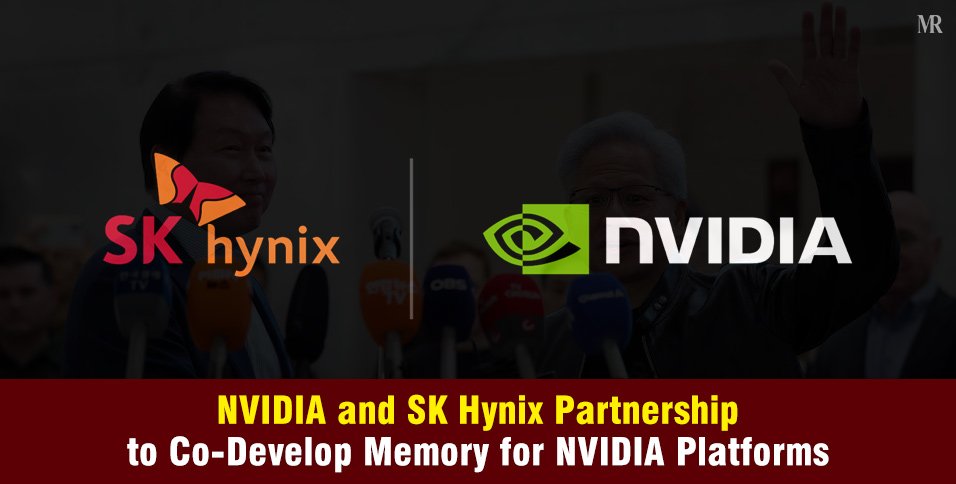
NVIDIA and SK Hynix have signed a new multiyear technology partnership to build next-generation memory chips. This deal ensures NVIDIA secures a steady supply of advanced memory for its fast-growing AI factory systems. These specialized chips will power advanced supercomputers, personal computers, and robotics platforms.
The NVIDIA and SK Hynix partnership announcement emerged during a high-profile visit by NVIDIA CEO Jensen Huang to Seoul, where he met with South Korean tech leaders to secure vital components for the global AI boom.
History of the NVIDIA and SK Hynix Collaboration
The latest NVIDIA and SK Hynix collaboration builds on years of deep co-engineering that has powered some of the world’s most advanced computing platforms.
Historically, SK Hynix has been NVIDIA’s largest memory partner, a relationship that this new agreement reinforces and expands. NVIDIA already procures billions of dollars worth of memory from the South Korean chipmaker annually, and these volumes are set to grow substantially.
The physical limits of standard silicon require memory and processors to be designed closely together. AI workloads process massive datasets, making memory bandwidth a common issue. This multiyear technology partnership ensures that SK Hynix can design high-bandwidth memory alongside NVIDIA’s long-term hardware roadmaps, keeping supply in lockstep with fast-moving infrastructure demands.
Expanding Memory Architecture Across New Platforms
Under this new NVIDIA and SK Hynix deal, SK Hynix will diversify its components into multiple breakthrough markets that NVIDIA is creating. The joint development spans three primary pillars:
- AI infrastructure
- Personal AI
- Physical AI
The memory will integrate directly into several next-generation platforms:
- Vera Rubin AI Supercomputers: Next-generation AI supercomputing clusters require unprecedented memory bandwidth to train frontier models.
- Vera CPUs: NVIDIA’s first standalone data center microprocessor, designed to compete directly with traditional x86 server chips and custom cloud processors.
- RTX Spark-Powered PCs: Premium personal computers built to handle advanced generative AI workloads locally.
- Jetson Thor Robotic Platforms: Computing brains engineered specifically for humanoid robots and autonomous mechanical systems.
“SK Hynix has been an extraordinary partner to NVIDIA, playing a central role in delivering advanced memory technologies for NVIDIA AI computing platforms,” stated Jensen Huang, founder and CEO of NVIDIA.
“Together, we will co-develop the next generation of memory for AI factories and support the accelerating global expansion of AI infrastructure.”
Improving Semiconductor Design with AI
Beyond manufacturing physical hardware, the NVIDIA and SK Hynix partnership changes how the companies design semiconductor chips.
SK Hynix is deploying NVIDIA CUDA-X libraries and AI to accelerate complex semiconductor simulations. This includes tech-heavy workloads like technology computer-aided design (TCAD) and computational lithography workflows.
SK Hynix also uses the NVIDIA PhysicsNeMo framework to run core-workload acceleration across its internal simulation codes and AI physics workflows.
By introducing these tools to the broader electronic design automation ecosystem, the initiative sets up three-way collaborations among chipmakers, software vendors, and NVIDIA.
This software-driven approach reduces the time needed to test and validate new memory architectures.
Building Digital Twins for Autonomous Fabs
The collaboration introduces advanced automation to the factory floor. SK Hynix is building comprehensive fab digital twins to serve as the foundation for fully autonomous manufacturing operations.
| Technology Used | Operational Purpose |
| NVIDIA Omniverse & OpenUSD | Creating detailed 3D factory scenes to visualize and optimize complex manufacturing environments. |
| NVIDIA cuOpt & Metropolis | Optimizing factory floor logistics, including the movement of autonomous mobile robots. |
| Agentic AI Workflows | Connecting digital twins to legacy software so AI systems can reason over data and automate tasks. |
These digital systems allow engineering teams to simulate layout changes, track asset efficiency, and solve manufacturing problems before altering a single piece of physical equipment.
South Korean Alliances and Market Impact
Jensen Huang’s trip to Seoul extended beyond the memory supply chain to secure a broader sovereign AI footprint. Parallel agreements with other South Korean giants establish a comprehensive ecosystem for local data center infrastructure:
- SK Telecom: Will build a massive gigawatt-scale AI cloud in South Korea using NVIDIA technology, with the first facility scheduled to go online in 2027.
- Naver and Doosan: Both companies will leverage NVIDIA technology to construct advanced AI data centers. Doosan will also supply energy solutions for NVIDIA platforms and implement physical AI in its robotics business.
- LG Group: NVIDIA is collaborating with LG on electronics, cooling architectures, power delivery, and AI frameworks for humanoid robots.
These announcements came at a volatile time for local markets, as a global tech selloff caused South Korea’s Kospi index to drop almost 9% in a single day.
While SK Hynix shares dipped briefly, the long-term outlook remains stable due to secured enterprise demand.
Chey Tae-won, Chairman of SK Group, emphasized the deep importance of the agreement:
“SK Hynix and NVIDIA have been building toward this for years, and this partnership reflects the depth of that collaboration. Together, we are co-developing the next generation of memory for AI factories and applying AI to how we design and manufacture semiconductors.”
End Note
The NVIDIA and SK Hynix Partnership positions both companies to lead the next phase of global AI computing infrastructure.
By securing a multiyear supply of customized, high-performance memory, NVIDIA protects its hardware roadmap against industry-wide shortages.
Concurrently, SK Hynix cements its position at the top of the semiconductor supply chain by embedding its components into upcoming supercomputers, PCs, and robotics.
As AI factories scale worldwide, this deep technical integration ensures that hardware architecture can match the processing demands of next-generation software.
Maria Isabel Rodrigues