Mirror Review
June 09, 2026
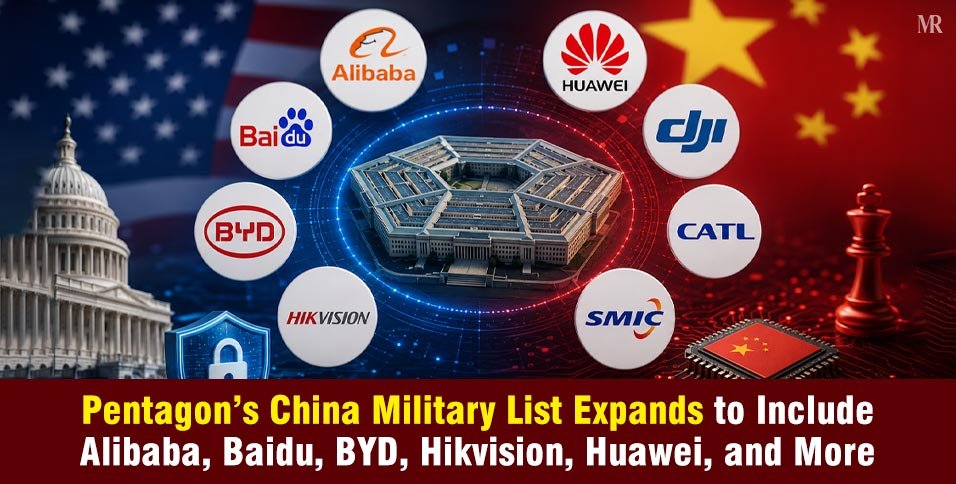
The U.S. Department of Defense has added major tech and car companies like Alibaba, Baidu, and BYD to its China military list. This decision stops these famous businesses from winning direct U.S. military contracts. Washington believes these commercial brands help build up China’s military capabilities.
While the Pentagon’s China Military List used to target only traditional defense contractors, it now focuses on everyday consumer brands. This is a major change in how the United States tracks foreign business risks.
Evolution of the DoD China Military Blacklist
The Pentagon manages this index under a congressional mandate established in 2021. Officially known as the Section 1260h list of Chinese military companies, the framework requires defense officials to identify commercial enterprises operating directly or indirectly within the United States that support the People’s Liberation Army.
The legal scope has broadened widely over time. It no longer just covers entities owned by the Chinese military. It also targets any enterprise feeding the broader defense industrial base of China. The Chinese military companies list 2026 has grown to 188 entities, up from roughly 130 firms during the previous annual cycle.
The primary mechanism driving these designations involves corporate ties to Chinese industrial initiatives. U.S. defense officials monitor affiliations with China’s Ministry of Industry and Information Technology, which oversees the domestic technology sector.
Additionally, the Pentagon tracks companies selected for state-backed development programs. These include the “Little Giant” and “Single Champion” schemes, which the U.S. views as vehicles for advancing Beijing’s strategic objectives.
Major Corporations Added to the 1260H List in 2026
The newest iteration of the Pentagon’s China Military List impacts multiple high-profile consumer and enterprise brands across diverse tech sectors. The table below highlights key additions and the specific industrial roles identified by the U.S. government:
| Company Name | Industry Sector | Primary Government Affiliations / Programs |
| Alibaba Group | E-commerce & Cloud Computing | Affiliated with MIIT and SASAC |
| Baidu, Inc. | AI & Autonomous Driving | Affiliated with MIIT and SASAC |
| BYD Company | Electric Vehicles & Batteries | Affiliated with MIIT and SASAC enterprise zones |
| Unitree | Robotics & Humanoid Development | Designated “Little Giant”; received state innovation aid |
| WuXi AppTec | Biotechnology & Pharmaceuticals | Indirectly owned by SASAC; affiliated with the PLA |
| CXMT & YMTC | Semiconductor Manufacturing | Directly affiliated with MIIT and state industrial bases |
The presence of consumer-facing brands like Wang Chuanfu’s BYD is particularly notable. BYD dominates the global electric vehicle market and ranks among the top 10 car companies worldwide. Its addition comes at a time when several U.S. lawmakers are seeking absolute bans on Chinese electric cars.
Furthermore, the addition of robotics firm Unitree occurs just a week after domestic semiconductor giant Nvidia announced research partnerships with the company to develop advanced humanoid units.
Opposition and Legal Denial from China
The sudden expansion of the list of Chinese military companies operating in the United States triggered immediate pushback from corporate executives and international diplomats. The targeted firms strongly deny any connection to state defense initiatives.
Alibaba management published a direct public statement opposing the move:
“There’s no basis to conclude that Alibaba should be placed on the Section 1260H List. Alibaba is not a Chinese military company nor part of any military-civil fusion strategy. We will take all available legal action against attempts to misrepresent our company.”
Baidu corporate communications stated:
“As Baidu is neither a Chinese military company nor a military-civil fusion contributor to the Chinese defense industrial base, the Company believes that there is no justification for the Company’s inclusion on such list. The CMC List is not a sanctions list. The U.S. government procurement limitations tied to the list will not impact the business of the Company, and the CMC List does not restrict transacting in the securities of the Company.”
Biotech firm WuXi AppTec also termed the designation incorrect and promised immediate corporate action to challenge the filing.
Concurrently, the Chinese Embassy in Washington voiced strong opposition to the expanding commercial restrictions. Embassy spokespersons accused the United States of overstretching national security boundaries to create discriminatory lists that intentionally damage global business operations.
Real Consequences of the Pentagon’s China Military List
While a company placed on the DoD China Military Blacklist can legally continue commercial retail sales inside the United States, the designation creates major administrative hurdles.
Under current federal laws, the Defense Department cannot contract directly with listed entities.
Furthermore, a strict secondary ban will take effect in June 2027, preventing the Pentagon from buying any products or services via third-party vendors.
These rules force American primary defense contractors to audit their software stacks and hardware supply lines. If a domestic firm handles logistics for the military, it must drop these Chinese tech companies as sub-tier suppliers to avoid losing its federal funding.
Beyond direct procurement bans, inclusion on the registry causes severe reputational damage, scares off institutional investors, and can lead to delisting from major U.S. stock exchanges.
Changes in Geopolitical Trade
The updated Pentagon’s China Military List gives a reality check regarding international commerce.
The long-awaited release came shortly after a diplomatic meeting between U.S. and Chinese leadership designed to maintain a delicate trade war truce. However, regional analysts note that the U.S. is no longer treating these entities as isolated commercial businesses. Instead, federal agencies are treating the entire international technology stack as a contested security field.
The administrative history of this specific update highlights the ongoing tensions.
The Pentagon briefly posted a nearly identical list of firms with alleged Chinese military ties in February but yanked it down within hours to prevent a breakdown in summit negotiations. The final version reinstates memory chipmakers CXMT and YMTC, signaling that U.S. policymakers are successfully pressuring China’s advanced industrial sectors.
To counter this framework, China has deployed its own legal toolkit, including an Unreliable Entity List. This lets Chinese courts penalize multinational corporations that comply with U.S. security mandates to the detriment of Chinese market interests.
End Note
The expansion of the Pentagon’s China military list to 188 entities is a critical moment in international trade decoupling.
By pulling mainstream commercial technology champions into a national security framework, the U.S. government is redefining the boundaries of global supply chains.
As companies like Alibaba, Baidu, and BYD prepare for legal battles to challenge their designations, global firms face a difficult choice between complying with strict Western defense standards or maintaining integration with the Chinese tech sector.
Maria Isabel Rodrigues