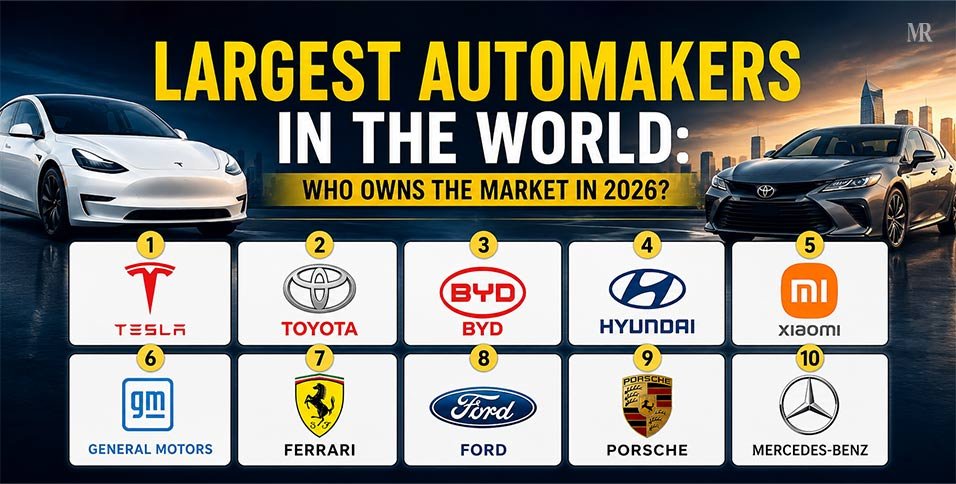
The largest automakers in the world in 2026 are Tesla, Toyota, BYD, Hyundai, Xiaomi, General Motors, Ferrari, Ford, Porsche, and Mercedes-Benz. Ranked by market capitalization, these companies represent the highest-valued automotive businesses globally and collectively shape the future of transportation through electric vehicles, software, manufacturing scale, and luxury innovation.
But being the “largest” doesn’t always mean selling the most cars. Toyota remains the world’s biggest automaker by annual vehicle sales, while Tesla commands a far higher market value because investors see it as a leader in electric vehicles, artificial intelligence, autonomous driving, and energy technology. Similarly, Ferrari ranks among the world’s most valuable automakers despite producing only a fraction of the vehicles sold by mass-market brands.
In this article, you’ll find a table of the top 10 largest automakers in the world, followed by an overview of each company’s market position, competitive strengths, and the key factors driving its valuation in 2026.
What Makes an Automaker the ‘Largest’?
An automaker is a company that designs, manufactures, markets, and sells motor vehicles such as cars, trucks, SUVs, and electric vehicles.
There are a few ways to measure the size of an automaker:
- Market capitalization: The total stock market value of the company.
- Vehicle sales volume: The number of cars sold per year.
- Revenue: Total annual income from all business activities.
- Employees: Workforce size across global operations.
This list ranks top automakers by market capitalization, which reflects investor confidence, brand strength, technology potential, and long-term growth expectations. That’s why EV-focused and tech-driven companies like Tesla and Xiaomi rank higher than legacy giants like Volkswagen or Honda despite lower revenue or sales volumes.
Top 10 Largest Automakers in the World by Market Cap (2026)
Data as of mid-2026. Market caps are approximate and fluctuate daily with stock prices.
| Company | Established | Country | Market Cap | Best Known For |
| 1. Tesla | 2003 | USA | $1.5T | World’s most valuable automaker and leading EV brand |
| 2. Toyota | 1937 | Japan | $204B | World’s largest automaker by annual vehicle sales |
| 3. BYD | 1995 | China | $119B | Leading EV and battery manufacturer with vertical integration |
| 4. Hyundai | 1967 | South Korea | $103B | Global automotive group known for rapid EV innovation and owning Kia and Genesis |
| 5. Xiaomi | 2010 (entered EV market in 2024) | China | $82.4B | Consumer tech giant expanding aggressively into smart electric vehicles |
| 6. General Motors | 1908 | USA | $71.7B | America’s largest legacy automaker with brands like Chevrolet and Cadillac |
| 7. Ferrari | 1939 | Italy | $62B | World’s most valuable luxury sports car manufacturer by brand prestige and margins |
| 8. Ford | 1903 | USA | $55.6B | Iconic automaker known for the F-Series trucks and commercial vehicles |
| 9. Porsche | 1931 | Germany | $51B | Premium performance and luxury sports cars |
| 10. Mercedes-Benz | 1926 | Germany | $50.3B | Premium luxury vehicles and performance engineering |
Here’s a detailed look at each of the top 10 biggest car companies globally, including what they make, where they stand, and what’s driving their valuation in 2026.
1. Tesla — Market Cap: ~$1.5 Trillion
- Headquarters: Austin, Texas, USA
Tesla is the world’s largest automaker by market capitalization and the most valuable electric vehicle company. Its $1.59 trillion market cap is more than six times Toyota’s, even though Toyota sells more than six times as many vehicles per year. Investors don’t see Tesla as just a car company. They value it as an AI, robotics, software, and energy company that also happens to make cars.
Tesla’s core products, the Model Y, Model 3, Model S, Model X, and Cybertruck, continue to lead the global EV market. The company operates Gigafactories in the United States, Germany, and China, with a combined output that supports global EV demand.
Tesla’s Full Self-Driving (FSD) software, energy storage products like Powerwall and Megapack, and its robotaxi and humanoid robot (Optimus) program are the main reasons behind its sky-high valuation.
Tesla reported 2025 revenue of approximately $94.8 billion and delivered around 1.64 million vehicles, but that doesn’t fully explain its $1.59T market cap. The rest is pure future potential: autonomous driving, AI infrastructure, energy storage, and next-generation manufacturing.
In short, Tesla is the largest EV company in the world by market capitalization, and its lead over every other automaker isn’t closing anytime soon.
2. Toyota — Market Cap: ~$204 Billion
- Headquarters: Toyota City, Japan
Toyota is the biggest car manufacturer in the world by volume. In 2025, the company sold a record 11.3 million vehicles globally under the Toyota, Lexus, Daihatsu, and Hino brands, making it the world’s top-selling automaker for the sixth consecutive year
Revenue exceeded $318 billion in FY2025, with net income of around $24 billion. Toyota remains a dominant force in hybrids, with the Prius and Corolla Hybrid among the world’s best-selling fuel-efficient vehicles. It’s also investing heavily in solid-state batteries, hydrogen fuel cell technology, and EVs via its bZ series.
Toyota’s strength is in scale, manufacturing excellence, and its multi-pathway powertrain strategy, covering hybrids, plug-in hybrids, EVs, and hydrogen. But in the eyes of investors, that diversified approach doesn’t carry the same growth premium as Tesla’s all-in EV and AI bet.
Toyota is still the most important automaker in the world in real-world terms and a close number two when it comes to market value.
3. BYD — Market Cap: ~$119 Billion
- Headquarters: Shenzhen, China
Founded by Wang Chuanfu, BYD is China’s biggest EV success story and one of the most important automakers in the world right now. In 2025, BYD surpassed Tesla in global electric vehicle sales by delivering more than 2.26 million pure electric vehicles worldwide on top of millions more plug-in hybrids.
What makes BYD different is vertical integration. The company manufactures its own batteries, semiconductors, and many key components in-house. That gives it stronger cost control and faster production scaling than most of its rivals. Its Blade Battery technology is widely regarded as one of the safest and most energy-dense in the industry.
BYD now sells vehicles across Europe, Southeast Asia, South America, and beyond. Models like the Qin Plus, Han, and Seal are competitive on both price and range. The company also has a major business in electric buses and commercial vehicles, making it a broader EV powerhouse rather than just a passenger car brand.
In the global ranking of the largest car manufacturers, BYD’s rise from a battery maker to the world’s third-most-valuable automaker in under a decade is one of the industry’s most remarkable stories.
4. Hyundai Motor Company — Market Cap: ~$103 Billion
- Headquarters: Seoul, South Korea
Hyundai is one of the world’s largest automotive groups, known for its award-winning electric vehicles, global manufacturing network, and ownership of Kia and Genesis. Its portfolio spans everything from affordable family cars to premium luxury SUVs.
Its Ioniq EV lineup has been a game-changer. The Ioniq 5 and Ioniq 6 have both won global car-of-the-year awards and achieved strong sales in North America, Europe, and Australia. Hyundai’s annual revenue now exceeds $120 billion, and it continues to expand its manufacturing footprint with new plants in Georgia, USA.
Hyundai also invests heavily in hydrogen fuel cell vehicles and autonomous driving technology through its stake in Motional. This multi-tech approach has made it a favourite among investors looking for EV-exposed automakers with proven financial discipline.
5. Xiaomi — Market Cap: ~$82.4 Billion
- Headquarters: Beijing, China
Xiaomi is the biggest consumer electronics company to successfully enter the automotive industry, rapidly becoming a major EV player through its software-first approach and integrated smart ecosystem. The company, best known for smartphones and consumer electronics, launched its SU7 electric sedan in 2024, and it became one of the most successful EV launches in China’s history.
In 2026, Xiaomi is targeting more than 550,000 EV deliveries. It’s also preparing the launch of the YU7, an SUV with a high-performance GT variant producing over 1,000 hp. What makes Xiaomi especially interesting is its connected ecosystem: linking smartphones, smart home devices, and cars into one integrated software platform. Analysts draw frequent comparisons to Tesla’s approach.
Xiaomi’s place among the top 10 largest automakers in the world is not about legacy or volume. It’s about what investors believe this company can become in the next five to ten years.
6. General Motors — Market Cap: ~$71.7 Billion
- Headquarters: Detroit, Michigan, USA
General Motors is America’s largest traditional automaker and one of the top car companies in the world by revenue. It owns Chevrolet, Buick, GMC, and Cadillac, covering everything from pickup trucks to luxury sedans.
GM’s annual revenue exceeds $170 billion. The company is pushing aggressively into EVs through its Ultium battery platform, which underpins models like the Cadillac Lyriq, Chevrolet Equinox EV, and Silverado EV.
GM’s Cruise robotaxi division, despite regulatory setbacks in 2024, remains an important part of its long-term autonomous driving strategy.
GM Defense recently signed a collaboration with Lockheed Martin to expand America’s manufacturing and defense industrial base.
7. Ferrari — Market Cap: ~$62 Billion
- Headquarters: Maranello, Italy
Ferrari is the world’s most prestigious luxury sports car manufacturer, generating exceptional profitability and brand value despite producing relatively few vehicles each year. As a top luxury automaker, Ferrari sells fewer than 14,000 vehicles per year, a fraction of what any other automaker on this list produces, yet its market cap puts it ahead of Ford, Mercedes-Benz, Porsche, Volkswagen, and a dozen other global giants.
The secret is margin. Ferrari consistently delivers operating margins above 25%, among the highest in the entire automotive industry. Every car it makes carries a waiting list. Prices start above $200,000 and regularly reach into the millions for limited editions.
Formula 1 remains central to the Ferrari brand. Its Scuderia team keeps the badge at the pinnacle of motorsport and in the public eye year-round. The company also became the first luxury Italian automaker to unveil a hybrid supercar lineup, with the SF90 Stradale leading its electrification journey. In May 2026, Ferrari’s First EV, Luce, debuted at $640K with a 530 KM Range.
For investors, Ferrari is a luxury goods company that also makes cars, and that distinction explains why it ranks among the top 10 largest automakers in the world despite its tiny production numbers.
8. Ford Motor Company — Market Cap: ~$55.6 Billion
- Headquarters: Dearborn, Michigan, USA
Ford is one of the most iconic names in automotive history, and it famously remains one of the big three automakers, with an annual revenue that sits close to $170 billion.
The F-Series pickup truck is still the best-selling vehicle line in the United States — a position it has held for over four decades. That franchise alone generates billions in annual profit and anchors Ford’s financials while it invests in its EV future.
Ford’s electric lineup includes the Mustang Mach-E, F-150 Lightning, and the E-Transit commercial van. The company has restructured its business into Ford Blue (ICE vehicles), Ford Pro (commercial vehicles), and Ford Model e (EVs) to manage its transition more clearly. Commercial vehicles, through Ford Pro, are a key growth engine, particularly in European fleet markets.
9. Porsche — Market Cap: ~$51 Billion
- Headquarters: Stuttgart, Germany
Porsche is one of the world’s most valuable luxury automakers, renowned for combining high-performance engineering with exceptional profitability. Best known for iconic sports cars like the 911 and premium SUVs such as the Cayenne and Macan, the company has built a loyal global customer base and one of the strongest brands in the automotive industry.
Unlike mass-market manufacturers, Porsche focuses on premium vehicles with high margins rather than high production volumes. This strategy has enabled it to maintain strong financial performance while continuing to invest in innovation and electrification. Models like the all-electric Taycan and the electric Macan demonstrate Porsche’s commitment to expanding its EV portfolio without compromising the driving experience that defines the brand.
As part of the Volkswagen Group, Porsche also benefits from shared technology platforms and global manufacturing expertise while preserving its distinct identity. Its combination of brand prestige, pricing power, and consistent profitability explains why it ranks among the world’s largest automakers by market capitalization despite producing far fewer vehicles than many mainstream competitors.
10. Mercedes-Benz — Market Cap: ~$50.3 Billion
- Headquarters: Stuttgart, Germany
Mercedes-Benz is one of the world’s most recognisable luxury automotive brands and one of the biggest car companies in Europe. The company focuses on premium and ultra-luxury vehicles, with the EQ electric lineup now sitting alongside its classic S-Class, GLE, and AMG performance range.
Mercedes earns high profit margins by positioning itself at the top end of the market. Its strategy in 2026 centres on pushing deeper into the luxury segment, where pricing power is strongest, and margin pressure from Chinese EVs is still relatively limited. Models like the EQS, EQE, and the upcoming all-electric G-Class keep the EV portfolio growing.
Despite a challenging macro environment and intense EV competition in Europe, Mercedes continues investing in software-defined vehicles and next-generation battery architecture. The company employs over 160,000 people worldwide.
Key Trends Shaping the Largest Automakers in 2026
- Electrification continues to reshape the industry: S&P Global forecasts that battery electric vehicle (BEV) sales will reach around 17.4 million units in 2026, with electrified vehicles accounting for nearly 30% of global sales, reinforcing the growth potential of EV-focused automakers.
- Chinese automakers are reshaping the global ranking: BYD and Xiaomi are both in the top five, reflecting China’s growing influence across EV technology, battery production, and connected mobility.
- Luxury equals margin power: Ferrari’s position at #7, despite selling fewer than 14,000 cars a year, shows that profit per vehicle and brand exclusivity can outweigh raw production volume in the eyes of investors.
- Asian manufacturers remain strong: Toyota and Hyundai both sit in the top four, demonstrating that Asian manufacturers with strong hybrid and EV credentials remain globally competitive.
Conclusion
The world’s largest automakers are no longer defined solely by how many vehicles they build or sell. In today’s market, technology leadership, software capabilities, electric vehicle innovation, brand strength, and future growth potential play an equally important role in determining corporate value.
As electrification, artificial intelligence, and connected mobility continue to reshape transportation, the list of the largest automakers in the world will keep evolving alongside the industry itself.
If you found this ranking of the top automobile manufacturers insightful, share it with fellow automotive enthusiasts and investors who want to stay informed about the companies driving the future of mobility!
Maria Isabel Rodrigues
FAQs
- Which is the largest EV manufacturer by market capitalization?
Tesla is the largest EV manufacturer in the world by market capitalization as of 2026, with a market cap of approximately $1.59 trillion. BYD is the second-largest EV-focused automaker by market cap, at around $126 billion, and also leads in actual EV unit deliveries globally.
- Who is the world’s largest automaker by annual vehicle sales?
Toyota is the world’s largest automaker by annual vehicle sales. In 2025, the Japanese manufacturer sold approximately 11.3 million vehicles across its Toyota, Lexus, Daihatsu, and Hino brands, maintaining its position as the global sales leader.
- Which automaker produces the most vehicles in the world?
Toyota is also the world’s largest automaker by production volume, manufacturing around 11 million vehicles annually through its extensive global network of factories. Its efficient production system and worldwide manufacturing footprint enable it to consistently outpace competitors.
- Which automaker generates the highest revenue in the world?
By annual revenue, Volkswagen Group is the world’s largest automaker, generating approximately $367.87 billion in revenue. It is followed by Toyota, which reported around $337.34 billion in revenue. Volkswagen’s portfolio includes brands such as Volkswagen, Audi, Porsche, Škoda, Lamborghini, Bentley, and SEAT, contributing to its industry-leading sales.
- Who are the Big 3 automakers?
The traditional Big 3 automakers refer to the three major American car manufacturers: General Motors, Ford, and Stellantis (formed by the merger of Fiat Chrysler and PSA Group). However, in today’s global market-cap ranking, the Big 3 by investor value are Tesla, Toyota, and BYD, a very different trio that reflects how much the industry has changed.