Citigroup stands as one of the largest financial institutions in the world, moving nearly $6 trillion across global markets every single day. Yet behind its massive operations is a leader who broke a centuries-old mold on Wall Street: Citigroup CEO Jane Fraser.
Jane Fraser made history in March 2021 when she became the first woman CEO of a major Wall Street bank. Her ascent to the top of top-tier finance was neither accidental nor standard.
Born in Scotland, Jane Fraser spent over two decades climbing through consulting and banking roles, solving tough turnarounds and reshaping massive divisions along the way. She took over Citi during a critical era, taking on the job of restructuring a global financial powerhouse.
This article explores the untold story of Citigroup CEO Jane Fraser. You will discover her early background, her step-by-step career timeline, her management approach, her current pay and net worth, and the practical lessons her journey offers for future leaders.
Jane Fraser at a Glance
The table below provides a quick summary of essential facts regarding Citigroup CEO Jane Fraser.
| Detail | Fact |
| Full Name | Jane Fraser |
| Born | July 13, 1967 |
| Birthplace | St Andrews, Scotland |
| Nationality | British-American |
| Current Position | Chair and CEO, Citigroup |
| Became CEO | March 2021 |
| Education | MA in Economics (University of Cambridge), MBA (Harvard Business School) |
| Previous Employers | Goldman Sachs, Asesores Bursátiles, McKinsey & Company |
| Years at Citi | Since 2004 |
| Known For | First female CEO of a major Wall Street bank |
Who Is Jane Fraser?
Jane Fraser is a global business leader who serves as the Chair and Chief Executive Officer of Citigroup. She holds the distinction of being the first female CEO of Citigroup and the first woman CEO of a major Wall Street bank.
Jane Fraser is widely recognized for her execution-focused leadership style and her decision to simplify Citi’s sprawling footprint. Under her guidance, the bank exited over a dozen international consumer banking markets to concentrate resources on high-return sectors like Treasury and Trade Solutions, Wealth Management, and Investment Banking.
Her biggest achievements include turning around Citi Private Bank, guiding Citi Latin America through complex restructurings, and leading the entire firm through major operational updates. Her story matters today because she demonstrated that flexible working models, analytical rigor, and patient career choices can lead directly to the pinnacle of corporate finance.
Jane Fraser’s Early Life and Education
Jane Fraser was born on July 13, 1967, in St Andrews, Scotland. Growing up in a supportive environment, she developed an early interest in economics, global trade, and mathematics. She attended Girton College at the University of Cambridge, where she earned a BA and MA in Economics between 1985 and 1988.
After completing her undergraduate degree, she spent a few years gaining practical experience in investment banking and international finance. In 1992, she moved to the United States to attend Harvard Business School. She earned her Master of Business Administration (MBA) in 1994, graduating near the top of her class.
Her time in Scotland and Cambridge gave her a strong foundation in economic theory, while her Harvard MBA equipped her with practical management frameworks. During these formative years, she developed sharp analytical skills and a calm, deliberate communication style that defined her later success in high-stakes negotiations.
Jane Fraser’s Early Career Before Citigroup
Before joining Citigroup, Jane Fraser built a diverse career across investment banking and top-tier management consulting. Each stage prepared her for complex corporate decisions.
1. Goldman Sachs
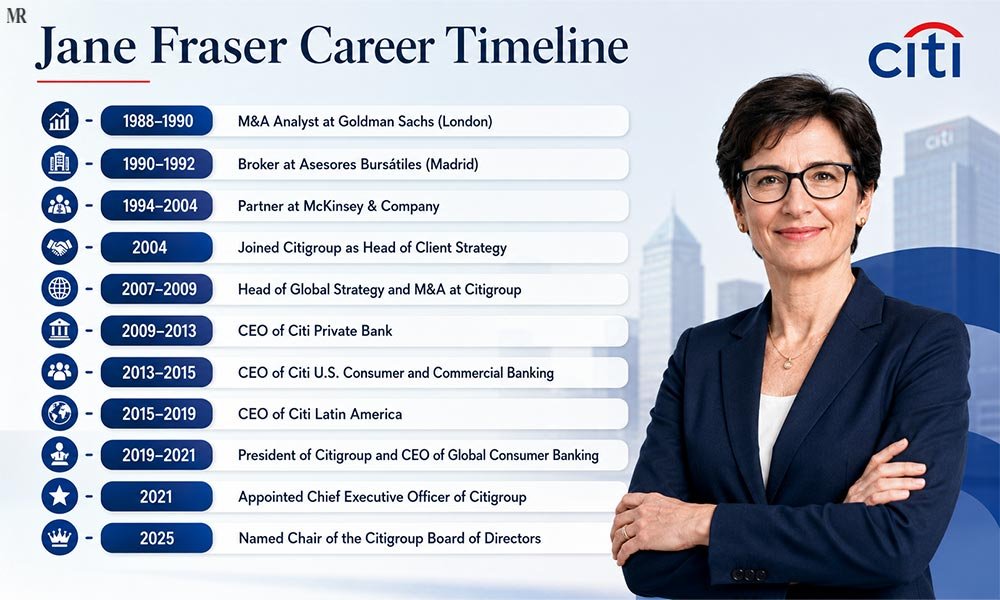
Jane Fraser started her professional career as an analyst in the M&A department at Goldman Sachs in London from 1988 to 1990. As a young analyst, she evaluated mergers, modeled cash flows, and analyzed corporate balance sheets during a boom period for European deals.
2. Asesores Bursátiles
In 1990, she moved to Madrid, Spain, where she worked as a broker for Asesores Bursátiles, a Spanish brokerage firm. This role allowed her to gain direct experience in European equity markets while mastering Spanish, a language skill that proved crucial later in her career.
3. McKinsey & Company
After earning her Harvard MBA in 1994, Jane Fraser joined McKinsey & Company. She spent ten years at the firm, rising to become a Partner in the financial services and global strategy practice. At McKinsey, she authored research on global banking trends and advised top executives on restructuring.
During her tenure at McKinsey, she requested a part-time arrangement after having children, proving that high performance does not require a rigid 80-hour office routine every single week. Her deep advisory work at McKinsey caught the attention of Citigroup executives, who eventually recruited her directly into bank leadership.
Jane Fraser’s Career Timeline at Citigroup
Jane Fraser joined Citigroup in 2004, beginning a remarkable corporate journey that spanned nearly two decades before her appointment as CEO.
Joining Citigroup (2004)
She entered Citi as the Head of Client Strategy in the Investment Bank. Shortly after, she became the Head of Global Strategy and M&A, serving from 2007 to 2009. In this position, she helped direct the bank through the severe liquidity pressures of the 2008 global financial crisis, helping decide which non-core assets to sell.
Leading Citi Private Bank (2009)
In 2009, she was named CEO of Citi Private Bank. At the time, the division was struggling with high costs and lost client trust following the financial crisis. She re-centered the business around high-net-worth individuals, lowered structural costs, and brought the unit back to steady profitability.
Building on this operational success, her mandate expanded in 2013 when she was named CEO of Citi U.S. Consumer and Commercial Banking. In this role, she also took direct oversight of CitiMortgage, leading the division through critical regulatory updates and operational realignment while simultaneously managing the bank’s nationwide retail footprint.
CEO of Citi U.S. Consumer Banking and Latin America (2013–2019)
In 2013, she became CEO of Citi U.S. Consumer and Commercial Banking. In 2015, she took over as CEO of Citi Latin America. She spent four years managing operations across the region, where she successfully oversaw the complex overhaul of Citi Banamex in Mexico.
President of Citi and CEO of Global Consumer Banking (2019)
In October 2019, Citigroup named Jane Fraser President of Citigroup and CEO of Global Consumer Banking. This step clearly positioned her as the successor to outgoing CEO Michael Corbat.
Becoming Citigroup CEO (2021)
On March 1, 2021, Jane Fraser officially became the CEO of Citigroup. She took charge with a clear mandate: trim inefficient operations, address regulatory consent orders, modernize risk management controls, and improve shareholder returns.
Since taking over as CEO, Fraser’s multi-year restructuring strategy has driven an 83% increase in Citigroup’s overall value, significantly outperforming broader bank sector indices.
Jane Fraser Career Timeline
Jane Fraser’s Institutional Memberships
Beyond her corporate responsibilities at Citigroup, Jane Fraser is actively leading across key economic and educational institutions.
She serves as Vice Chair for the Partnership for New York City and sits on the Board of Directors for the Council on Foreign Relations.
Her global perspective and economic advisory influence extend to her appointments on the U.S. President’s Export Council and the Economic Club of New York.
Additionally, she advises higher education leaders as a member of the Harvard Business School Board of Dean’s Advisors and the Stanford Global Advisory Board.
Citigroup CEO Jane Fraser’s Leadership Style
Jane Fraser approaches leadership with directness, high accountability, and empathy. Unlike traditional Wall Street figures who emphasize pure expansion, her philosophy centers on clarity and focus.
1. Business Simplification
Her major achievement as Citigroup CEO is the “One Citi” plan. Under this program, she systematically exited 13 international retail banking markets, including outlets in Asia and Europe, to focus on institutional services, wealth, and commercial banking.
2. Risk and Operational Upgrades
She made regulatory compliance a top priority. She committed billions to modernizing Citi’s internal reporting, data architecture, and compliance tracking to satisfy oversight requirements from federal regulators.
3. Financial Compensation and Net Worth
According to official SEC filings, Jane Fraser’s total compensation for fiscal year 2025 was approved at $42 million, representing a 22 percent increase from the previous year as financial results improved.
Public financial records estimate Jane Fraser net worth at over $110 million, built through decades of executive stock grants and salary earnings.
Speaking on her overall approach to long-term returns during an investor update, Jane Fraser stated: “We are taking full advantage of the market conditions to make the investments and take actions that will drive growth for the next number of years. We are playing the long game.”
In Q2 2026, Citigroup CEO Jane Fraser has overseen strong growth across core operating divisions. Citigroup reported a 14 percent year-over-year increase in total quarterly revenue to $24.8 billion. Net income jumped 45 percent to $5.8 billion, driven by a 45 percent rise in equity markets revenue and a 44 percent surge in investment banking fees.
Lessons Entrepreneurs Can Learn from Jane Fraser
Jane Fraser’s career offers actionable takeaways for business leaders and entrepreneurs.
- Focus on Core Strengths: Fraser showed that shrinking a company’s product footprint can actually increase total profitability. Entrepreneurs should eliminate weak products to fund their best performers.
- Prioritize Culture and Flexibility: By working part-time at McKinsey while raising children, she proved that career progress depends on results rather than face time.
- Fix Problems Directly: When assigned difficult divisions, such as Citi Private Bank or Latin American operations, she tackled problems head-on instead of masking losses.
- Maintain Long-Term Perspective: Major business updates take years to show in profit margins. Leaders must stay patient while market sentiment catches up.
End Note
The story of Citigroup CEO Jane Fraser shows how clear vision, persistence, and strategic choices have made her one of the top women CEOs. From her early days studying economics at Cambridge to leading Wall Street’s most global bank, she consistently turned complex corporate challenges into structured growth opportunities. By streamlining Citi’s global operations and modernizing its infrastructure, she established a resilient foundation for the bank’s future.
FAQs
- What is Jane Fraser known for?
Jane Fraser is known for becoming the first woman CEO of a major Wall Street bank when she took charge of Citigroup in March 2021. She is also recognized for executing Citigroup’s “One Citi” restructuring plan, which simplified the bank’s international footprint to focus on high-return institutional services and wealth management.
- What is Jane Fraser’s salary?
As noted in official filings for fiscal year 2025, Jane Fraser received $42 million in total annual compensation.
- Who is Jane Fraser’s husband?
Jane Fraser’s husband is Alberto Piedra, a former senior investment banker. Piedra previously served as the head of global banking at Dresdner Kleinwort and held leadership roles at Bank of America and Goldman Sachs before leaving corporate banking in 2009 to care for their children.
- What nationality is Jane Fraser Citigroup CEO?
Citigroup CEO Jane Fraser holds dual British and American citizenship. Born in St Andrews, Scotland, she moved to the United States to attend Harvard Business School and officially became a naturalized U.S. citizen in 2001.
- How powerful is Jane Fraser?
Jane Fraser is considered one of the most influential executives in global finance. As Chair and CEO of Citigroup, she oversees an institution with trillions of dollars in assets. Highlighting her leadership impact, Fraser was ranked 4th on Fortune’s list of Most Powerful Women in 2023.