Mirror Review
May 27th, 2026
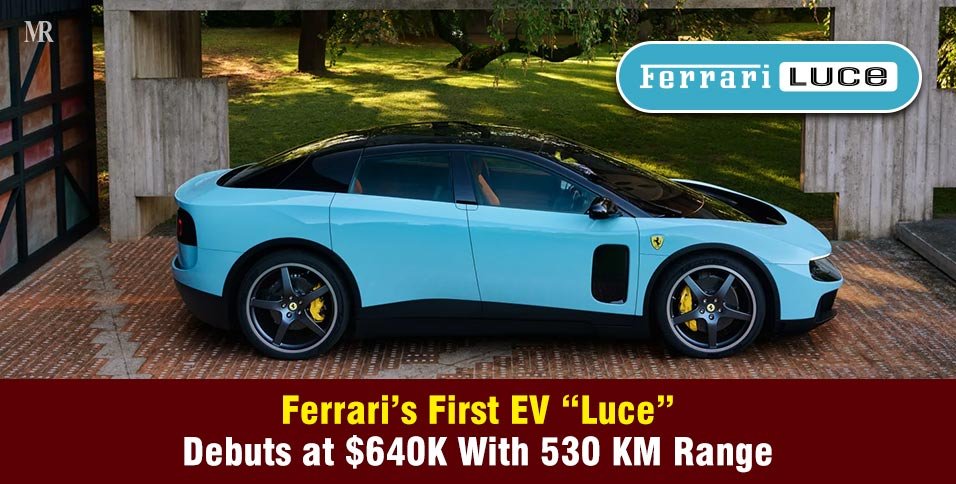
Ferrari has officially entered the electric vehicle market with the global debut of its first fully electric vehicle, the Ferrari Luce. Unveiled in Rome at the Vela di Calatrava, the historic model debuts with a starting price of 550,000 euros, which converts to approximately $640,000. Ferrari’s new EV features a certified driving range of 530 kilometers (roughly 330 miles) on a single charge. Engineered and manufactured entirely in-house at Maranello, Italy, the zero-emissions model represents a radical architectural shift for the legendary Italian automaker. Customer deliveries for the new electric speedster are scheduled to begin in the fourth quarter of 2026.
Market Reactions After Revealing Ferrari Luce EV
Despite the milestone nature of the launch of Ferrari’s First EV, Wall Street and European financial markets reacted with immediate skepticism. Following the official unveiling, Ferrari shares fell sharply in both European and American trading.
- Milan Stock Exchange: Milan-listed shares dropped around 8% on Tuesday following the announcement. This decline extends a broader market correction, leaving the stock down more than 32% over the last 12 months.
- U.S. Public Markets: U.S.-listed shares fell 5.3% shortly after the vehicle details became public.
Financial analysts attribute the sudden stock market decline to a classic corporate finance pattern.
“Ultimately many fans are disappointed that Ferrari is embracing the EV concept, believing it dilutes the supercar brand, which has modelled itself around classic design and raw, combustion-engine power,” explained Michael Field, chief equity strategist at Morningstar. Field also noted that high research and development costs place significant near-term pressure on profit margins.
Technical Specifications of the New EV Ferrari
Ferrari’s new EV establishes an entirely new vehicle segment for the brand by using a bespoke technical platform with four electric motors, one dedicated to each wheel.
- Powertrain and Acceleration Metrics
The multi-motor configuration delivers all-wheel-drive performance, launching the heavy vehicle from 0 to 60 miles per hour in less than 2.5 seconds. The platform achieves a maximum top speed of 192 miles per hour (roughly 309 km/h).
- Battery Management and Vehicle Range
The vehicle achieves a total driving range of 530 kilometers. While this operating range is lower than competing premium platforms from manufacturers like BMW or Volvo, which can exceed 500 miles, Ferrari engineers deliberately prioritized performance, thermal management, and interior cabin space over maximum battery range. The electrical architecture coordinates power routing across integrated 800-volt, 48-volt, and 12-volt systems.
Apple Designers Redefine Ferrari’s Cabin Experience
To shape the physical layout of Ferrari’s first fully electric vehicle, the corporate leadership team partnered with Sir Jony Ive and Marc Newson from the creative collective LoveFrom. The partnership introduces a clean, minimalist design language that relies heavily on custom glass materials.
- Spatial Engineering and Practical Utility
The vehicle features a four-door layout with a five-seat configuration, making it the most spacious and versatile production model in company history. During a private viewing at Castel Gandolfo, Pope Leo XIV inspected the spatial layout firsthand. When the Pontiff asked, “Is this the first four-door Ferrari?” Ferrari President John Elkann replied,“The first five-seater,” emphasizing the brand’s new focus on daily utility.
- Tactile Cockpit Controls
The interior avoids pure touchscreen reliance, combining physical buttons, mechanical toggles, and switches with custom Samsung OLED digital displays. A three-spoke steering wheel machined from a single piece of recycled aluminum anchors the driver’s workspace. The steering assembly also houses physical analogue control modules, an active torque meter, and magnetic control paddles to manage regenerative braking dynamics.
Aerodynamic Innovation Maximizes Efficiency
The bodywork of the new Ferrari electric vehicle achieves the lowest drag coefficient in the historic brand’s history. Engineers accomplished this efficiency through comprehensive airflow management and active body adjustments.
- Active Front Air Grilles:
For the first time on a brand vehicle, software-controlled active grilles dynamically regulate airflow through internal heat exchangers. This design creates a smooth teardrop profile that balances component cooling with driving range.
- Suspended Front Wing:
A floating wing on the bonnet channels air directly to the cabin HVAC plenum chamber while minimizing drag-inducing air vortex formations.
- Virtual Kammback Effect:
Airflow over the transom perimeter creates a clean fluid line separation, which increases stabilizing high-pressure downforce over the rear glass screen.
- Active Ride-Height Logic:
When traveling at high speeds, an advanced active suspension system automatically lowers the front end of the chassis by 10 millimeters, shielding the wheels and reducing the total frontal area to cut wind resistance.
Italian Leaders Debate the Electric Transition
The design choices of the Ferrari Luce EV have triggered an intense national debate across Italy, drawing sharp public criticism from prominent industrial and political figures.
“Electric, outrageously expensive (550 thousand euros!) and, from an aesthetic point of view, it speaks for itself… It looks like anything but a car from the Prancing Horse. And this is supposed to be ‘innovation’? Who knows what Enzo Ferrari would say… “ remarked Matteo Salvini, Italian Deputy Prime Minister and Transport Minister.
Former Ferrari Chairman Luca di Montezemolo, who led the legendary manufacturer for decades, voiced similar disappointment regarding the new design direction. Di Montezemolo told Italian journalists that the silent, glass-heavy vehicle represents a distinct deviation from the heritage of raw combustion-engine power. “I hope that they take off the prancing horse from that car,” di Montezemolo stated, adding that the brand risks damaging its historical legacy.
In response to the public criticism, current Ferrari CEO Benedetto Vigna urged critics to respect the natural evolution of automotive technology. Vigna explained to reporters that new engineering platforms require completely new visual styles. “When you have a new technology, you need to make sure that that technology is properly represented in the design, so the design must be different,” Vigna stated.
Predictive Logic: Will the Elite Embrace Electric?
From a historical perspective, luxury buyers rarely purchase supercars based on practical utility or ecological efficiency. They buy them for mechanical emotion, prestige, and sensory feedback. By removing the traditional internal-combustion V12 engine, Ferrari is attempting to replace mechanical sound with an external amplification system that pumps axle vibrations out to the street like an electric guitar.
The immediate 8% drop in stock valuation indicates that the broader market views this architectural pivot as a high-stakes gamble. If existing collectors reject the minimalist Apple-inspired aesthetic, Ferrari will face immense pressure to recoup its massive research and development investments.
However, the inclusion of five seats and all-wheel drive opens up entirely new customer demographics in urban global markets. The long-term commercial success of the vehicle depends entirely on whether new high-net-worth buyers can accept a quiet, glass-clad speedster bearing the iconic Prancing Horse badge.
End Note
The official launch of the Ferrari Luce marks a permanent shift in luxury automotive manufacturing. While political figures and traditional brand purists express anger over the silent drivetrain and modern glass body, corporate leadership remains committed to this new technological path. Delivering 530 kilometers of range alongside a 2.5-second acceleration time, Ferrari’s first EV challenges decades of established supercar design traditions. Whether this $640,000 electric speedster expands the brand’s global audience or dilutes its exclusive performance legacy remains a critical question that the global automotive market will answer when customer deliveries begin later this year.
Maria Isabel Rodrigues