Mirror Review
June 17, 2026
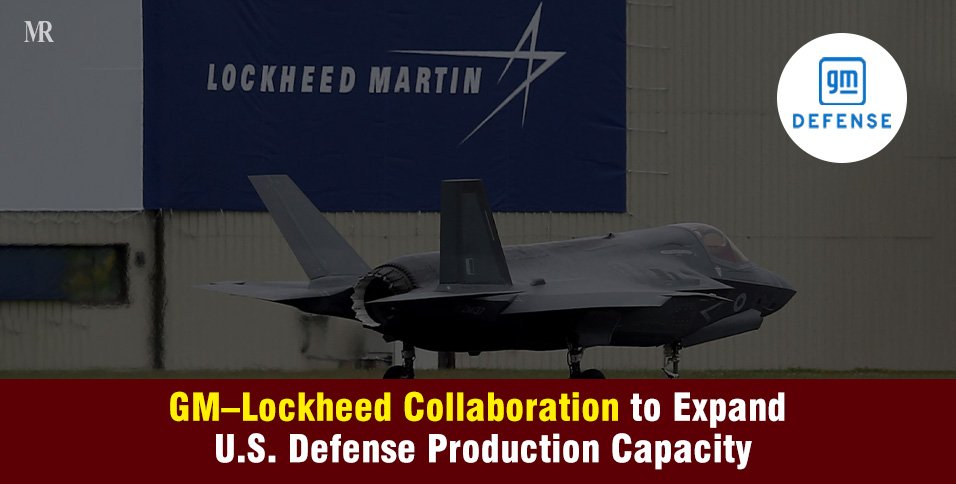
Lockheed Martin and GM Defense formed a new collaboration on June 16, 2026, to expand America’s manufacturing and defense industrial base. Facilitated by the U.S. Department of Defense, the two companies signed a memorandum of understanding to combine defense production expertise with high-rate commercial manufacturing. The GM Lockheed collaboration focuses on strengthening supply chains, advancing design capabilities, and boosting U.S. production capacity for mission-critical systems. This partnership arrives as the US moves to increase weapons production and replenish defense stockpiles.
Direct Benefits of the GM Lockheed Martin Deal
The GM Lockheed Martin deal addresses a critical issue in national security: the ability to scale production quickly.
While advanced technology matters, the military cannot protect national interests without the capacity to build and deliver those systems reliably at a mass scale.
This alliance merges the unique strengths of both companies to solve production shortages:
- Lockheed Martin provides specialized defense production knowledge and is investing $9 billion through 2030 to modernize 20 of its facilities and supply bases.
- GM Defense offers the massive commercial manufacturing footprint of General Motors, along with advanced engineering and deep experience in high-rate assembly lines.
By applying commercial factory methods to military requirements, the companies intend to speed up production timelines while keeping strict quality and performance standards.
Key Pillars of the GM Defense Lockheed Martin Partnership
The GM Lockheed Martin partnership centers on three focus areas designed to modernize defense factories:
| Focus Area | Key Objectives |
| Supply Chain Resilience | Finding and fixing bottlenecks, strengthening defense supply chains, and increasing overall reliability. |
| Manufacturing and Design | Applying advanced engineering and digital design tools to improve factory floor efficiency. |
| Production Capacity | Using commercial manufacturing infrastructure to accelerate production readiness for defense parts. |
Leadership Perspectives on the General Motors Lockheed Martin Deal
Executives from both organizations highlight that this relationship is a direct response to the growing demand for production capacity and manufacturing agility across the defense sector.
Frank St. John, chief operating officer of Lockheed Martin, emphasized the importance of scale in modern defense:
“America’s security depends not only on developing advanced technologies, but on our ability to produce them quickly, reliably and at scale. This collaboration brings together two leaders in American manufacturing and innovation to explore new ways to strengthen the defense industrial base, expand production capacity and accelerate delivery of critical capabilities for the United States and its allies.”
Steve duMont, president of GM Defense, focused on the operational efficiency the alliance will bring:
“Working together, GM Defense and Lockheed will further strengthen American manufacturing and national defense by driving greater speed, efficiency, and innovation in the aerospace and defense sectors. Over the coming weeks, we will be working to identify initial projects to pursue together.”
Bruce Brown, vice president of strategy at GM Defense, added that the alliance is exactly what the country needs right now. He noted that the country needs the capacity to build and deliver reliably, which is where GM’s mass production experience can assist the defense sector.
Involvement of Automakers in National Defense
The involvement of automakers in national defense is not a new concept, but rather a return to a proven historical model.
During World War II, General Motors shifted its massive commercial factories to build tanks, trucks, and aircraft parts for the military. This industrial pivot earned American manufacturing the nickname “the Arsenal of Democracy.”
While GM Defense was reestablished in 2017 as a newer business segment, it builds on decades of corporate knowledge and billions of dollars spent by General Motors on independent research and development. Today, GM Defense serves clients like the U.S. Army, the Secret Service, and NASA.
The current geopolitical climate has sparked a similar need for industrial mobilization. Ongoing international conflicts have drawn down U.S. defense stockpiles, particularly for munitions
At the same time, federal policies are pushing for more domestic manufacturing and the reshoring of vital industries.
This environment led the White House to hold discussions with major automakers, including GM and Ford, about finding ways to better support the defense industrial base.
Future Outlook and Broader Industry Trends
The GM Lockheed collaboration is currently in its early stages under a memorandum of understanding, meaning specific contract values and final projects are still being determined.
However, reports indicate that the initial work will likely involve GM manufacturing commonly used parts to help Lockheed bolster its munitions production. GM Defense intends to utilize its existing laboratories and production facilities for these projects.
This trend of combining commercial manufacturing speed with defense expertise extends beyond a single deal.
Reports show that GM has also held preliminary discussions with other major defense contractors, including courageously expanding talks with RTX and L3Harris regarding similar manufacturing partnerships to help boost weapons production.
As defense demands grow, leveraging the high-rate assembly lines of commercial automotive companies may become the standard method for maintaining military readiness and supply chain security.
End Note
By pairing the high-rate manufacturing capabilities of General Motors with the advanced defense technology of Lockheed Martin, the GM Lockheed collaboration aims to deliver critical defense components with greater speed and efficiency.
As the defense sector adapts to shifting geopolitical demands, this alliance highlights how commercial industrial strength can reinforce national security goals.