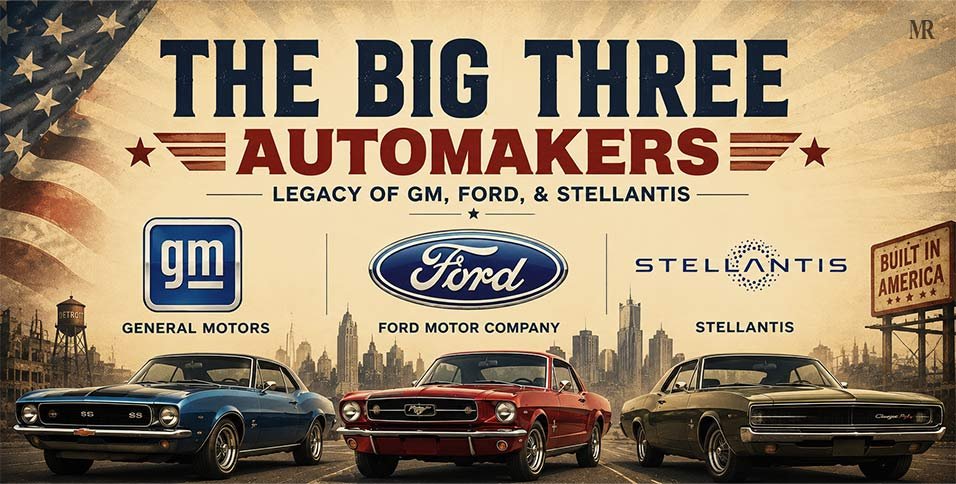
When people talk about the backbone of American auto manufacturing, three names always come up: General Motors, Ford Motor Company, and Stellantis (formerly Chrysler). Together, these are the Big Three automakers. For most of the 20th century, they ran the automotive industry. They built the cars that put America on wheels, employed millions, and turned Detroit into the industrial capital of the world.
Today, the landscape looks very different. Foreign competition, shifting consumer tastes, and the electric vehicle revolution have all tested these legacy car brands. But the Big Three are still in the game, adapting, investing, and fighting for relevance in a rapidly changing industry.
This article breaks down who these American Automakers are, why they earned the “Big Three” title, and where each one stands heading into 2026.
Why Are They Called the Big Three Automakers?
The term “Big Three” came into wide use in the mid-20th century. At the time, General Motors, Ford, and Chrysler didn’t just dominate the U.S. auto market… they owned it.
At their peak in the 1960s, the Big 3 automakers controlled over 90% of all U.S. car sales. That level of market dominance was essentially unmatched in any major consumer industry. No other car brands came close.
Here’s why that dominance happened:
- Ford invented the moving assembly line in 1913, which slashed production costs and made cars affordable for average Americans.
- General Motors, under CEO Alfred P. Sloan in the 1920s, introduced the concept of tiered brands, from affordable Chevrolet to luxury Cadillac, giving buyers options at every income level.
- Chrysler, founded in 1925 by Walter P. Chrysler, focused on engineering innovation and aggressive acquisitions, buying Dodge in 1928 and quickly becoming the third-largest U.S. automaker.
Together, the Big Three Automakers built the middle class, shaped labor standards through the United Auto Workers (UAW) union, and powered entire regional economies across the Midwest. GM alone employed over 600,000 workers at its mid-century peak.
The term stuck, even as things changed.
Chrysler went through bankruptcy in 2009, was acquired by Fiat, and eventually became part of Stellantis, a multinational group formed in 2021 through a merger of Fiat Chrysler and France’s PSA Group. But the label “Big Three automakers” still refers to GM, Ford, and Stellantis because these three legacy companies share Detroit roots, U.S. market dominance, and a common history that no other automakers can claim.
History and Current Standing of Each Big Three Automaker
1. General Motors (GM)
- Founded: 1908 | Headquarters: Detroit, Michigan
- Key Brands: Chevrolet, Buick, GMC, Cadillac
General Motors was founded in 1908 by William C. Durant. Within a few years, Durant began acquiring other automakers and parts suppliers, turning GM into a corporate empire. By the 1920s, Alfred P. Sloan took over and restructured the company around tiered brands. This idea became the template for the entire auto industry.
GM’s post-WWII decades were its golden era. It launched iconic vehicles like the Chevrolet Bel-Air, Cadillac Eldorado, and the Pontiac GTO. At its height, GM controlled nearly half of the U.S. car market on its own.
The cracks began to show in the 1970s during the oil crisis, when fuel-hungry American vehicles lost ground to more efficient Japanese imports from Toyota and Honda. Quality issues and management bloat dragged GM into decline through the 1980s and 1990s.
Then came 2009, when GM filed for bankruptcy during the financial crisis and received a $49.5 billion government bailout. It emerged restructured, leaner, and publicly re-listed.
Where GM Stands Today
GM has staged a serious recovery. In 2025, the company posted its highest U.S. market share in a decade and its fourth consecutive year of market share gains, driven by strong demand for trucks and SUVs.
The headline challenge was EV restructuring. GM took a $7.6 billion write-down in the second half of 2025, tied to right-sizing its electric vehicle capacity after demand slowed and U.S. policy shifted with the removal of EV tax credits.
Still, Chevrolet is now the #2 EV brand in the United States, and Cadillac holds the #1 spot in U.S. luxury EV sales. Meanwhile. GM ranks #4 among the top car companies in the world by revenue.
CEO Mary Barra has maintained that EVs are still the long-term direction, even as the company recalibrates pace. GM is also managing $3–4 billion in projected tariff costs for 2026 and navigating ongoing challenges in its China joint venture with SAIC.
2. Ford Motor Company
- Founded: 1903 | Headquarters: Dearborn, Michigan
- Key Brands: Ford, Lincoln
Henry Ford founded the Ford Motor Company in 1903. But his real breakthrough came in 1908 with the Model T, the first mass-market car designed to be affordable for ordinary Americans. Then in 1913, Ford introduced the moving assembly line at his Highland Park plant, cutting the time to build a car from over 12 hours to just 93 minutes. That single innovation changed manufacturing forever.
Ford’s River Rouge Complex in Dearborn became one of the most famous industrial sites in the world. This was a vertically integrated facility where raw materials went in one end, and finished cars came out the other, with over 100,000 workers on-site at its peak.
After the Model T era, Ford evolved with the times: the Mustang debuted in 1964 and became a cultural icon; the F-Series pickup truck, launched in 1948, eventually became the best-selling vehicle in America, a title it held for over four consecutive decades.
Like GM, Ford hit turbulence in the 1970s oil crisis and again in 2008, when it accepted $5.9 billion in government loans to restructure without filing for bankruptcy (unlike GM and Chrysler).
Where Ford Stands Today
Ford’s 2025 results were a mixed bag. Annual revenue hit a record $187.3 billion. But the company posted a net loss of $8.2 billion, driven by $4.8 billion in EV-related losses through its Model e segment and over $7 billion in special restructuring charges.
Ford Pro, its commercial vehicles division, was the standout performer with $6.8 billion in operating income, and Super Duty pickups had their best sales year since 2004.
Ford runs three business segments:
- Ford Blue: Traditional ICE and hybrid vehicles (F-150, Bronco, Explorer). Revenue flat at $101 billion in 2025 but solid margins on trucks and hybrids.
- Ford Pro: Commercial vehicles and fleet services. This is Ford’s most profitable unit and is growing rapidly through software subscriptions, which grew 30% in 2025.
- Ford Model e: EV division. Still losing money, $4.8 billion operating loss in 2025, but losses are narrowing. Ford expects profitability by 2029 using its next-gen UEV platform.
The company’s EV pivot is slower than originally planned, but the Ford Pro commercial business gives it a profitable cushion while it figures out EVs. In 2026, Ford ranks #8 among the largest automakers in the world by market cap.
3. Stellantis (Formerly Chrysler in the Big Three)
- Founded (Chrysler): 1925 | Stellantis formed: 2021 | Headquarters: Amsterdam (global), Auburn Hills, MI (North America)
- Key Brands: Jeep, Ram, Dodge, Chrysler, Fiat, Alfa Romeo, Maserati, Peugeot, Citroën, Opel, and more
Chrysler started in 1925 when Walter P. Chrysler reorganized Maxwell Motors. It grew quickly, acquiring Dodge Brothers in 1928, launching Plymouth the same year, and becoming a serious rival to GM and Ford by the 1930s.
Chrysler built a reputation for engineering innovation: it pioneered the all-steel car body in 1928 and consistently led in performance engineering through the muscle car era of the 1960s with legendary models like the Dodge Charger and Plymouth Barracuda.
But Chrysler was always the most financially fragile of the Big Three. It needed a government bailout in 1979 under Lee Iacocca, recovered in the 1980s, struggled again in the 1990s despite a brief merger with Daimler (1998–2007), and then filed for bankruptcy in 2009. It was subsequently acquired by Italian automaker Fiat, and the combined entity became Fiat Chrysler Automobiles (FCA).
In January 2021, FCA merged with France’s PSA Group to form Stellantis, now the world’s fifth-largest automaker by revenue, operating 16 brands across four continents.
Where Stellantis Stands Today
2025 was a year of significant turmoil for Stellantis. The company announced a sweeping business reset in February 2026, taking approximately €22.2 billion in charges for the second half of 2025. These charges covered EV supply chain restructuring, changes to warranty provisions, and a full realignment of its product plan to better match actual customer demand.
The reset also reflected a pivot away from aggressive EV-only targets toward a multi-energy approach, offering customers a choice between EVs, plug-in hybrids, traditional hybrids, and internal combustion engines.
In May 2026, Stellantis unveiled FaSTLAne 2030, its €60 billion five-year strategic plan. The plan includes:
- More than 60 new vehicle launches and 50 major refreshes across all brands by 2030
- 29 new battery-electric vehicles
- 15 plug-in hybrid or range-extended electric vehicles
- 24 hybrid electric vehicles
- 39 ICE and mild hybrid vehicles
The company’s brand portfolio, including Jeep, Ram, and Dodge for North America, plus Peugeot, Citroën, Fiat, and Maserati globally, gives it unusual breadth. The challenge is making each of those brands profitable without duplicating costs.
How the Big Three Automakers Are Adapting to Electric Vehicles
All three of the Big Three automakers are investing heavily in EVs, but none of them are finding it easy. High development costs, slower-than-expected consumer adoption, and changing government policy (including the removal of the $7,500 U.S. EV tax credit) have forced all three to recalibrate.
| Company | EV Status (2025–2026) | Key EV Models |
| General Motors | $7.6B write-down; EVs still part of long-term plan | Equinox EV, Silverado EV, Cadillac LYRIQ |
| Ford Motor Company | $4.8B EV loss in 2025; targeting EV profitability by 2029; new UEV platform in development | Mustang Mach-E, F-150 Lightning, Explorer EV |
| Stellantis | €22.2B business reset; pivoting to multi-energy (EV + hybrid + ICE) | Jeep Avenger EV, Ram 1500 REV, Fiat 500e |
The key takeaway: all three are committed to EVs long-term, but all three have also slowed down their timelines and right-sized their investments to match real-world demand. This is a more sustainable path than chasing targets that outpace the actual market.
Key Challenges the Big Three Automakers Face in 2026
The Big Three automakers are undergoing a complex set of pressures simultaneously:
- Foreign Competition: Chinese EV brands are advancing rapidly on cost and technology. GM’s SAIC-GM joint venture in China is under significant competitive pressure from local EV makers.
- Quality and Warranty Costs: Ford issued more recalls than any other automaker in 2025. Stellantis has committed to a quality turnaround as a core part of its 2026 strategy.
- Consumer Preferences: Trucks and SUVs remain the most profitable segment for all three companies. The shift to EVs is complicated by the fact that EV versions of these vehicles cost more and face more buyer resistance than EV sedans.
Conclusion
The Big Three automakers, General Motors, Ford Motor Company, and Stellantis, built the modern American automobile industry. They introduced mass production, shaped American culture, and employed millions across the Midwest for over a century.
Today, they face a different kind of test. The transition to electric vehicles is real, but it’s proving slower and more expensive than originally planned. All three have taken billions in EV-related write-downs and restructuring charges. All three have adjusted their timelines. And all three are leaning on trucks, SUVs, and commercial vehicles to stay profitable while they sort out their electric future.
The Big Three are no longer untouchable. Toyota, Tesla, and Chinese brands like BYD are all serious global competitors. But GM, Ford, and Stellantis have something the newcomers don’t: deep manufacturing infrastructure, established dealer networks, and brand loyalty built over generations.
They’re not the same companies they were in 1965. But then again, neither is the car industry. The Big Three automakers are evolving, and for now, they’re still very much in the driver’s seat.
Maria Isabel Rodrigues