What inspires someone to start a business? For some, it’s the dream of financial success. For others, it’s the desire to solve a problem that affects millions of people.
The most memorable founder stories often belong to entrepreneurs who looked beyond profits and asked a simple question: How can I make people’s lives better?
Many of today’s most admired companies were born from personal experiences, frustrations, or a desire to create meaningful change. Whether it was making online dating safer for women, helping children in need, protecting the environment, reducing poverty, or encouraging healthier lifestyles, these founders transformed purpose into businesses that continue to make a global impact.
Purpose-driven entrepreneurship is more relevant than ever. Customers increasingly support brands that share their values, employees want to work for organizations with meaningful missions, and investors recognize that long-term success often comes from solving real problems.
Here are ten of the most inspiring founder stories that demonstrate how purpose, innovation, and determination can build companies that change industries and the world.
How We Selected These Founder Stories
The founders featured in this list share more than entrepreneurial success. They built companies around meaningful missions that addressed real challenges. We selected these stories based on their lasting business success, measurable social or environmental impact, leadership, innovation, and the valuable lessons they offer aspiring entrepreneurs.
List of the Top 10 Most Inspiring Founder Stories
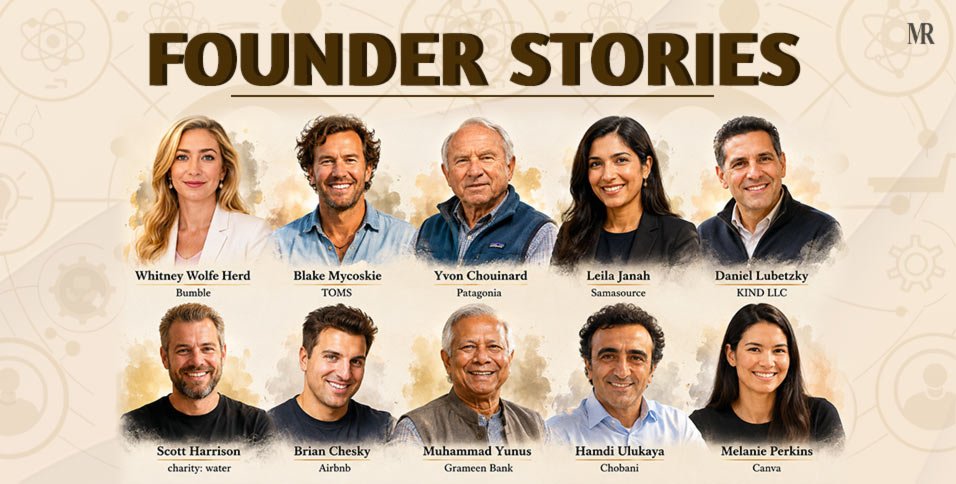
| Founder | Company | Mission |
| Whitney Wolfe Herd | Bumble | Create a safer and more respectful dating platform for women |
| Blake Mycoskie | TOMS | Build a business that gives back to communities in need |
| Yvon Chouinard | Patagonia | Protect the environment through responsible business |
| Leila Janah | Samasource | Fight poverty by creating digital employment opportunities |
| Daniel Lubetzky | KIND LLC | Promote healthier food and kindness through business |
| Scott Harrison | charity: water | Provide clean drinking water worldwide |
| Brian Chesky | Airbnb | Make travel more affordable and accessible |
| Muhammad Yunus | Grameen Bank | Expand financial inclusion through microfinance |
| Hamdi Ulukaya | Chobani | Build an ethical company that supports communities |
| Melanie Perkins | Canva | Make graphic design accessible to everyone |
1. Whitney Wolfe Herd – Bumble
Whitney Wolfe Herd didn’t set out to create just another dating app. After leaving Tinder following a highly publicized legal dispute, she wanted to build a platform where women felt more comfortable and in control.
In 2014, she launched Bumble with a simple but groundbreaking idea: only women could initiate conversations after a match. This approach challenged traditional dating norms and encouraged more respectful interactions.
The concept quickly resonated with users around the world. Bumble expanded beyond dating to include networking and friendship features, proving that meaningful connections extend beyond romance.
In 2021, Whitney Wolfe Herd became one of the youngest female CEOs to take a company public, showing that solving a genuine problem can lead to both social impact and commercial success.
2. Blake Mycoskie – TOMS
Blake Mycoskie’s entrepreneurial journey changed during a trip to Argentina, where he saw children walking barefoot because their families couldn’t afford shoes.
Instead of making a donation and moving on, he created TOMS in 2006 with the famous “One for One” model, promising to donate a pair of shoes for every pair sold. Customers weren’t simply buying footwear; they were contributing to a larger mission.
The idea captured global attention and inspired a new generation of socially responsible businesses.
Although TOMS later evolved its giving model to support broader community initiatives, the company’s original mission transformed the conversation around corporate responsibility.
Mycoskie demonstrated that businesses could create meaningful impact while remaining commercially successful.
3. Yvon Chouinard – Patagonia
Yvon Chouinard began as a climber who made his own equipment, but his passion for nature soon shaped a much bigger vision. When he founded Patagonia, his goal wasn’t simply to sell outdoor clothing… it was to protect the environments that adventurers loved to explore.
Sustainability became part of Patagonia’s identity long before it became a global business trend.
Patagonia encouraged customers to repair clothing instead of replacing it, invested in sustainable technology and materials, and consistently supported environmental causes.
Chouinard reinforced his commitment in 2022 by transferring ownership of the company to a trust and nonprofit dedicated to fighting climate change. His story proves that green entrepreneurs can remain profitable while staying true to a mission that benefits future generations.
4. Leila Janah – Samasource
Growing up, Leila Janah believed that talent exists everywhere, but opportunity does not.
After working in international development, she saw that millions of people living in poverty didn’t need charity as much as they needed access to dignified work. That realization led her to found Samasource in 2008, connecting people in underserved communities with digital jobs from global companies.
Samasource pioneered an “impact sourcing” model that provided employment, skills training, and stable incomes to thousands of workers across Africa and Asia.
Rather than treating poverty as an unsolvable problem, Janah used technology to create economic opportunity at scale. This founder story remains an inspiring example of how businesses can become a powerful force for social change.
5. Daniel Lubetzky – KIND LLC
Daniel Lubetzky believed consumers deserved snack foods made with simple, recognizable ingredients instead of heavily processed alternatives.
Inspired by his family’s experiences during the Holocaust and guided by a belief in empathy and understanding, he founded KIND in 2004 with a mission that extended beyond healthy eating. The company’s name reflected its commitment to kindness in both products and people.
KIND quickly became one of the fastest-growing snack brands in the United States by combining transparency, nutrition, and authentic storytelling.
Beyond food, Lubetzky launched initiatives that encouraged dialogue, inclusion, and acts of kindness within communities.
His innovative entrepreneurship shows that a strong mission can strengthen a brand, build customer trust, and create lasting business success without losing sight of its values.
6. Scott Harrison – charity: water
Scott Harrison’s life took an unexpected turn after years of working as a nightclub promoter. Seeking a greater sense of purpose, he volunteered aboard a hospital ship in West Africa, where he witnessed communities struggling without access to clean drinking water.
The experience changed his perspective and inspired him to tackle one of the world’s most urgent humanitarian challenges.
In 2006, he founded charity: water with a commitment to transparency and impact. The organization funds clean water projects in developing countries and has helped bring safe drinking water to millions of people worldwide.
Harrison’s story demonstrates that social entrepreneurs don’t always need to invent new technology to make a difference. Sometimes, solving a basic human need can create one of the most meaningful organizations in the world.
7. Brian Chesky – Airbnb
Brian Chesky didn’t start Airbnb with the intention of disrupting the hospitality industry. During a time when he and his roommate struggled to pay rent, they rented out air mattresses in their apartment to conference attendees who couldn’t find hotel rooms. What began as a temporary solution soon revealed a much bigger opportunity.
Founded in 2008, Airbnb transformed the way people travel by allowing homeowners to share their spaces with guests from around the world.
The platform created new income opportunities for millions of hosts while giving travelers more affordable and personalized accommodation options.
Chesky’s digital entrepreneurship journey proves that some of the world’s biggest businesses begin by solving an everyday problem that many people overlook.
8. Muhammad Yunus – Grameen Bank
While teaching economics in Bangladesh, Muhammad Yunus realized that many people living in poverty remained trapped because they couldn’t access even the smallest loans.
Traditional banks considered them too risky, leaving aspiring entrepreneurs without the financial resources needed to improve their lives.
To solve this problem, Yunus founded Grameen Bank, introducing the concept of microfinance.
By offering small loans without requiring traditional collateral, the bank empowered millions of people, particularly women, to start businesses, support their families, and become financially independent.
His innovative approach earned him the Nobel Peace Prize and forever changed the way the world views financial inclusion and poverty reduction.
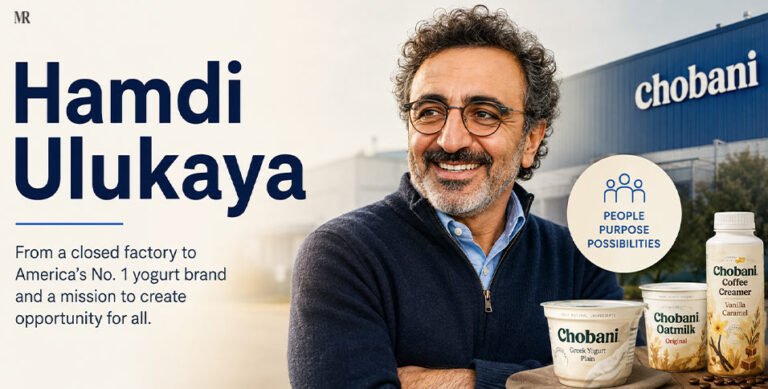
9. Hamdi Ulukaya – Chobani
When Hamdi Ulukaya purchased an abandoned yogurt factory in New York in 2005, he wasn’t simply entering the food industry. He wanted to make high-quality yogurt more accessible while building a company that treated people with dignity and respect.
As an immigrant himself, he believed businesses should create opportunities for employees and local communities.
Chobani quickly became one of America’s leading yogurt brands through its focus on quality and innovation.
At the same time, Ulukaya earned recognition even from the UN for hiring refugees, supporting workers through generous employee ownership programs, and promoting inclusive workplace policies.
His leadership demonstrates that a company’s culture can become just as important as the products it sells.
10. Melanie Perkins – Canva
Melanie Perkins noticed a common problem while teaching graphic design software to university students: professional design tools were powerful but far too complicated for most people.
She believed that creating presentations, social media graphics, and marketing materials shouldn’t require months of technical training.
After years of refining her idea and overcoming repeated investor rejections, she co-founded Canva in 2013. The platform made graphic design accessible through an intuitive drag-and-drop interface, empowering individuals, educators, nonprofits, and businesses around the world.
Perkins’ persistence and commitment to democratizing design transformed Canva into one of the world’s most successful technology companies, proving that simplifying complex problems can create extraordinary opportunities.
Key Lessons from These Successful Founder Stories
Although these famous founders are different types of entrepreneurs and come from different industries and backgrounds, their journeys reveal strikingly similar lessons. Each of these lessons from successful founders identified a problem that mattered deeply and committed themselves to solving it with persistence, innovation, and purpose.
1. Start With a Problem Worth Solving
The strongest businesses rarely begin with a product. They begin with a problem. Whitney Wolfe Herd wanted to improve online dating, Scott Harrison tackled the global water crisis, and Daniel Lubetzky reimagined healthier snacks. Their companies grew because they addressed genuine needs rather than chasing trends.
2. Purpose Builds Stronger Brands
People don’t just buy products. They support brands they believe in. Patagonia’s commitment to environmental conservation and TOMS’ mission of giving back helped create loyal communities that connected with the companies’ values as much as their offerings.
3. Innovation Doesn’t Always Mean New Technology
Many of these founders succeeded by applying fresh thinking to existing problems. Muhammad Yunus reinvented lending through microfinance, while Airbnb transformed unused homes into accommodations. Their success came from changing business models, not necessarily inventing new technologies.
4. Persistence Matters More Than Immediate Success
Nearly every founder on this list faced setbacks, rejection, or uncertainty before achieving success. Melanie Perkins spent years convincing investors to believe in Canva, while Brian Chesky built Airbnb during one of the toughest economic periods in recent history. Their resilience became one of their greatest competitive advantages.
5. Business Can Be a Force for Good
Perhaps the biggest lesson is that profitability and purpose don’t have to compete. These founders proved that businesses can generate revenue while improving lives, protecting the environment, expanding opportunities, and creating lasting social impact.
Conclusion
Every successful company has a beginning, but the most inspiring founder stories are remembered not because of how much money they made. They’re remembered because of the problems they chose to solve.
From safer online communities and sustainable fashion to clean water, financial inclusion, and accessible design, these entrepreneurs transformed personal convictions into businesses that have touched millions of lives.
Their journeys remind us that great entrepreneurship starts with empathy, grows through innovation, and succeeds because it creates value for others.
While industries and technologies continue to evolve, the principle behind these stories remains timeless: businesses built with purpose often create the greatest and most enduring impact.
Whether you’re launching your first startup, leading a growing company, or simply searching for inspiration, these founder stories show that the most meaningful businesses aren’t just built to succeed… they’re built to make a difference!
Maria Isabel Rodrigues