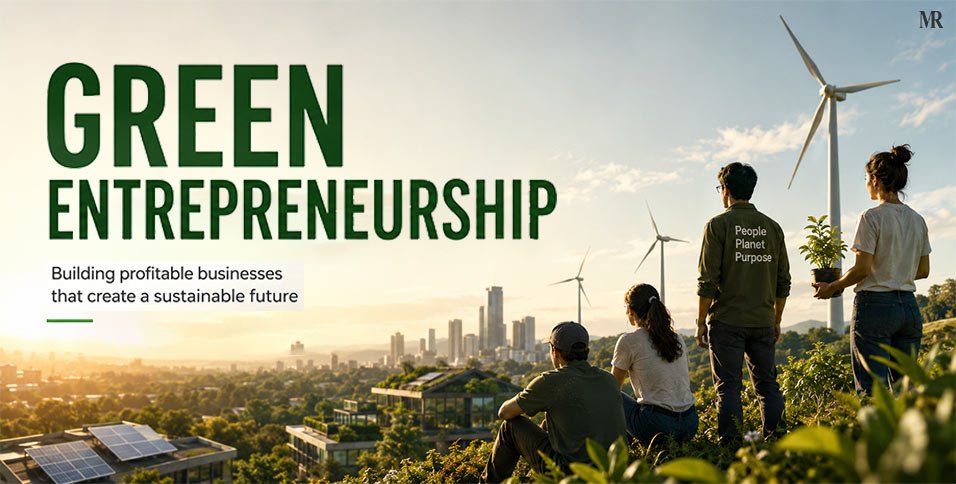
Climate change is no longer a future problem, it’s a present-day business reality. Governments are tightening emissions targets. Investors are demanding ESG accountability. Consumers are choosing brands that align with their values. And in the middle of all this, a new generation of founders is building businesses that treat the planet as a stakeholder, not an afterthought.
That’s exactly what green entrepreneurship is about.
Green entrepreneurship, also called sustainable entrepreneurship, refers to starting and scaling businesses that create economic value while actively reducing environmental harm.
These are not charity projects. They’re commercially viable companies solving real climate problems: clean energy, sustainable products, waste reduction, circular systems, and more.
This guide breaks down what green entrepreneurship means, why it’s growing fast in 2026, the main types with real examples, proven business models, and how you can start one.
What Is Green Entrepreneurship?
Green entrepreneurship means building a business that solves an environmental problem and generates profit at the same time. The core idea: prioritize environmental sustainability alongside profitability.
Unlike traditional businesses that treat environmental responsibility as a compliance box to tick, green entrepreneurs embed it into their core model.
They ask:
- What environmental problem am I solving?
- How does my business reduce harm at scale?
Key principles green businesses operate on:
- Reducing carbon emissions or resource consumption
- Promoting circular economy thinking — reuse, recycle, regenerate
- Using renewable energy or sustainable inputs
- Measuring environmental impact, not just revenue
Why Green Entrepreneurship Is Booming in 2026
Several forces are converging to make this one of the fastest-growing types of entrepreneurship of the decade.
- ESG regulations are tightening: The EU’s Corporate Sustainability Reporting Directive (CSRD) now mandates strict sustainability disclosures for large publicly listed companies, forcing transparency across global supply chains.
- Capital is moving into climate tech: Clean energy and low-emission technologies now attract over $2 trillion annually, and investors are getting more selective, demanding real-world impact over moonshot pitches.
- Consumer Demand: According to the WEF, 80% of consumers state they will pay more for sustainable brands.
- Renewable energy is now cost-competitive: According to the IEA, solar energy commands 42% of the renewable energy market, with wind contributing another 25–30%.
7 Types of Green Entrepreneurship
Green entrepreneurship spans multiple industries, from renewable energy and sustainable agriculture to circular economy platforms and climate-focused software solutions. Here’s a clear breakdown of each type, a real-world example, and what makes it scalable.
| Type | Example | Why It Matters |
| 1. Renewable Energy | Sunrun — residential solar + financing | Universal demand; recurring revenue model |
| 2. Sustainable Products | Patagonia — recycled materials, Worn Wear repair program | Brand loyalty; supply chain differentiation |
| 3. Circular Economy | Back Market — refurbished electronics marketplace | Lower cost for buyers; zero-waste business loop |
| 4. Green Technology | Watershed — corporate carbon accounting SaaS | ESG regulatory tailwinds; high retention SaaS |
| 5. Sustainable Agriculture | Beyond Meat — plant-based protein alternatives | Massive food industry scale opportunity |
| 6. Clean Transportation | Tesla — EVs, charging network, battery storage | Policy mandates + consumer shift to EVs |
| 7. Waste Management | Renewlogy — plastics-to-fuel conversion | Untapped 350M+ tonne waste feedstock globally |
1. Renewable Energy Entrepreneurship
Renewable Energy Entrepreneurship consists of businesses that generate, store, or distribute clean energy, including solar, wind, hydropower, green hydrogen, and battery storage systems.
- Example: Sunrun (USA) is one of the largest residential solar companies in the US. It installs rooftop solar panels and offers financing models that let homeowners go solar with $0 upfront. In 2025, US solar and wind together hit 17% of total US power generation, up sharply from prior years, and solar is growing faster than any other source.
- Why it’s scalable: Energy is a universal need. Once infrastructure is in place, long-term service contracts create a highly predictable cash flow.
2. Sustainable Product Entrepreneurship
Businesses that replace conventional consumer or industrial products with eco-friendly alternatives like biodegradable packaging, organic materials, recycled inputs, low-carbon manufacturing, and other sustainable technologies come under Sustainable Product Entrepreneurship.
- Example: Patagonia is a primary example of this model. The company targets net-zero greenhouse gas emissions by 2040 by cleaning up its internal supply chain rather than relying on carbon offsets. To scale its impact, Patagonia co-founded the Brands for Public Lands coalition, uniting over 100 brands representing more than $19.9 billion in annual revenue to protect public ecosystems.
- Why it’s scalable: Brand trust compounds over time. Consumers who buy into sustainable values tend to become loyal repeat buyers and brand advocates.
3. Circular Economy Entrepreneurship
Circular Economy Entrepreneurship consists of businesses designed around eliminating waste through product repair, refurbishment, recycling, and resale marketplaces. Instead of the traditional take-make-dispose model, these companies keep materials in active economic use as long as possible.
- Example: Back Market (France/Global) is a resale marketplace for refurbished electronics. It connects buyers with certified refurbishers, giving devices a second life instead of contributing to e-waste. It helped avoid 1,666 US tons of e-waste in 2023.
- Why it’s scalable: As new product costs rise and sustainability awareness grows, the refurbished goods market is expanding rapidly. It’s a win for buyers (lower prices) and the planet (less waste).
4. Green Technology Entrepreneurship
Green Technology Entrepreneurship consists of software and technology companies building digital solutions to environmental problems, including carbon tracking platforms, smart energy management software, AI-powered climate modeling, and sustainability analytics.
- Example: Watershed (USA) provides a corporate carbon accounting and management platform. Companies use it to measure their Scope 1, 2, and 3 emissions, set reduction targets, and report to regulators and investors. It raised $185M and works with clients like Airbnb, Spotify, and Sweetgreen.
- Why it’s scalable: As ESG disclosure requirements tighten globally, every large company needs a solution like this. It’s a SaaS model with high retention and expanding compliance reporting.
5. Sustainable Agriculture Entrepreneurship
Sustainable Agriculture Entrepreneurship consists of businesses reimagining how food is grown, processed, and delivered to reduce emissions, conserve freshwater resources, and maximize nutritional value per square foot of land.
- Example: Beyond Meat pioneered plant-based meat alternatives that replicate the taste and texture of animal products. Their approach reduces greenhouse gas emissions, land use, and water consumption compared to conventional livestock farming. The plant-based food market continues to grow as consumers seek lower-carbon protein sources.
- Why it’s scalable: Food is a $9.5 trillion global industry. Even marginal shifts in how protein is produced and consumed can have enormous environmental impact.
6. Clean Transportation Entrepreneurship
Businesses replacing fossil-fuel-powered transport with electric, hydrogen, or hybrid alternatives, across vehicles, logistics, and mobility platforms, come under Clean Transportation Entrepreneurship.
- Example: Tesla built an entire ecosystem around clean transit, including the vehicles, factory infrastructure, and software stack. Its Gigafactories target carbon-neutral production. The company also operates one of the world’s largest EV charging networks (Supercharger), and its dedicated energy division sells utility-scale battery storage, such as the Powerwall and Megapack.
- Why it’s scalable: The IEA’s Net Zero scenario calls for EV production to increase sixfold from 2025 to 2030. The infrastructure, software, and financing layers around EVs all represent massive entrepreneurship opportunities.
7. Waste Management Entrepreneurship
Waste Management Entrepreneurship consists of businesses turning waste streams into high-value commodities through waste-to-energy conversion, advanced plastic recycling, industrial composting, and environmental pollution remediation technologies.
- Example: Renewlogy (USA) specializes in converting hard-to-recycle plastics (types 3–7) into liquid fuel. While these plastics typically end up in landfills or oceans, Renewlogy’s industrial process converts them into diesel, jet fuel, and naphtha, giving plastic a second commercial life.
- Why it’s scalable: Global plastic waste generation exceeds 350 million tonnes annually. Waste-to-value startups that can process at an industrial scale can access enormous untapped feedstock.
What Makes a Business Truly Green
Understanding the different types of enterprises helps clarify the landscape, but execution requires strict operational criteria. Not every business that uses the word “sustainable” qualifies as genuine green entrepreneurship. True green enterprises separate themselves from greenwashing through verifiable practices:
- Environmental accountability: Measuring and reporting actual data regarding emissions, waste, and water usage, rather than just stating intentions.
- Innovation-Driven Solutions: Solving ecological problems that conventional businesses ignore or externalize.
- Long-Term Asset Management: Prioritizing long-term ecosystem value over temporary short-term profit margins.
- Ethical Supply Chains: Maintaining fair labor, responsible sourcing, and fully transparent operations from day one.
- Rigorous Impact Metrics: Tracking KPIs beyond revenue, including specific metrics like tonnes of carbon offset, waste diverted, and energy saved.
Benefits of Green Entrepreneurship
According to financial market data and global consumer research, founders, investors, and employees are gravitating toward green businesses for several clear reasons:
- Strong Brand Loyalty: Sustainability-focused businesses often experience higher customer retention, stronger word-of-mouth marketing, and better long-term trust than traditional competitors.
- Government Incentives: Targeted tax credits, capital grants, clean energy subsidies, and public green procurement policies actively reward sustainable operations with financial relief.
- Corporate Resilience: Companies with authentic, data-backed sustainability credentials consistently outperform their traditional peers on consumer trust and retention metrics.
- Top-Tier Talent Acquisition: Purpose-driven businesses attract higher-caliber job candidates, particularly among younger professionals who prioritize corporate values.
- Regulatory Alignment: As environmental laws tighten globally, green businesses operate ahead of the compliance curve rather than spending capital scrambling to adapt.
Challenges Green Entrepreneurs Actually Face
The opportunity is real — but so are the hurdles. Being honest about these challenges is what separates durable green businesses from well-intentioned failures.
- High startup costs: Clean energy infrastructure, R&D for sustainable materials, and circular supply chains all require significant upfront capital.
- Slow adoption cycles: Enterprise clients and governments move slowly. Long sales cycles can strain early-stage cash flow.
- Greenwashing scrutiny: Consumers and regulators are increasingly skeptical. A single misleading claim can destroy brand credibility permanently.
- Infrastructure gaps: In many markets, the grid, logistics networks, and recycling systems needed to support green businesses simply don’t exist yet.
- Regulatory complexity: Navigating carbon markets, ESG reporting standards, and environmental permits across multiple jurisdictions is resource-intensive.
- Scaling sustainable operations: What works at a small scale often breaks at an industrial scale. Supply chains, unit economics, and environmental performance all shift as companies grow.
How to Start a Green Business: A Practical Flow
- Identify a specific environmental problem: Don’t start with ‘sustainability’ as a vague mission. Start with a concrete problem: plastic in waterways, carbon in supply chains, food waste in retail.
- Research existing solutions and gaps: Who else is working on this? Where do current solutions fall short? Your competitive edge lives in that gap.
- Validate market demand: Is there a customer willing to pay for your solution? Talk to 50 potential customers before building anything.
- Build a sustainable and profitable business model: Pick a model (SaaS, marketplace, EaaS, carbon credits) that can generate recurring revenue, not just grants.
- Source ethical inputs: Your supply chain is part of your environmental footprint. Audit it from day one.
- Measure your environmental impact: Choose the right metrics (tonnes of CO₂ avoided, litres of water saved, kilograms of waste diverted) and track them rigorously.
- Scale responsibly: Don’t sacrifice your environmental mission for growth speed. The businesses that last are those where impact and revenue scale together.
End Note
Green entrepreneurship is one of the most important business trends of this decade — not because it’s fashionable, but because the underlying economics and regulatory environment now support it at scale.
The market is moving. Capital is moving. Consumer behavior is moving. The question isn’t whether green entrepreneurship will become mainstream… it already is. The question is whether you’re building in that direction.
Whether you’re drawn to renewable energy, sustainable products, circular systems, or clean tech, the playbook is the same: find a real environmental problem, build a business model that solves it profitably, and measure your impact with the same rigor you apply to your revenue.
Green entrepreneurship isn’t about doing less harm. It’s about building businesses that actively make things better and that’s the most durable competitive advantage a company can have in 2026.
Maria Isabel Rodrigues