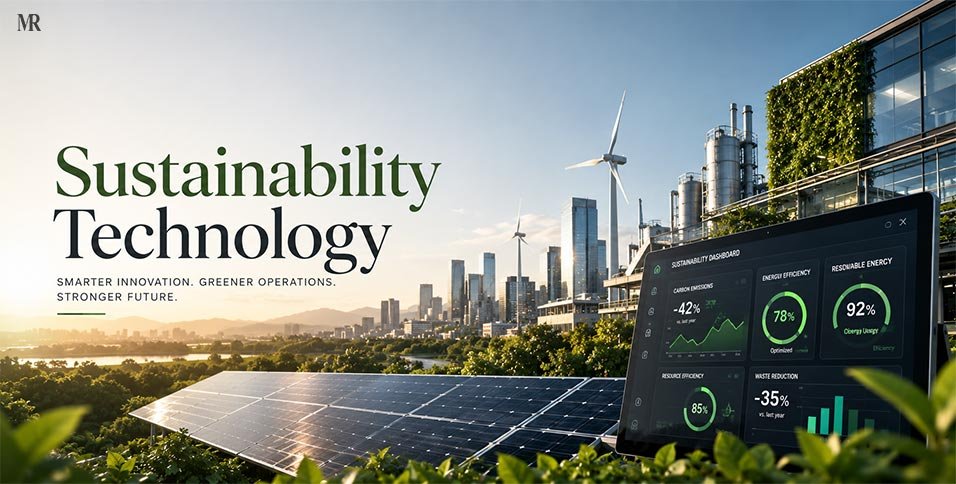
A few years ago, Sustainability Technology was mostly about looking responsible. Today, it is about staying profitable. Companies that use green technology cut costs, attract better investors, and keep their employees longer. And the data proves this clearly.
According to Morgan Stanley’s Sustainable Signals: Corporates 2026 report, which surveyed over 300 companies across North America, Europe, and Asia-Pacific, 88% of businesses see sustainability as a long-term value creation opportunity.
More than 80% say they can already measure the return on investment (ROI) from their sustainability efforts, just like they measure any other business investment.
This is not a feel-good trend. It is a business shift.
So, What Exactly Is Sustainability Technology?
Sustainability technology refers to digital tools, software, and hardware innovations that allow organizations to measure, manage, and lower their ecological footprint while improving operational output.
It brings together green technology (like physical solar panels or waste treatment systems) and sustainable innovation (such as data analytics that calculate carbon outputs).
Organizations integrate these tools directly into their day-to-day operations to achieve specific goals:
- Reduce Emissions: Software platforms track Greenhouse Gas (GHG) protocols across supply chains to spot and eliminate carbon spikes.
- Save Energy: Automated industrial systems power down machinery during idle periods to prevent electricity waste.
- Minimize Waste: Artificial intelligence monitors raw materials to ensure production lines use resources effectively.
- Improve Operations: Digital tools remove paper trails, speed up compliance reporting, and keep machinery running reliably.
Why Sustainability Technology Matters for Businesses
Investing in modern green infrastructure offers major financial and structural rewards. Key business benefits include:
- Lower Operational Costs: Using less power and water cuts utility expenses immediately.
- Regulatory Readiness: Passing audits becomes simpler. For instance, the Science Based Targets initiative (SBTi) confirmed in January 2026 that over 10,000 global companies now use validated science-based targets to meet tightening international mandates.
- Investor Attraction: Financial institutions favor organizations with transparent data; expectations from investors as a primary driver for sustainability strategy have doubled since 2025 to 42%.
- Stronger Brand Reputation: Customers stick with brands that prove their green claims using verified data instead of vague marketing promises.
- Improved Profitability: 27% of business leaders identify increased profitability as the primary value creation opportunity over the next five years.
Types of Sustainability Technology Used in Businesses
To build a resilient model, enterprises install diverse forms of sustainability technology in their business across their properties and workflows.
1. Renewable Energy Systems
To reduce reliance on aging power grids, companies set up on-site solar power installations and wind energy systems. Modern facilities tie these directly into smart grids, allowing them to store excess clean energy in localized industrial batteries and draw from it during peak billing hours.
2. Smart Energy Management
Internet of Things (IoT) sensors and smart lighting platforms track room occupancy in real time. Combined with AI energy optimization software, these systems automatically adjust power distribution based on weather changes, building occupancy, and current utility rates.
3. Green Manufacturing Technology
Industrial facilities rely heavily on automation and advanced waste reduction systems to build circular manufacturing loops.
| Technology Component | Operational Function | Business Impact |
| Digital Twins | Simulates product life cycles before physical manufacturing begins | Cuts down prototype material waste and shortens development cycles |
| Circular Platforms | Tracks byproduct scrap and connects with local recycling networks | Lowers raw material procurement costs |
4. Sustainable Supply Chain Technology
Transparency matters more than ever. Logistics teams use blockchain tracking to verify the ethical origins of raw materials. Meanwhile, carbon footprint analytics and automated route optimization software help fleet managers reduce delivery miles and fuel consumption.
5. Sustainable IT & Data Centers
The rapid growth of artificial intelligence has created an immense demand for digital infrastructure. Because of this, companies are shifting toward green cloud computing, energy-efficient servers, and carbon-neutral data centers that utilize advanced cooling methods to handle heavy computational workloads without draining local grids. Notably, 15% of sustainability leaders are now also closely involved in responsible AI strategy.
6. Smart Buildings
Commercial real estate relies on integrated HVAC optimization platforms and smart water systems. These tools continuously monitor pipe pressure and air quality, detecting hidden leaks and system inefficiencies before they turn into costly maintenance issues.
7. Responsible Attitude to High Level of Security
Beyond energy efficiency, modern facilities must prioritize digital integrity to maintain a secure and reliable operational environment. Integrating robust penetration testing services allows companies to proactively identify vulnerabilities in their smart infrastructure, ensuring that sustainability efforts are protected by the highest standards of safety and data resilience.
Real-World Examples Of Sustainability Tech in Businesses
Several global brands are setting benchmarks by integrating large-scale sustainability systems into their commercial models. One such example is the Microsoft and Brookfield deal.
1. Microsoft and Brookfield Renewable Asset Deal
In one of the largest clean energy agreements ever recorded, Microsoft partnered with Brookfield Renewable Partners to deploy over 10.5 gigawatts of new renewable energy capacity between 2026 and 2030. This massive commitment directly supports the expansion of cloud and AI infrastructure with clean electricity.
2. Regional Supply Chain Innovation
Beyond global tech firms, certain regions are proving the value of localized green tech:
- Europe: Companies here lead in viewing sustainability as a revenue driver, with 38% identifying revenue growth as the top value opportunity.
- APAC: Investor expectations are a particularly strong motivator in this region, cited by 47% of sustainability decision-makers.
- North America: Half of the companies in this region report meeting or exceeding their sustainability strategy expectations, focusing heavily on value creation.
Challenges Businesses Face
Deploying green tools requires navigating distinct operational hurdles:
- High Initial Investment: Buying advanced hardware and software requires significant upfront capital. The 2026 Morgan Stanley corporate survey highlighted that 39% of executives view high investment costs as their primary operational barrier.
- Integration Complexity: Merging new IoT sensors or carbon tracking software with outdated legacy systems often causes temporary workflow delays.
- Macroeconomic Uncertainty: 36% of leaders in 2026 cite economic instability as a major barrier to delivery, a significant increase from 15% in 2025.
- Lack of Data: 30% of organizations struggle with a lack of sufficient data to inform their green strategies.
- ROI Measurement: While most companies still measure ROI easily, 73% reported doing so in 2026, down from 83% the previous year.
Future Trends in Sustainability Technology
Driven by rising resource demands and rapid computational growth, the clean technology landscape is evolving quickly.
- Advanced Baseload Energy: To meet the immense power needs of expanding data centers, financial institutions like J.P. Morgan note a massive trend toward small modular nuclear reactors (SMRs) and deep geothermal energy systems to guarantee constant, clean power.
- AI-Driven Circular Economy Platforms: Machine learning tools will soon automate the sorting and distribution of industrial scrap materials right at the factory floor.
- Stricter Scope 2 Reporting Tools: Proposed updates to global greenhouse gas protocols are pushing companies to buy automated software that tracks utility emissions hour by hour, replacing vague annual estimates with precise data.
- Climate Risk Mitigation: 78% of businesses now view physical climate risks, like extreme weather, as likely to impact operations, prompting a surge in resilience technology.
- Embedded Governance: Sustainability criteria are becoming standard in business decisions; 63% of companies now include these factors in capex and R&D budgeting.
Conclusion
Implementing sustainability technology in business is no longer just an optional public relations exercise. It has evolved into an essential operational strategy that protects profit margins, satisfies strict regulatory bodies, and builds resilient supply chains. By acting early and adopting these tools today, organizations can trim structural waste, address resource scarcity, and secure a lasting competitive advantage in an evolving global market.
Maria Isabel Rodrigues