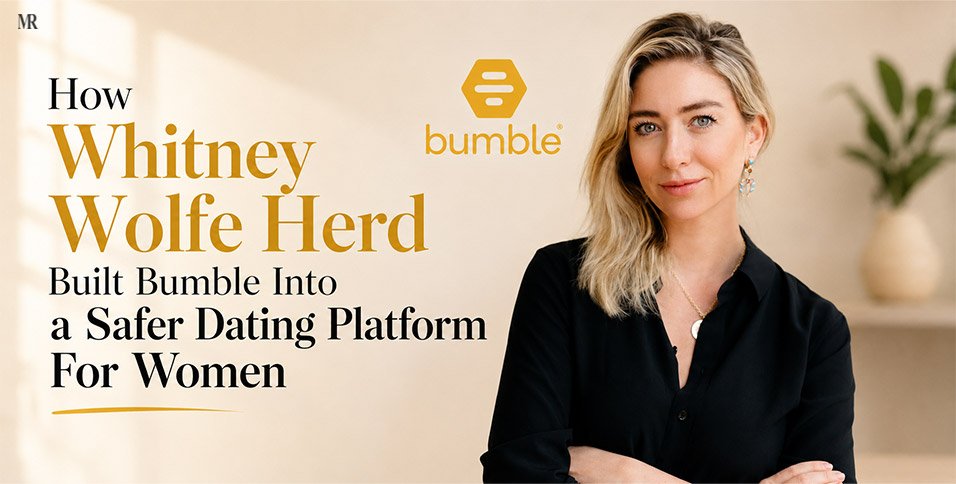
For years, online dating followed the same pattern. Anyone could make the first move, and women often had to deal with unwanted messages, harassment, or uncomfortable conversations.
But what if dating apps worked differently? What if women decided when a conversation could begin?
That single question became the foundation of Bumble.
Behind the idea was Whitney Wolfe Herd, an entrepreneur who turned a difficult career setback into one of the biggest success stories in modern tech. Her journey isn’t just about building a billion-dollar company. It’s about challenging old norms, creating a safer online experience, and proving that empathy can become a competitive advantage.
Here’s how Whitney Wolfe Herd transformed one bold idea into a global platform used by millions.
Whitney Wolfe Herd at a Glance
| Full Name | Whitney Wolfe Herd |
| Born | July 1989, Salt Lake City, Utah, U.S. |
| Age | Mid-30s (as of 2026) |
| Education | Southern Methodist University, B.A. in International Studies |
| Title | Founder and CEO, Bumble |
| Prior Role | Co-founder and Vice President of Marketing, Tinder (2012–2014) |
| Signature Achievement | Youngest woman to take a company public in the U.S.at age 31. (Bumble’s February 2021 IPO) |
Early Life and Whitney Wolfe Herd’s Education
Born on July 1, 1989, in Salt Lake City, Utah, Whitney grew up in a family that valued ambition and independent thinking. While many people her age were still figuring out what they wanted to do, she was already experimenting with business ideas and learning how products could solve real problems.
Whitney later attended Southern Methodist University (SMU) in Dallas, Texas, where she studied International Studies. Although her degree wasn’t in technology or business, it helped her understand cultures, communication, and global issues.
College also gave her the freedom to explore entrepreneurship firsthand. During the aftermath of the 2010 Deepwater Horizon oil spill, Whitney Wolfe Herd launched a small business selling bamboo tote bags, with part of the proceeds supporting communities affected by the disaster. It wasn’t a massive company, but it revealed something important about her approach to business: profit and purpose didn’t have to be separate goals.
Looking back, those early experiences reflected a pattern that would define her career. Rather than waiting for someone else to solve a problem, Whitney preferred to ask, “What can I do about it?”
Whitney Wolfe Herd’s Career Before Bumble
Most successful founders don’t build billion-dollar companies on their first attempt. They learn by joining fast-moving startups, making difficult decisions, and experiencing both wins and setbacks. Whitney Wolfe Herd’s career followed that same path.
- Learning the Startup World at Hatch Labs
After graduating from Southern Methodist University, Whitney joined Hatch Labs, a startup incubator known for developing new mobile apps. It was an exciting time for the tech industry, with smartphones changing how people communicated, shopped, and built relationships.
Working in a startup environment exposed her to every stage of product development. Instead of focusing on one department, she saw how ideas evolved into products that people used every day. The experience taught her an important lesson: great products succeed when they solve real human problems.
One project at Hatch Labs would change the direction of her career forever.
That project eventually became Tinder.
- Helping Build Tinder’s Early Growth
As one of the early members of the team, Whitney played a significant role in the app’s branding and marketing. She helped shape its identity, contributed to user growth strategies, and is widely credited with suggesting the now-famous name “Tinder.”
The app quickly became one of the fastest-growing dating platforms in the world, attracting millions of users within just a few years. For a young entrepreneur in her twenties, it was an incredible opportunity to witness how a simple idea could scale into a global business.
But rapid growth often brings equally complex challenges.
- A Difficult Chapter That Changed Everything
In 2014, Whitney left Tinder following disagreements with company leadership. She later filed a lawsuit alleging sexual harassment and discrimination, and the case was eventually settled without any admission of wrongdoing.
For many people, an experience like that would have marked the end of a startup career. After working so hard to help build a successful company, starting over can feel impossible.
Whitney faced that same crossroads.
She could have walked away from the tech industry altogether. Instead, she chose to ask a different question:
What if the problem wasn’t online dating itself but the way it had been designed?
That question became the turning point in Whitney Wolfe Herd’s success story. Rather than letting one difficult chapter define her future, she used it to imagine a platform where respect, safety, and meaningful connections came first.
The answer to that question would soon become Bumble.
Bumble: The Moment That Changed Everything
After leaving Tinder, Whitney Wolfe Herd considered stepping away from the technology industry altogether. The experience had been emotionally draining, and building another dating app was the last thing she imagined doing.
Around that time, she connected with Russian entrepreneur Andrey Andreev, the founder of the dating platform Badoo. Their early conversations weren’t about creating another swipe-based app. Whitney’s original idea was to build a female-focused social network that encouraged kindness and positive interactions.
As they explored the concept, they realized the same philosophy could transform online dating. Instead of redesigning how people matched, they focused on changing who started the conversation.
It was a surprisingly simple change with the potential to reshape user behavior.
What if women made the first move?
That single decision challenged years of online dating norms. More importantly, it addressed one of the biggest concerns many women faced like unsolicited messages and uncomfortable interactions.
In December 2014, Whitney Wolfe Herd launched Bumble with a mission that went beyond helping people find romantic partners. She wanted to build a platform where respect, safety, and meaningful conversations came first.
The idea resonated with the audience almost immediately.
How Whitney Wolfe Herd Built Bumble
- A New Rule That Changed Online Dating
At first glance, Bumble looked similar to other dating apps. Users created profiles, swiped through potential matches, and connected with people who shared mutual interest.
The difference appeared only after a match was made.
On Bumble, women had 24 hours to send the first message in heterosexual matches. If they didn’t, the match disappeared.
It was a bold design choice. Instead of trying to solve harassment through policies alone, Bumble redesigned the user experience to encourage more intentional conversations.
The feature sparked curiosity, conversation, and, eventually, widespread adoption. Millions of users appreciated that Bumble wasn’t just another dating app. It offered a different experience.
Sometimes, meaningful innovation isn’t about adding more features. It’s about changing one rule that changes everything else.
- Building Trust Into the Product
Creating a safer platform required more than a unique messaging rule.
Under Whitney Wolfe Herd’s leadership, Bumble continued investing in features that promoted accountability and user safety. The platform introduced photo verification, reporting and blocking tools, AI-assisted moderation, and policies against hate speech and abusive behavior.
These features weren’t added as afterthoughts. They reflected Bumble’s core belief that people are more likely to build genuine connections when they feel respected and secure.
That philosophy helped Bumble stand out in an increasingly competitive online dating market.
- Growing Beyond Dating
Whitney also recognized that meaningful relationships extend beyond romance.
In 2016, Bumble introduced Bumble BFF, allowing users to find new friends, especially after moving to a new city or entering a different stage of life.
Soon after came Bumble Bizz, a networking feature designed to help professionals build business relationships and mentorship opportunities.
These additions transformed Bumble from a dating app into a broader social connection platform.
It raised an interesting question:
What if technology could help people build every important relationship and not just romantic ones?
That broader vision expanded Bumble’s audience and reinforced its purpose-driven identity.
- Turning a Startup Into a Global Brand
As user adoption accelerated, Bumble expanded into dozens of countries while continuing to adapt to local cultures and dating preferences.
Its marketing campaigns focused less on finding “the perfect match” and more on confidence, respect, equality, and healthy communication. This messaging helped the brand resonate with younger generations who expected more from digital platforms.
By combining thoughtful product design with a clear mission, Whitney Wolfe Herd’s Bumble became one of the most recognized names in the online dating industry.
Bumble’s Historic IPO
On February 11, 2021, Bumble went public on the Nasdaq under the ticker BMBL. The Bumble IPO valued the company at more than $13 billion, making it one of the biggest public offerings by a female-founded technology company.
At just 31 years old, Whitney Wolfe Herd became the youngest woman to take a company public in the United States at the time. Her ownership stake also briefly made her one of the world’s youngest self-made female billionaires.
The milestone wasn’t just a financial achievement. It challenged long-standing assumptions about who could build and lead successful technology companies.
For aspiring entrepreneurs, it was proof that businesses driven by purpose can also deliver remarkable growth.
Whitney Wolfe Herd’s Leadership Style
Successful companies are often reflections of the people who build them. Bumble’s culture and products closely mirror Whitney Wolfe Herd’s leadership philosophy.
- She Leads With Empathy
Rather than focusing only on rapid expansion, Whitney has consistently emphasized creating products that improve users’ experiences. Decisions are guided by how people feel while using the platform, not just by engagement metrics.
- She Turns Personal Experience Into Innovation
Many entrepreneurs try to forget difficult moments. Whitney chose to learn from hers.
Instead of allowing past challenges to define her career, she used them to identify a problem millions of women experienced online and built a solution around it.
- She Challenges Industry Norms
The most disruptive ideas often sound risky in the beginning.
When Bumble required women to make the first move, many questioned whether the concept would succeed. Today, that feature remains one of the platform’s defining characteristics and a reminder that meaningful innovation often starts by questioning accepted conventions.
- She Builds With Purpose
Whether introducing new safety tools, expanding into friendships and professional networking, or advocating for healthier online interactions, Whitney has consistently aligned Bumble’s growth with its original mission.
Her leadership demonstrates that long-term trust can become a company’s greatest competitive advantage.
Where Is Whitney Wolfe Herd Today?
Today, Whitney Wolfe Herd remains closely associated with Bumble and continues to shape conversations around online safety, women’s leadership, and the future of digital relationships.
Following leadership transitions over the years, she returned as Bumble CEO in 2025 to guide the company through its next phase of growth, with a renewed focus on improving the user experience and strengthening the platform’s long-term strategy.
Her journey continues to evolve, but the mission that inspired Bumble from the beginning remains unchanged: creating a space where people can build healthier, more respectful connections.
What Entrepreneurs Can Learn from Whitney Wolfe Herd
Every purpose-driven founder story is different, but Whitney Wolfe Herd’s success story offers lessons that apply far beyond the technology industry.
- Solve problems people genuinely care about.
Bumble succeeded because it addressed a real concern that millions of users had accepted as unavoidable.
- Don’t let setbacks define your future.
Whitney’s biggest challenge became the catalyst for her greatest achievement.
- Question established norms.
Innovation often begins by asking, “Why does it have to work this way?”
- Build trust before chasing growth.
A loyal community is often a stronger competitive advantage than rapid expansion alone.
- Lead with purpose.
Companies that stand for something meaningful tend to create stronger brands, deeper customer loyalty, and lasting impact.
Conclusion
One question changed Whitney Wolfe Herd’s career and the online dating industry:
What if women made the first move?
That simple idea grew into a global platform that challenged long-held assumptions about how people connect online. But Bumble’s success wasn’t built on one feature alone. It came from a willingness to rethink the user experience, prioritize trust, and create technology that reflected real human needs.
For aspiring entrepreneurs, this Whitney Wolfe Herd biography is a reminder that breakthrough businesses rarely begin with complicated ideas. They begin with noticing a problem others overlook and having the courage to build a better solution.
The next great idea may not come from inventing something entirely new. It may come from asking a better question than everyone else.
Maria Isabel Rodrigues