Mirror Review
March 04, 2026
Imagine a single, narrow stretch of water, so vital that its blockage could shake the global economy!
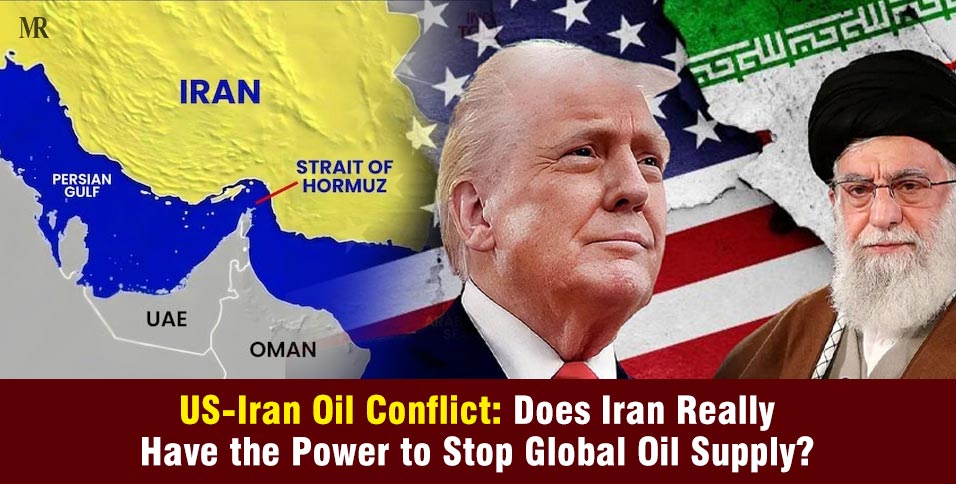
This is the reality of the Strait of Hormuz, a critical waterway now at the center of the escalating war tensions in the Middle East.
Following renewed military friction in the region and the US-Iran oil conflict, global energy markets are on edge.
Naval patrols have intensified across the Gulf, commercial tanker operators are reviewing routes, and maritime insurers have reportedly raised war-risk premiums.
So the question remains:
Does Iran truly have the power to disrupt global oil supply?
The Strait of Hormuz: The Main Artery of Global Oil
The Strait of Hormuz is the world’s most vital oil transit chokepoint.
This passage, which connects the Persian Gulf with the Gulf of Oman, is the main artery for a significant portion of global energy supplies.
Here’s an idea of its importance:
- In 2025, an average of 20 million barrels of oil passed through the strait each day.
- This volume represents aboutnearly 30% of the global seaborne oil trade.
Very few alternative routes exist.
Energy analysts repeatedly warn that if the strait were blocked, there is no immediate replacement capacity capable of offsetting such a loss in the short term.
But crude oil is only part of the story.
Strait of Hormuz Importance Other Than Oil
The strait also handles 20% of global liquefied natural gas (LNG) shipments, particularly from Qatar.
Any disruption would therefore impact not only fuel prices but also electricity markets across Asia and Europe.
Major economies, including China, India, Japan, and South Korea, depend heavily on Gulf exports routed through this narrow passage.
This geographic reality gives Iran a strong strategic advantage.
But is the threat to restrict the Strait of Hormuz even practical?
How Oil and Shipping Markets Are Reacting
Even without a formal blockade, markets have responded sharply.
Brent crude briefly surged toward the $85–$90 per barrel range, and analysts warn prices could test $100 per barrel if shipping disruptions intensify.
Meanwhile, shipping costs have soared:
- The benchmark freight rate for Very Large Crude Carriers (VLCCs) — tankers capable of carrying about 2 million barrels — hit a record $423,736 per day.
- That marked an astonishing 94% increase from Friday’s close as insurers withdrew war-risk cover amid heightened threat levels.
According to Sheel Bhattacharjee, head of freight pricing at Argus Media, charterers “stepped back from the market and avoided securing vessels” because of the increased threat despite no official closure of the waterway.
So far, oil continues to flow, but the fear of interruption alone is rattling markets.
OPEC+ Moves to Boost Output Amid Tension
Even as the US-Iran conflict threatens shipping flows, major oil producers have taken steps to adjust supply.
In a statement released on March 1, eight key members of the Organization of the Petroleum Exporting Countries (OPEC) announced a production adjustment.
The group which consisted of Saudi Arabia, Russia, Iraq, the UAE, Kuwait, Kazakhstan, Algeria, and Oman agreed to resume unwinding 1.65 million barrels per day of voluntary cuts first introduced in April 2023.
They also approved an additional 206,000 barrels per day increase starting in April 2026.
The decision to change the previous OPEC outlook was based on a steady global economic outlook and healthy market fundamentals, including low oil inventories.
Can Iran Actually Close the Strait of Hormuz?
For years, Iran has threatened to close the strait as a potential “pressure point” in any major conflict.
But the reality is far more complex.
A full closure would not only disrupt global supply but it would also block Iran’s own oil exports. Tehran depends on the same waterway to ship crude to key buyers, particularly in Asia.
Moreover, the region hosts a significant international naval presence.
President Donald Trump stated this week that the U.S. Navy could begin escorting oil tankers through the Strait of Hormuz if necessary, warning that the US is prepared to intervene directly to keep energy flows moving.
Energy strategists argue that a prolonged, total shutdown remains unlikely due to the high military and economic costs.
A more probable scenario? Targeted disruptions:
- Harassment of specific vessels
- Temporary slowdowns
- Tactical escalations
In such a scenario, Iran’s power lies less in physically sealing the waterway and more in keeping the threat credible.
Could the US Benefit From Higher Oil Prices?
Interestingly, some analysts argue the conflict could reinforce America’s role as a leading energy producer.
The United States is already one of the world’s largest oil producers, and higher global prices can make domestic shale production more profitable.
However, this is a double-edged sword.
While producers may benefit, American consumers would still face higher gasoline prices because domestic fuel costs are tied to global benchmarks like Brent crude.
Will The US-Iran Oil Conflict Affect Consumers?
If Brent crude climbs toward $100 per barrel, analysts warn U.S. gasoline prices could rise significantly within weeks.
The ripple effects would extend beyond fuel:
- Higher airline ticket prices
- Rising shipping and freight costs
- Increased inflationary pressure
With inflation already a concern in many economies, energy shocks could complicate central bank policy decisions worldwide.
That’s why financial markets are watching the Strait of Hormuz so closely.
Does Iran Hold Complete Power Over Strait of Hormuz?
Iran does not hold complete power but substantial influence over the Strait of Hormuz.
Iran may not be able to permanently shut down the Strait of Hormuz without severe economic and military consequences.
But it does not need to.
As long as tensions persist and the possibility of disruption remains credible, oil markets will continue pricing in uncertainty.
And in global energy markets, perception alone can move billions of dollars.
The true leverage in the US-Iran Oil Conflict may not be the physical closure of a waterway but the economic tremors triggered by the threat of it.
As the world monitors developments in the Gulf, one reality remains clear:
When it comes to oil, even uncertainty carries a price.