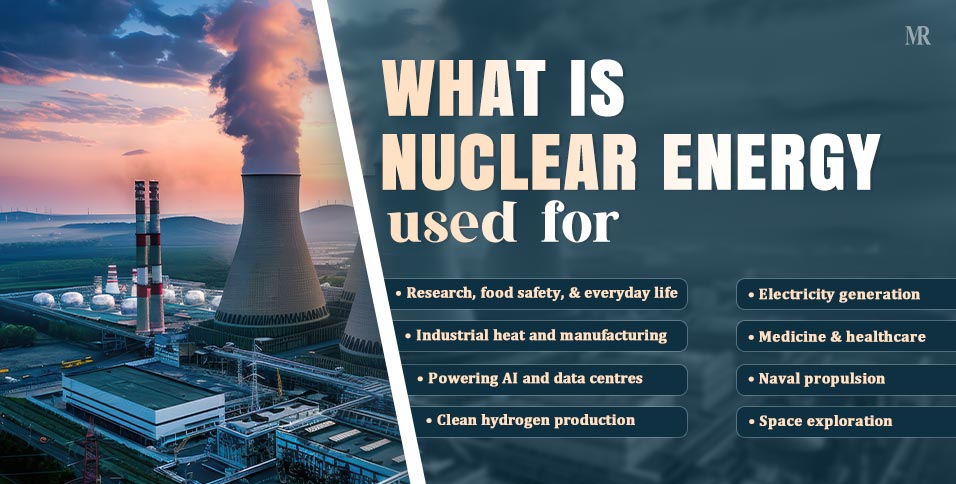
Most people associate nuclear energy with power plants and electricity. That association is correct, but it answers only a fraction of “What is nuclear energy used for?”
Nuclear energy today powers submarines beneath the Arctic, diagnoses cancer in hospital imaging suites, keeps NASA spacecraft transmitting from beyond our solar system, and is being actively contracted by Google, Amazon, Microsoft, and Meta to run the next generation of AI data centres.
In 2024, nuclear reactors generated more electricity than in any previous year on record, 2,667 TWh globally. This helped avoid 2.1 billion tonnes of CO₂ emissions, equivalent to wiping out the carbon footprint of the entire global aviation industry nearly twice over.
That milestone tells part of the story. What follows tells the rest.
Here Are The Top 8 Industries Highlighting Nuclear Energy Uses
Note: Most data and insights in this article are sourced from the World Nuclear Association, along with reports from the International Atomic Energy Agency, International Energy Agency, Nuclear Energy Institute, and other verified industry and government sources.
1. Electricity generation
Electricity generation is nuclear energy’s primary and largest use. According to the World Nuclear Association, there are around 440 commercial nuclear power reactors operating in over 30 countries, with approximately 400 GW of total capacity.
- The United States remains the world’s largest nuclear power producer, with 94 reactors generating about 781.9 TWh of electricity in 2024.
- China is rapidly expanding its nuclear fleet, operating 57 reactors and building 29 more.
- France leads Europe with 57 nuclear reactors generating about 67.3% of the country’s electricity, the highest share in the world.
For more information, read our blog on the top 10 countries with nuclear power.
Nuclear’s defining advantage in electricity generation is not volume — it is consistency.
The global reactor fleet ran at an average capacity factor of 83% in 2024, higher than any other source of electricity. And over 60% of reactors are achieving a capacity factor of more than 80%.
Wind and solar generate power only when conditions allow. But nuclear runs continuously, around the clock, regardless of weather, thus making it the backbone of low-carbon baseload power on modern grids.
This also raises an important question: Is nuclear energy renewable or nonrenewable?
We break it down in detail in our dedicated guide here!
- The SMR revolution
The Small Modular Reactor landscape in 2025 showcases over 80 diverse designs. SMRs present a substantial opportunity for decarbonisation, offering the flexibility to be deployed in remote locations or industrial settings while integrating with renewable energy systems.
Key competitors include NuScale, GE Hitachi, Rolls-Royce, and Rosatom.
SMR installations could reach 80 GW by 2040, accounting for 10% of overall nuclear capacity globally, with the right policy and cost reduction support.
In the United States alone, TerraPower is building Wyoming’s first commercial reactor, Kairos Power is constructing demonstration reactors in Tennessee, and the Department of Defense is building one of the country’s first microreactors in Idaho.
- The nuclear global build-out
More than 70 GW of new nuclear capacity is under construction globally — one of the highest levels in the last 30 years, and more than 40 countries have plans to expand nuclear’s role in their energy systems.
- Egypt is constructing four nuclear reactors, marking Africa’s first new nuclear build
- Bangladesh is building its first two reactors
- Turkey is constructing four reactors, strengthening its energy security
Moreover, the IEA’s Net Zero Emissions by 2050 Scenario sees nuclear capacity increase to 1,079 GW by 2050. This is more than double today’s installed base, according to the World Nuclear Association.
2. Powering AI and data centres
AI and data centres are the most significant new uses of nuclear energy to emerge in the 2020s, and it is moving fast.
The massive data centres needed to win the race for AI require 28 GW of new electricity by the end of next year. Experts have increased the five-year load growth forecast by almost 500%. Moreover, Google, Meta, and Amazon have joined 14 of the world’s biggest banks to pledge to triple global nuclear capacity by 2050.
The deals being signed are substantial. Big tech companies contracted more than 10 GW of possible new nuclear capacity in the United States over the past year.
- Microsoft committed to a 20-year, $16 billion deal tied to the Three Mile Island restart (835 MW, targeting 2028).
- Google signed a deal with Kairos Power to purchase 500 MW of electricity from a new fleet of advanced SMRs.
- Amazon invested $20 billion at Susquehanna, and Meta issued an RFP for 1–4 GW of new nuclear generation.
Furthermore, nuclear energy’s power density and carbon-free reliability are the core attractions. Data centres require an uninterrupted power supply, and unlike solar and wind, nuclear does not fluctuate with weather conditions. This is a crucial advantage for operations that cannot afford power interruptions.
The US Department of Energy is also exploring co-locating advanced nuclear reactors with data centres on federal land through new public-private partnerships, as part of the Trump administration’s bid to accelerate both technologies simultaneously.
3. Industrial heat and manufacturing
Beyond electricity, nuclear’s second major application, and its fastest growing, is supplying the sustained, very high temperatures that industrial processes require and that are difficult and expensive to electrify.
In 2024, nuclear reactors provided 2,644 GWh of electrical equivalent heat for non-electric industrial applications. China and Russia lead in these non-electric applications, showing how nuclear energy can support broader energy needs.
Key industrial uses include:
- Steel production:
Steel manufacturing requires temperatures exceeding 1,000°C, historically achieved by burning coking coal. Advanced high-temperature reactors can supply this heat directly, eliminating the carbon emissions from one of the world’s most polluting industries.
- Cement and chemicals:
Cement kilns and chemical plants, including ammonia synthesis for fertilisers, require continuous high-grade heat. Nuclear process heat is a direct substitute for gas-fired industrial furnaces.
- Desalination:
Nuclear-powered desalination is already operational in Japan, India, and Kazakhstan. A single NuScale Power Module coupled to a reverse osmosis desalination system could yield approximately 150 million gallons of clean water per day without generating carbon dioxide. Twelve modules would be able to provide desalinated water for a city of 2.3 million residents while also having surplus power for 400,000 homes.
- District heating:
Russia, China, and Switzerland currently use nuclear plant waste heat to warm homes and buildings. As energy prices rise and decarbonisation targets tighten, district heating from nuclear plants is attracting renewed interest across Europe.
4. Clean hydrogen production
When answering “What is nuclear energy used for?” it’s important to include its role in clean hydrogen production.
Hydrogen is central to decarbonising sectors that cannot be directly electrified, like heavy industry, long-haul shipping, aviation, and chemical manufacturing. Nuclear energy is one of the most compelling sources for producing energy at scale.
The NEA has found that nuclear is a competitive energy source to produce low-carbon hydrogen on a large scale. Moreover, amortised reactors in long-term operation can unlock production costs of less than $2 per kilogram — among the cheapest available.
The US Department of Energy also estimates that a single 1,000-megawatt nuclear reactor could produce up to 150,000 tonnes of hydrogen each year. Around 95% of hydrogen currently produced in the United States comes from natural gas, resulting in significant carbon emissions. Thus, nuclear offers a carbon-free alternative at comparable or lower cost.
Two primary production methods are in active development:
- High-temperature steam electrolysis (HTSE)
Nuclear plants supply both electricity and heat to electrolysers that split water into hydrogen and oxygen more efficiently than standard room-temperature electrolysis.
Two live demonstration projects were progressing in 2025: Vistra Corporation demonstrating an electrolysis system at the Davis-Besse Nuclear Power Station in Ohio, and Xcel Energy demonstrating high-temperature electrolysis at the Prairie Island Nuclear Generating Plant, with hydrogen production expected to begin in 2026.
- Thermochemical cycles
High-temperature gas-cooled reactors supply sustained heat above 700°C to drive chemical reactions that split water without any electrolysis.
Research presented at the 2025 International Conference on Nuclear Engineering confirms that high-temperature electrolysis and thermochemical cycles offer the highest efficiency pathways, while High-Temperature Gas-cooled Reactors and Molten Salt Reactors provide effective integration platforms.
5. Medicine and healthcare
Nuclear medicine is a mature, large-scale global industry that most people interact with without realising it. The radioisotopes produced in nuclear reactors are essential to diagnosing and treating cancer, heart disease, and neurological conditions.
- Technetium-99m — the workhorse isotope
Technetium-99m is used in about 80% of all nuclear medicine procedures worldwide.
The United States carries out 50% of all global procedures using Tc-99m, approximately 40,000–50,000 procedures daily. It is used for cardiac imaging, bone scans, cancer detection, lung perfusion scans, brain imaging, and dozens of other diagnostic applications.
Tc-99m supports about 56,000 patient studies daily in the US alone, helping physicians detect heart disease, cancer, and other serious conditions.
Because its parent isotope Mo-99 has a 66-hour half-life, it cannot be stockpiled and it must be produced, shipped, and administered on a continuous weekly cycle.
In September 2025, the US Department of Energy’s National Nuclear Security Administration and the Centers for Medicare and Medicaid Services announced new actions to support domestic production of Mo-99, including a proposed $10 add-on payment for radiopharmaceuticals derived from domestically produced Mo-99 starting January 2026. This is designed to reduce US dependence on foreign isotope supply chains.
- Next-generation cancer treatment
Nuclear medicine stands at the threshold of a new era of advanced therapeutic treatments.
The NEA’s second International Workshop on the Security of Supply of Medical Radioisotopes in October 2024 showcased significant advances in cancer treatment using novel radioisotopes including Lutetium-177 and Actinium-225.
These isotopes are engineered to attach to specific cancer cell receptors and deliver radiation directly to tumour cells — a targeted approach that spares surrounding healthy tissue in ways conventional radiotherapy cannot.
Other medical uses of nuclear technology include radiation sterilisation of surgical equipment, blood irradiation for immunocompromised patients, and PET imaging using fluorine-18 for metabolic disease assessment.
6. Space exploration
When spacecraft travel beyond the inner solar system, sunlight becomes too weak to power solar panels effectively. Nuclear becomes the only viable energy source and it has been powering humanity’s most ambitious space missions for decades.
- Radioisotope Thermoelectric Generators (RTGs)
RTGs convert the heat produced by radioactive decay directly into electricity with no moving parts and no possibility of mechanical failure. NASA’s Voyager 1 and Voyager 2, launched in 1977, are both still transmitting scientific data from interstellar space, powered entirely by RTGs.
The Mars rovers Curiosity and Perseverance both use nuclear power systems that allow them to operate through Martian nights and dust storms that would cripple solar-powered rovers.
- The next frontier: nuclear reactors in space
RTGs provide milliwatts to watts of power. The next generation of space missions, including sustained human presence on the Moon and Mars, will require kilowatts.
NASA’s Kilopower project and its successor programmes are developing compact fission reactors capable of providing 1–10 kW of continuous power for lunar and planetary surface operations.
In December 2025, France-based Framatome signed an MOU with Italy’s national energy research agency to explore advanced nuclear reactor technologies specifically for powering future settlements on the Moon, covering reactor fuel development, materials capable of withstanding extreme lunar conditions, and additive manufacturing for reactor components.
Also in late 2025, Space Ocean Corporation and Space Nuclear Power Corporation signed a letter of intent to test a 10-kilowatt microreactor aboard a satellite, with plans to use nuclear reactors as a core power source for future lunar and planetary missions.
Nuclear thermal propulsion, using a reactor to heat propellant directly rather than burning chemical fuel, is also in active development by NASA and DARPA, offering roughly twice the fuel efficiency of the best chemical rocket engines for deep space missions.
7. Naval propulsion
Nuclear power transformed naval warfare and maritime operations in the second half of the twentieth century. It remains a cornerstone of military capability today.
Around 180 nuclear reactors currently power approximately 140 ships and submarines worldwide. These nuclear-powered submarines can operate submerged for months without surfacing to refuel. a strategic advantage that conventional diesel submarines cannot match.
The United States, United Kingdom, France, Russia, China, and India all operate nuclear-powered submarines. Additionally, the US and France also operate nuclear-powered aircraft carriers.
The AUKUS agreement between Australia, the United Kingdom, and the United States, announced in 2021 and progressing through 2025, will see Australia acquire nuclear-powered submarines in the most significant expansion of naval nuclear technology in decades.
8. Research, food safety, and everyday life
- Research reactors
Over 50 countries operate approximately 220 research reactors. These facilities train nuclear engineers, test new materials and fuel types for future power plants, conduct neutron scattering experiments that underpin materials science, and produce the medical isotopes described above.
- Food irradiation
Gamma radiation from nuclear reactors kills bacteria, moulds, and insects in food without applying heat. This process extends shelf life, eliminates pathogens in spices and grains, and reduces food waste. It is approved by the WHO and in use in over 60 countries. The food itself does not become radioactive; only the radiation passes through it, the same way X-rays pass through a patient.
- Smoke detectors
Americium-241, a byproduct of nuclear reactors, is the active element in the majority of ionisation-type smoke detectors installed in homes and buildings worldwide. Most people have a small nuclear source within twenty metres of where they sleep.
- Neutron radiography
Neutron imaging reveals the interior of objects that X-rays cannot penetrate, including metal engine components, aircraft turbine blades, and historic artefacts. It is an essential tool in aerospace engineering and materials science.
End Note: What Does The Future Hold For Nuclear Energies?
While answering “What is nuclear energy used for?” we notice that the uses of nuclear energy are expanding, not contracting.
Global nuclear power generation is expected to reach a new all-time high in 2025, driven by increased output from France, restarts in Japan, and new reactor activations across China, India, South Korea, and Europe.
Over the next few years, an additional 29 GW of nuclear capacity is anticipated to come online worldwide.
New nuclear partnerships with tech customers now total nearly 30 GW of commitments across the US alone, with numbers still growing.
Industrial heat applications, clean hydrogen, and space power systems are all in active development. And nuclear medicine is entering what the NEA describes as a new era of targeted cancer therapy.
The question for the next decade is not whether nuclear energy will be used more — the data make that outcome clear. The question is how fast the new applications can move from demonstration to deployment.
If you found this blog on “What is nuclear energy used for?” useful, feel free to share it with others who want to understand the applications of nuclear energy!
Maria Isabel Rodrigues
FAQs
- What is the most common use of nuclear energy?
Electricity generation is by far the largest use of nuclear energy. Nuclear power plants supply approximately 10% of global electricity, with some countries,notably France, generating over 67% of their power from nuclear.
- Can nuclear energy be used to make hydrogen?
Yes. Nuclear plants can produce clean hydrogen through high-temperature electrolysis and thermochemical processes. The US DOE estimates a single 1,000 MW reactor could produce up to 150,000 tonnes of hydrogen annually. Live demonstration projects are already operating at US nuclear plants.
- How is nuclear energy used in medicine?
Nuclear reactors produce radioisotopes used in diagnostic imaging and cancer treatment. Technetium-99m alone is used in about 80% of all nuclear medicine procedures globally, including heart scans, bone scans, and cancer detection, at a rate of 40,000–50,000 procedures per day in the United States.
- Why are tech companies investing in nuclear energy?
AI data centres require massive, uninterrupted, carbon-free power that solar and wind cannot reliably provide. Microsoft, Google, Amazon, and Meta have collectively contracted over 10 GW of new nuclear capacity in the US to power their AI infrastructure.
- Is nuclear energy used in space?
Yes. NASA’s Voyager probes, launched in 1977, are still transmitting from interstellar space, powered by nuclear RTGs. The Mars rovers Curiosity and Perseverance both use nuclear power systems. New compact fission reactors are being developed specifically for lunar and Martian surface operations.