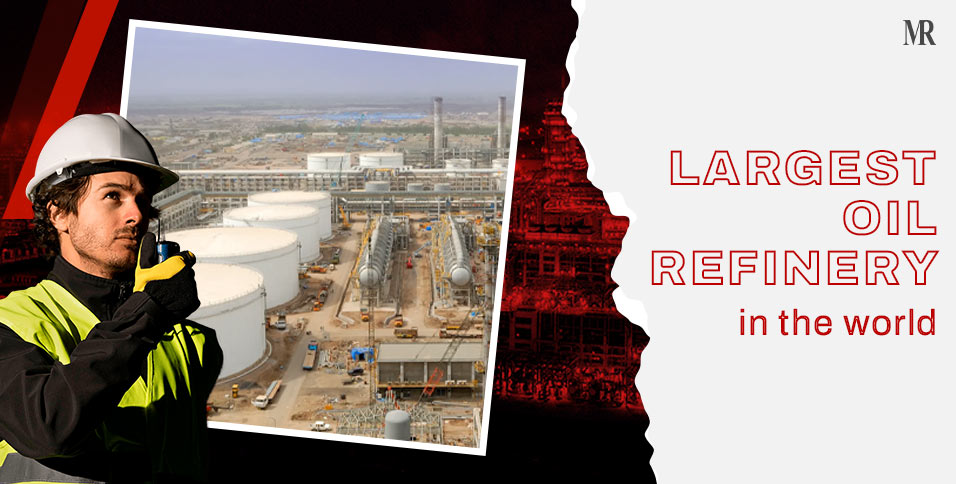
Did you know the Largest Oil Refinery In The World is located in India!?
Yes you read that right!
The Jamnagar Refinery, situated in Gujarat, India, is the largest oil refinery in the world owned by Reliance Industries. This single facility in South Asia has the highest processing capacity of 1.24M bpd and covers a massive area of over 7,500 acres.
This massive complex serves as a backbone for global energy markets, as it not only produces fuel, but it also serves as a massive integrated hub for petrochemicals and advanced materials.
So let’s explore what exactly makes the Jamnagar refinery the biggest in the world!
What Are Oil Refineries?
An oil refinery is an industrial factory that takes raw crude oil from the ground and breaks it down into useful products like gasoline, diesel, and jet fuel.
It acts like a giant chemical kitchen, using heat and pressure to separate the “raw ingredients” into the specific fuels we need to power cars, planes, and homes.
Overview Of The Jamnagar Refinery
| Owner | Reliance Industries |
| Location | Jamnagar, Gujarat, India |
| Global Rank | #1 Largest oil refinery in the world |
| Capacity | 1.24 million bpd |
| Area in acres | 7,500+ acres |
| Complexity Index | 21.1 (highest globally) |
| Crude Types Processed | 200+ grades (heavy & sour crude) |
| Key Products | Petrol, diesel, jet fuel, petrochemicals |
| Integration | Oil-to-Chemicals (O2C) hub |
| Port Facility | VLCC-capable deep-water port |
| Chairman | Mukesh Ambani |
| Future Expansion | Green Energy Giga Complex |
The Vision Behind The Reliance Jamnagar Refinery
When Reliance Industries, led by Mukesh Ambani, decided to build this grassroots refinery in the late 1990s, the goal was to put India on the global energy map.
The first phase of the Jamnagar complex was commissioned in just 30 months. In the world of heavy engineering, this is considered a record-breaking timeline.
Building a “grassroots” facility means starting from an empty plot of land with no existing infrastructure.
Today, that empty plot is a sophisticated industrial city. It features its own dedicated port, a massive power plant, and a complex network of pipelines that move fuel and chemicals across the site and to the coast.
What Makes The Jamnagar Refinery Stand Out
The Jamnagar refinery stands out because of its “Complexity Index.” In simple terms, a refinery’s complexity measures its ability to process lower-quality, cheaper crude oil into high-value products like Euro-VI grade petrol and diesel.
The Jamnagar complex has a complexity index of 21.1. This is the highest in the world. Because of this high technical capability, the refinery can process over 216 different grades of crude oil.
Whether the oil is “heavy” or “sour” (containing high sulfur), Jamnagar can handle it. This gives Reliance a massive financial edge. They can buy the “bottom of the barrel” crude that other refineries cannot use and turn it into the cleanest fuels available.
The World’s Largest Units Under One Roof
The sheer volume of individual units within the Jamnagar refinery is what helps it maintain its status as the Largest Oil Refinery In The World. The facility houses several “world’s largest” titles, including:
- Fluidised Catalytic Cracker (FCC): This unit breaks down heavy oil molecules into lighter, more valuable products like gasoline.
- Paraxylene Complex: Jamnagar hosts the world’s largest Paraxylene (PX) complex with a capacity of 4.6 million metric tonnes per annum (MMTPA).
- Refinery Off-Gas Cracker (ROGC): This is the world’s largest ROGC complex. It uses gases produced during the refining process as “feedstock” to create ethylene, making the petrochemical business highly cost-competitive.
- Petcoke Gasification: Reliance operates the largest petcoke gasifier in the world. This unit takes low-value petroleum coke and turns it into syngas, which powers the refinery and reduces the need for expensive imported natural gas.
Integrated Oil-to-Chemicals (O2C) Strategy
One of the reasons the Jamnagar refinery is so successful is its integration. Reliance does not just stop at making fuel. The O2C business model ensures that every part of the crude oil barrel is used to create value.
The refinery is connected to downstream petrochemical plants that produce polymers, polyesters, and elastomers.
For example, the Paraxylene produced here is the building block for the entire polyester industry. It eventually becomes the clothes you wear or the plastic bottles you use.
By owning the entire chain from the “well to the wardrobe,” Reliance maximizes profit and minimizes waste.
Logistics: The Marine And Port Infrastructure
You cannot run the Largest Oil Refinery In The World without world-class transport. The Jamnagar complex is supported by high-quality logistics assets. This includes a deep-water marine facility that can accommodate the world’s largest ships.
- VLCC Berthing: The port allows Very Large Crude Carriers (VLCCs) to dock and unload millions of barrels of oil directly into the refinery’s storage tanks.
- Product Export: Once the oil is refined, it is loaded onto product vessels and chemical carriers for export to international demand centers.
- Global Trading: Reliance maintains international trading offices to ensure that Jamnagar’s products are sold in the most profitable markets at any given time.
The Role Of Petrochemicals At Jamnagar
Petrochemicals are the invisible backbone of modern life, and Reliance is the largest integrated polyester producer in the world. At Jamnagar, the focus is on creating “Chemistry for Smiles.”
The facility produces:
- Polymers: Like Polypropylene (PP) and Poly Vinyl Chloride (PVC), used in everything from car parts to water pipes.
- Aromatics: Such as Benzene and Toluene, which are essential for medicines and dyes.
- Polyesters: Jamnagar produces the raw materials for “Only Vimal” and other textile brands, making fashion affordable for millions.
Furthermore, the company is currently investing an additional Rs 75,000 crore (US$ 10 billion) to expand these capacities even further. By 2026, they aim to be among the Top 5 producers of PVC globally.
The Future: Dhirubhai Ambani Green Energy Giga Complex
Even as the Largest Oil Refinery In The World, Jamnagar is preparing for a world beyond oil. Reliance has set a target to be net-zero carbon by 2035. To achieve this, the Jamnagar site is hosting a new revolution with the Dhirubhai Ambani Green Energy Giga Complex.
The Dhirubhai Ambani Green Energy Giga Complex is being built over 5,000 acres within the Jamnagar site. This complex will feature four major “Giga Factories”:
- Solar Photovoltaic Factory: To produce high-efficiency solar panels.
- Energy Storage Battery Factory: For grid-scale power storage.
- Electrolyser Factory: To produce Green Hydrogen.
- Fuel Cell Factory: To convert hydrogen into clean electricity.
This shift shows that the Jamnagar refinery area is not just about the “old” energy of oil, but also the “new” energy of the future.
Moreover, the chairman and managing director of Reliance Industries, Mukesh Ambani, has described this transition as a “seva” (service) to save the planet from climate change.
Jamnagar Refinery: Safety And Awards
Running a facility of this size requires an incredible focus on safety and operational excellence.
Over the years, the Jamnagar Manufacturing Division has received numerous awards, including the “Manufacturing ICON Award” and the “Refinery of the Year” award from the Federation of Indian Petroleum Industry (FIPI).
In 2012, the Discovery Channel even listed it among the world’s top five manufacturing units.
These awards highlight that Jamnagar is not just about quantity; it is about quality, safety, and leading the industry in project management.
Comparison: Top 10 Largest Oil Refinery In The World
While Jamnagar holds the title of the largest oil refinery in the world, it is interesting to see how it compares to other global giants. Many of the other largest refineries are located in Asia, particularly South Korea.
| Rank | Refinery Name | Country | Capacity (Approx. BPD) |
| 1 | Jamnagar Refinery (Reliance) | India | 1,240,000 |
| 2 | Paraguana Refinery Complex | Venezuela | 940,000 |
| 3 | SK Energy Ulsan Refinery | South Korea | 840,000 |
| 4 | GS Caltex Yeosu Refinery | South Korea | 800,000 |
| 5 | S-Oil Onsan Refinery | South Korea | 669,000 |
| 6 | Motiva Port Arthur Refinery | USA | 630,000 |
| 7 | ExxonMobil Singapore Refinery | Singapore | 592,000 |
| 8 | Garyville Refinery (Marathon) | USA | 578,000 |
| 9 | ExxonMobil Baytown Refinery | USA | 560,000 |
| 10 | Ras Tanura Refinery | Saudi Arabia | 550,000 |
End Note
The Largest Oil Refinery In The World is a testament to what can be achieved with a long-term vision and technical expertise.
The Jamnagar refinery has turned India into a global refining hub. By processing 1.24 million barrels of oil every day, it ensures energy security and drives economic growth.
As it transitions into the Dhirubhai Ambani Green Energy Giga Complex, it will likely remain the most important energy site in the world for decades to come.
Whether through traditional fuel or green hydrogen, Jamnagar is where the future of energy is being built.
Maria Isabel Rodrigues
FAQs
- The world’s largest oil refinery is in which country?
The Jamnagar Refinery complex, the world’s largest oil refinery, is located in the state of Gujarat, India. It has a capacity of 1.24 million bpd and covers an area of over 7,500 acres.
- Which is the 2nd largest oil Refinery in the world?
The Paraguana Refinery Complex in Venezuela is technically the second largest by design capacity (940,000 bpd), though the Ulsan Refinery in South Korea often has higher consistent operational throughput.
- What are the top 5 oil refineries?
The top five refineries are Jamnagar (India), Paraguana (Venezuela), Ulsan (South Korea), Yeosu (South Korea), and Onsan (South Korea).
- Who owned 90% of the oil industry?
In the late 19th century, John D. Rockefeller’s Standard Oil Company owned approximately 90% of the oil industry in the United States before it was broken up by anti-trust laws.