The global electronics manufacturing services (EMS) industry is bigger than ever, valued at $648.11 billion in 2025, with AI hardware, data center infrastructure, electric vehicles, and smart manufacturing increasing demand worldwide.
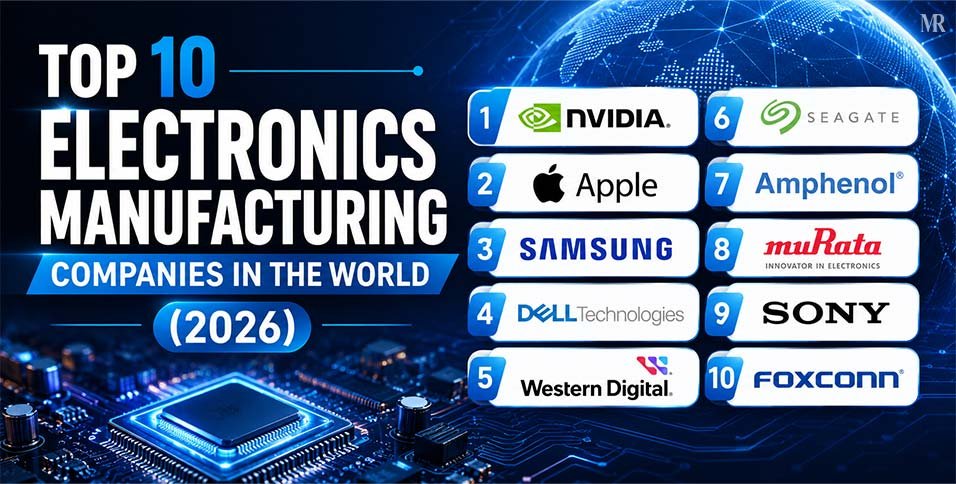
The top 10 electronics manufacturing companies in the world in 2026 are NVIDIA, Apple, Samsung Electronics, Dell Technologies, Western Digital, Seagate Technology, Amphenol, Murata Manufacturing, Sony, and Foxconn, ranked primarily by market capitalization and their influence across the global electronics supply chain.
From chip designers to contract manufacturers, these companies are changing what the world’s devices look, feel, and run like.
In this listicle you’ll find what makes each company stand out, what they build, and why they belong on this list.
What are Electronics Manufacturing Companies?
Electronics manufacturing companies design, produce, or assemble electronic products and components used in consumer devices, enterprise infrastructure, automotive systems, healthcare equipment, and industrial applications. Their products range from semiconductors and printed circuit boards (PCBs) to smartphones, servers, storage devices, sensors, and networking equipment. Many also provide Electronics Manufacturing Services (EMS), assembling products for global technology brands.
List of the Top 10 Electronics Manufacturing Companies 2026
| Company | Country | Market Cap (2026) | Key Strength |
| 1. NVIDIA | USA | ~$4.8T | AI GPUs & Data Center |
| 2. Apple | USA | ~$4T | Consumer Electronics & Ecosystem |
| 3. Samsung Electronics | South Korea | ~$1.4T | Memory, Displays & Devices |
| 4. Dell Technologies | USA | ~$264.5B | Enterprise PCs & Servers |
| 5. Western Digital | USA | ~$232.7B | Data Storage Solutions |
| 6. Seagate Technology | Ireland | ~$230B | HDD & AI Storage |
| 7. Amphenol | USA | ~$203B | Electronic Connectors |
| 8. Murata Manufacturing | Japan | ~$121B | Electronic Components |
| 9. Sony | Japan | ~$113.8B | Image Sensors & Entertainment |
| 10. Foxconn | Taiwan | ~$109.3B | EMS Contract Manufacturer |
1. NVIDIA — The AI Chip Powerhouse
What NVIDIA Does:
NVIDIA designs graphics processing units (GPUs), the specialized chips that run everything from video games to large-scale AI models. Unlike traditional CPUs that handle tasks one at a time, GPUs can run thousands of operations in parallel, which makes them ideal for AI training and inference.
Why It’s #1 on This List?
NVIDIA holds the top spot by a wide margin. As of mid-2026, its market cap sits at around $4.8 trillion, which is the highest of any electronics company in the world. Revenue tells an equally striking story:
- FY2026 (ending January 2026): $215.9 billion, a 65% year-over-year increase
- Q3 FY2027 (ending April 2026): $81.6 billion, up 85% year-over-year
- Data Center revenue alone hit $75.2 billion in Q3 FY2027, driven by the Blackwell platform architecture
Its Blackwell GPU platform is currently the most sought-after piece of AI hardware on the planet. As CEO Jensen Huang put it: “Blackwell sales are off the charts, and cloud GPUs are sold out.” Hyperscalers like AWS, Microsoft Azure, Google Cloud, and Oracle are all deploying Blackwell systems at scale to serve AI workloads.
NVIDIA is the defining name in semiconductor manufacturing for AI. Its CUDA software ecosystem locks developers in, and its data center infrastructure business is growing exponentially. The company also partners with automakers for autonomous driving compute through the DRIVE AGX platform.
2. Apple — Consumer Electronics’ Most Profitable Brand
What Apple Does:
Apple designs and markets consumer electronics like iPhones, Macs, iPads, wearables, and a growing suite of software services. While Apple outsources much of its manufacturing to contract firms like Foxconn, it designs its own silicon (Apple M-series chips) and controls the full user experience from hardware to OS to app store.
Why It’s #2 on This List?
Apple closed FY2025 with $416 billion in total revenue, the highest in its history, up 6.4% from $391 billion in FY2024. Its market cap hovers around $4 trillion, making it one of the most valuable companies in human history. Net income reached $112 billion, with a 27% net margin.
- iPhone continues to drive roughly 50% of total revenue
- Services (App Store, iCloud, Apple TV+) hit an all-time high in FY2025
- The M5-powered MacBook Pro and iPad Pro launched in late 2025, driving Mac and iPad sales
Apple Intelligence, the company’s push into on-device AI, is now available across its product lineup and is expected to push upgrade cycles in 2026 as users seek AI-capable hardware.
Apple is also a major player in the global electronics supply chain. Its demand for components like displays, memory chips, image sensors, and connectors directly shapes the revenues of other electronics manufacturers on this list of the top electronics manufacturing companies, including Samsung and Sony.
3. Samsung Electronics — The Vertically Integrated Giant
What Samsung Does:
Samsung Electronics is arguably the most diversified electronics manufacturer in the world. It makes memory chips (DRAM and NAND), display panels (OLED and LCD), smartphones, televisions, home appliances, and foundry-produced semiconductors, all under one roof. That vertical integration is its core competitive advantage.
Why It’s #3 on This List?
Samsung reported KRW 333.6 trillion (approximately $233 billion) in FY2025 revenue, a 10.9% increase from the prior year, and KRW 43.6 trillion in operating profit, a 560% recovery from the FY2023 low of KRW 6.6 trillion. Q4 2025 was its highest-ever quarterly revenue at KRW 93.8 trillion.
- The second-largest chip vendor in the world with a 9.1% market share
- Shipped 241.2 million smartphones in 2025 for a 19.1% global market share
- Held 29.1% of the global TV market and ranked #1 for 20 consecutive years
- Spent KRW 37.7 trillion (~$25.5 billion) on R&D in 2025 — a new record
Samsung’s HBM (High-Bandwidth Memory) products, which are critical for AI GPU systems, are now qualified at NVIDIA and Broadcom, giving it a solid position in the AI memory boom. The Galaxy S26 series launched in early 2026 with Agentic AI features that aim to extend Samsung’s lead in Android flagship smartphones.
Samsung is the rare company that is both a supplier to and a competitor of Apple. It manufactures components (displays, memory) that go into iPhones while competing directly in the smartphone market with its Galaxy lineup.
4. Dell Technologies — The Enterprise Electronics Stalwart
What Dell Does:
Dell designs and sells PCs, laptops, servers, storage systems, and networking infrastructure primarily to businesses and enterprises. It is one of the longest-standing names in the electronics manufacturing industry and has transformed from a PC manufacturer into one of the world’s leading providers of enterprise infrastructure.
Why It’s on This List?
As of 2026, Dell has a market capitalization of approximately $264.5 billion, supported by strong demand for AI-optimized servers and data center solutions. Moreover, Dell reported $95.6 billion in fiscal 2025 revenue, up 8% year over year, while operating income increased 15% to $6.2 billion.
- Infrastructure Solutions Group revenue reached $43.6 billion, increasing 29% year over year.
- Servers and Networking revenue hit a record $6.6 billion in Q4 FY2025, up 37%, driven by AI server deployments.
- Dell ended FY2025 with an AI server backlog of approximately $9 billion, supported by strong enterprise and hyperscaler demand for NVIDIA-powered infrastructure.
Dell is one of the clearest examples of how the line between electronics manufacturer and IT solutions provider has blurred. Enterprise electronics today includes AI servers, data storage racks, and edge computing hardware and not just PCs.
5. Western Digital — The Data Storage Specialist
What Western Digital Does:
Western Digital makes hard disk drives (HDDs) and solid-state drives (SSDs) for consumers, businesses, and cloud data centers. It has over a dozen manufacturing and assembly facilities and around 50,000 employees across 36 countries.
Why It’s on This List
Western Digital has become one of the world’s most important data storage manufacturers, supplying high-capacity hard disk drives (HDDs) that power hyperscale data centers, cloud platforms, and enterprise AI infrastructure. With a market capitalization of approximately $232.7 billion in 2026, the company is benefiting from the explosive growth in AI-generated data and enterprise storage demand.
- Q3 FY2026 revenue reached $3.34 billion, increasing 45% year over year.
- Targets AI-optimized HDD redesigns to serve next-generation data centers
- AI-driven storage demand continues to accelerate, with CEO Irving Tan noting that “virtually every AI workload, from training, inference, agentic AI to physical AI, creates data that is stored persistently and cost-efficiently on HDDs.”
Western Digital sits in the electronic component manufacturer category alongside Seagate. Both companies are key players in the data center supply chain, which has become as critical as consumer electronics in the modern economy.
6. Seagate Technology — AI-Powered Storage Innovation
What Seagate Does:
Seagate Technology is one of the world’s leading manufacturers of mass-capacity data storage solutions, supplying hard disk drives (HDDs) that power hyperscale cloud providers, enterprise data centers, and AI infrastructure. Its EAVS (enhanced automated vision system) reduced manufacturing defects by 60% and saved millions in operational costs.
Why It’s on This List?
Like Western Digital, Seagate benefits from the explosion of data generated by AI, IoT, and streaming. The company’s focus on high-capacity, data center-grade HDDs makes it a direct supplier to the hyperscalers driving AI infrastructure investment. Market cap sits around $230 billion in 2026.
- Q3 FY2026 revenue reached $3.11 billion, up 44% year over year.
- Seagate continues advancing its Mozaic HAMR (Heat-Assisted Magnetic Recording) platform, enabling significantly higher storage densities to meet the growing demands of AI data centers and cloud infrastructure.
Seagate and Western Digital are often viewed together, but they have distinct manufacturing approaches. Seagate is more vertically integrated in HDD components, while Western Digital has a stronger SSD presence. Both are essential parts of the global electronics supply chain and therefore make it to this list of the best electronics manufacturing companies .
7. Amphenol — The Connector That Holds the Industry Together
What Amphenol Does:
Amphenol makes connectors, sensors, and cable assemblies, which are the physical interfaces that link components inside electronic systems. These might seem like simple parts, but without high-quality connectors, no circuit board, server rack, or device functions reliably. The company has around 50 manufacturing locations in China alone, plus major facilities in the US and globally.
Why It’s on This List?
Amphenol’s market cap sits around $203 billion in 2026. It is one of the largest electronic component manufacturers in the world and supplies across sectors, including defense, aerospace, automotive, data centers, and consumer electronics. Its Amphenol Aerospace division in New York produces high-reliability connectors for defense applications.
- FY2025 sales reached a record $23.1 billion, increasing 52% year over year, driven by strong organic growth across virtually all end markets.
- Amphenol completed five acquisitions in 2025, including Trexon, and closed the acquisition of CommScope’s Connectivity & Cable Solutions (CCS) business in early 2026, significantly expanding its fiber-optic and connectivity portfolio.
Electronic connector manufacturers like Amphenol are the unsung heroes of the electronics manufacturing industry. Their products are inside virtually every device on this list, from NVIDIA’s Blackwell servers to Apple’s iPhone. This makes Amphenol a picks-and-shovels play in the global electronics boom.
8. Murata Manufacturing — The Quiet Giant of Electronic Components
What Murata Does:
Murata Manufacturing is a Japanese company that produces passive electronic components, particularly MLCCs (multi-layer ceramic capacitors), inductors, and sensors. These tiny parts regulate current and filter signals inside virtually every modern electronic device. You’ve almost certainly never heard of Murata, but the device you’re reading this on likely contains its components.
Why It’s on This List?
Murata holds a dominant position in MLCC production globally. As electronics become smaller, more powerful, and more connected, the demand for high-quality passive components increases proportionally. Murata’s market cap is around $121 billion in 2026, and its components are embedded in smartphones, EVs, medical devices, and AI hardware alike.
- FY2026 revenue is forecast to reach ¥1.96 trillion (~$13.5 billion), supported by stronger demand across AI infrastructure, automotive, and industrial markets.
- Murata expects continued growth in MLCCs, power modules, and data center-related electronic components, fueled by AI servers, electric vehicles, and next-generation communication technologies.
Murata operates deep in the electronics supply chain. It’s an electronic component manufacturer in the truest sense, one that most consumers never encounter directly but one that the entire industry depends on. The shift toward electrification and connectivity is a structural tailwind for Murata’s business.
9. Sony — The Image Sensor Leader and Entertainment Powerhouse
What Sony Does:
Sony operates across consumer electronics, gaming, entertainment, and semiconductors. Its PlayStation gaming consoles have a massive global fanbase. But Sony’s most strategically important product might actually be its CMOS image sensors, the tiny chips inside most of the world’s smartphone cameras.
Why It’s on This List?
Sony holds over 40% of the global image sensor market. Nearly every major smartphone brand, like Apple, Samsung, Google, and Xiaomi, relies on Sony sensors for their camera systems. This component business gives Sony a durable revenue stream regardless of which device brand is winning at retail.
- Sony reported record FY2025 sales of ¥13.0 trillion (~$90 billion) and operating income of ¥1.4 trillion (~$9.7 billion), marking its highest-ever operating profit.
- Sony’s Imaging & Sensing Solutions business continues to lead the global CMOS image sensor market, supplying advanced sensors for premium smartphones, automotive cameras, and industrial applications.
Sony’s market cap sits at around $113.8 billion in 2026, reflecting its hybrid identity as both a consumer brand and a critical B2B component supplier.
Sony’s dual role as both an end-product manufacturer and a component manufacturer is relatively unique in the electronics industry. This vertical depth gives it pricing power and insulation from consumer market swings.
10. Foxconn (Hon Hai Precision Industry) — The World’s Largest Contract Manufacturer
What Foxconn does:
Foxconn is an electronics manufacturing services (EMS) company. In plain terms, it builds devices for other companies. Apple’s iPhones, NVIDIA’s AI servers, and countless other products are assembled by Foxconn’s workforce of over 1.3 million employees across factories in Taiwan, China, Vietnam, India, and beyond.
Why It’s on This List?
Foxconn posted full-year 2025 revenue of NT$8.1 trillion (approximately $250 billion), an 18% increase over 2024. Its Q4 2025 alone hit NT$2.6 trillion ($83 billion), exceeding analyst expectations by a significant margin.
- The AI server and cloud infrastructure segment drove most of the growth
- Foxconn signed a partnership with OpenAI in November 2025 to co-develop next-gen AI hardware
- It is partnering with NVIDIA and the Taiwanese government to build a major AI factory in Taiwan
Foxconn represents the manufacturing backbone of the electronics world. When Apple or NVIDIA announces a new product, it’s often Foxconn that has to figure out how to build millions of units quickly and reliably.
The EMS industry, which Foxconn leads, is distinct from original equipment manufacturers (OEMs) like Apple or Samsung. EMS companies don’t sell products to end consumers; they build products on behalf of brands that own the IP and marketing. Foxconn’s shift into AI server manufacturing marks a significant evolution beyond consumer electronics assembly.
What’s Driving the Electronics Manufacturing Industry in 2026?
A few trends are reshaping the electronics manufacturing companies on this list and the manufacturing industry at large.
- AI Infrastructure and High-Performance Computing
Artificial intelligence remains the biggest catalyst for electronics demand. Cloud providers including AWS, Microsoft Azure, Google Cloud, and Meta continue investing billions of dollars in AI data centers, driving demand for GPUs, high-bandwidth memory (HBM), storage systems, networking equipment, and advanced electronic components. Companies like NVIDIA, Samsung Electronics, Western Digital, Seagate, Amphenol, and Foxconn are among the biggest beneficiaries.
- The Semiconductor Market
The semiconductor industry is entering another growth cycle as AI, automotive electronics, industrial automation, and connected devices fuel demand for advanced chips. Manufacturers are investing heavily in memory, logic chips, advanced packaging, and semiconductor fabrication equipment, benefiting companies throughout the electronics supply chain.
- Smart Manufacturing and Industry 4.0
Electronics manufacturers are increasingly adopting robotics, AI-powered quality inspection, digital twins, and factory automation to improve efficiency and reduce defects. Smart factories enable faster production, predictive maintenance, and greater flexibility, making manufacturing more resilient and cost-effective.
- Supply Chain Diversification
To reduce geopolitical risks and improve supply chain resilience, manufacturers continue expanding production beyond China into countries such as India, Vietnam, Thailand, Malaysia, and Mexico. Many global electronics companies are building regional manufacturing hubs to better serve international markets while minimizing supply disruptions.
- 5G, IoT, and Edge Computing
The continued rollout of 5G networks and connected devices is increasing demand for networking hardware, optical communication equipment, sensors, storage devices, and electronic components. As more computing moves closer to end users, electronics manufacturers are developing specialized hardware designed for edge AI and industrial IoT applications.
- Electric Vehicles and Automotive Electronics
Electric vehicles require significantly more electronic components than conventional vehicles, creating new opportunities for semiconductor manufacturers, connector suppliers, sensor makers, and passive component manufacturers. This trend continues to support companies such as Murata Manufacturing, Amphenol, Samsung Electronics, and Sony.
Final Thoughts
The top 10 electronics manufacturing companies in the world in 2026 reflect a sector in the middle of a major transformation. It’s no longer just about who sells the most phones or laptops. The real value is shifting toward AI chips, data center infrastructure, advanced memory, and the components that make everything work.
NVIDIA sits at the top because it built the hardware backbone of the AI era. Apple leads consumer electronics with unmatched brand loyalty and profitability. Samsung holds the middle, a supplier to its rivals and a competitor in their markets. And companies like Foxconn, Amphenol, and Murata quietly power the entire ecosystem from behind the scenes.
Together, these electronics manufacturing companies form the backbone of global technology, and their influence will only grow as AI, 5G, and electrification reshape every industry on earth.
Maria Isabel Rodrigues