In 2026, the global motorcycle industry is valued at approximately $78.58 billion, and demand isn’t slowing down. Whether it’s affordable commuters in India, sports bikes in Europe, or electric two-wheelers on the rise everywhere, the world’s biggest motorcycle manufacturers are competing on scale, innovation, and global reach.
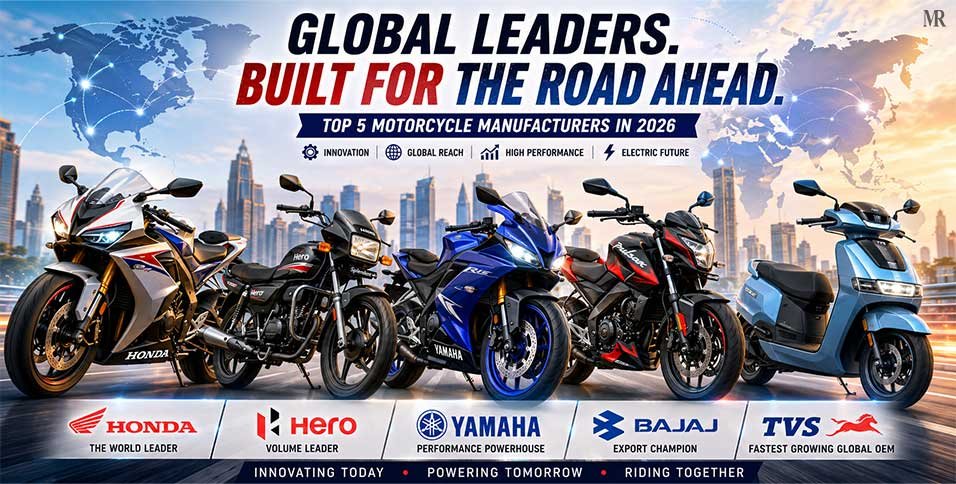
Honda, Hero MotoCorp, Yamaha Motor, Bajaj Auto, and TVS Motor are among the biggest motorcycle manufacturers in the world in 2026, leading the industry in revenue, production volume, and global market presence.
In this article, we rank the top 5 motorcycle manufacturers with a clear, data-backed look at each company, where they started, what they sell, and why they matter.
How We Ranked the Top Motorcycle Manufacturers
There’s no single way to rank the biggest motorcycle companies. Some lead in volume, others in revenue or exports. We ranked these motorcycle manufacturers by a combination of these factors:
- Annual revenue and profitability
- Motorcycle sales volume (units sold globally)
- Manufacturing scale and global footprint
- Export reach and international market presence
- Brand portfolio strength and innovations
These factors together give a well-rounded picture of who the largest and most influential two-wheeler manufacturers are in 2026.
List of the Top 5 Motorcycle Manufacturers in the World (2026)
| Company | HQ | Founded | Best-Known Models | Key Strength |
| 1. Honda | Japan | 1948 | CB Series, Gold Wing, Africa Twin | World’s largest by production & volume |
| 2. Hero MotoCorp | India | 1984 | Splendor, HF Deluxe, Xtreme 125R | 25 consecutive years as global #1 by units |
| 3. Yamaha Motor | Japan | 1955 | MT Series, YZF-R1, FZ | Strong sports & commuter lineup across 180+ markets |
| 4. Bajaj Auto | India | 1945 | Pulsar, Dominar, Chetak EV | India’s largest two-wheeler exporter |
| 5. TVS Motor | India | 1978 | Apache, Jupiter, iQube EV | Fastest-growing Indian OEM with 90+ country reach |
1. Honda — The Undisputed World Leader
Honda Motor Co. is the world’s largest motorcycle manufacturer, and it has held that title for decades. The company was founded in 1948 by Soichiro Honda in Hamamatsu, Japan. Honda’s origin story is almost cinematic: a small post-war workshop that made motorized bicycles from surplus military engines grew into a global giant that now sells motorcycles on every continent.
Honda went into motorcycles before cars, and that focus on two-wheelers is still very much alive. The motorcycle division consistently outperforms Honda’s automobile segment in operating margin, making it the group’s most profitable business unit.
Sales & Revenue
Honda sold a record 20.7 million motorcycles in 2025, a 4.9% increase year-on-year and the highest annual figure in the company’s history. In FY2026 (ending March 31, 2026), motorcycle revenue came in at ¥4,018.8 billion (~$27 billion USD), making it a standalone revenue stream bigger than many entire automakers. Honda holds approximately 40% global motorcycle market share, a figure that’s hard to overstate.
Best-Selling Motorcycles
- Honda Activa (dominates the Indian scooter market)
- CB Shine / CB Unicorn (reliable commuter workhorses across Asia)
- Honda CB Series (CB300R, CB500F) (strong in Europe and developed markets)
- Africa Twin (adventure touring benchmark globally)
- Gold Wing (premium touring icon for the North American market)
What Makes Honda Stand Out
Honda not only leads in volume, but it also leads in engine reliability engineering among motorcycle manufacturers. The brand’s DOHC (Double Overhead Cam) and PGM-FI (Programmed Fuel Injection) technologies are widely copied across the industry. Honda operates manufacturing plants in 23 countries and sells motorcycles in over 150 markets. That kind of footprint is unmatched.
On the electric front, Honda has committed to launching 30 EV models globally by 2030, including electric motorcycles and scooters under its EM series. In India, the world’s largest two-wheeler market, Honda is gunning to overtake Hero MotoCorp in volume, having posted strong consecutive growth.
2. Hero MotoCorp — 25 Years at the Top by Volume
Hero MotoCorp is the world’s largest two-wheeler manufacturer by unit sales, and it has held that title for 25 consecutive years. Based in New Delhi, India, the company was founded in 1984 as a joint venture between Hero Cycles and Honda of Japan, originally known as Hero Honda. In 2011, Honda exited the partnership. The Munjal family, Hero’s founding promoters, took full control and rebranded the company as Hero MotoCorp in 2012.
The rationale behind the original joint venture was simple: combine Hero’s distribution muscle in India with Honda’s engineering know-how. That foundation built one of the most recognizable motorcycle brands in the developing world. Today, the Munjal family holds around a 34.7% stake in the company.
Sales & Revenue
FY2025-26 was a landmark year for Hero MotoCorp. The company sold 6.469 million units, its best-ever annual volume, with revenue from operations reaching ₹46,830 crore (~$5.6 billion USD) and net profit at ₹5,268 crore, up significantly year-on-year.
Hero’s domestic share in the Indian motorcycle market sits at around 32%, and the company dispatched 5.70 lakh units in May 2026 alone, reflecting strong ongoing momentum.
Best-Selling Motorcycles
- Splendor (India’s best-selling motorcycle, year after year)
- HF Deluxe (budget commuter with massive rural and semi-urban demand)
- Xtreme 125R (growing fast in the entry-premium segment)
- Mavrick 440 (Hero’s mid-weight entry competing with Royal Enfield)
- Vida V1 / V2 (electric scooters with 11.2% market share in India’s EV segment)
What Makes Hero MotoCorp Stand Out
Hero’s strength is its distribution. The company runs one of the world’s largest two-wheeler dealer networks, with 9,000+ touchpoints across India. This reach gives it unmatched access to rural and semi-urban buyers, the segments that drive the bulk of India’s two-wheeler volume.
Internationally, Hero is now present in 52 countries, with global dispatch volumes growing 40% year-on-year in FY2026. The company has entered Europe and the UK, and its electric brand VIDA saw 190% growth in FY2026 retail sales, claiming an 11.2% EV market share in India.
Hero has also made a strategic investment in California-based Zero Motorcycles, one of the leading electric motorcycle startups globally, and the two companies are co-developing new EV models. Flex-fuel motorcycles are also set to roll out from July 2026, a first for India.
3. Yamaha Motor — The Sports and Performance Powerhouse
Yamaha Motor Co., Ltd. was established in 1955 as a spin-off from Yamaha Corporation, the Japanese music and electronics giant. While Yamaha Corp. makes pianos and audio equipment, Yamaha Motor operates as an independent company focused entirely on motorized products with motorcycles at the core.
The split might seem unusual, but the brand equity has been entirely distinct for decades. Yamaha Motor is known globally for its racing pedigree, engineering precision, and a portfolio that spans affordable 100cc commuters in Indonesia to high-performance superbikes in Europe and the US.
Sales & Revenue
Yamaha Motor reported full-year 2025 consolidated revenue of ¥2,534.2 billion (approximately US$17 billion). The company’s Land Mobility business, which includes motorcycles, generated ¥1,615.1 billion in revenue, remaining Yamaha’s largest business segment.
Despite production disruptions in Vietnam, motorcycle demand stayed firm with growth in Indonesia, the Philippines, and Thailand. Yamaha continues to sell motorcycles in over 180 countries and manufactures them across major markets including Japan, India, Indonesia, Thailand, and Brazil.
Best-Selling Motorcycles
- Yamaha FZ Series (FZ-S, FZ25) is a popular commuter in India and South Asia
- Yamaha MT Series (MT-07, MT-09) is an European street bestsellers
- Yamaha YZF-R1 is a flagship superbike, a racing icon
- Yamaha R15 is an entry sports bike hugely popular across Southeast Asia
- Yamaha NMAX / Aerox are scooters leading in ASEAN markets
What Makes Yamaha Motor Stand Out
In contrast to other motorcycle manufacturers, Yamaha’s real advantage is its balance between sports and commuter markets. Most manufacturers are strong in one. Yamaha does both well. The Yamaha R-series bikes are a staple of track days and racing events worldwide, while the FZ series is one of the best-selling 150cc bikes in Asia.
On technology, Yamaha has invested in connected motorcycle platforms, variable valve actuation (VCT) systems, and electric mobility. The company has launched e-scooters in Europe and Asia. Yamaha also benefits from a premium brand perception that lets it charge higher prices in developed markets protecting margins even when volumes soften.
4. Bajaj Auto — India’s Export Champion
Bajaj Auto was founded in 1945 in Pune, India, initially as an importer of Vespa scooters. By the 1970s, Bajaj was manufacturing its own two- and three-wheelers, becoming a household name in India. The company restructured significantly in the 2000s under Rajiv Bajaj’s leadership, exiting the scooter segment entirely to focus on motorcycles, where it could build a credible global position.
That bet paid off. Bajaj today is the second-largest motorcycle manufacturer in India by domestic volumes and the country’s largest exporter of two-wheelers and three-wheelers. The Bajaj Group controls around 55% of Bajaj Auto’s stock, with the Bajaj family holding promoter control.
Sales & Revenue
Bajaj Auto’s FY2026 automotive revenue grew to ₹60,530 crore (~$7.2 billion USD), a 21% increase year-on-year. Net profit touched ₹10,574 crore. In May 2026 alone, Bajaj sold 4.61 lakh total units, up 20% year-on-year, with exports surging 57% in the April–May 2026 period.
Internationally, Bajaj holds around 31% of its total volume from exports, with a presence in Africa, Latin America, and Southeast Asia. It’s the strongest Indian OEM in international markets by export volume.
Best-Selling Motorcycles
- Pulsar Series (NS200, RS200, N160): Bajaj’s backbone, dominant in the 150–200cc premium commuter space
- Dominar 400: Performance tourer at an accessible price
- Bajaj Platina: A high-volume commuter bike for budget buyers
- Chetak EV:: Bajaj’s flagship electric scooter, growing fast at 200,785 units in CY2025
- KTM (Duke, RC Series): Through Bajaj’s 48.77% stake in KTM AG
- Triumph Motorcycles (Street Twin, Tiger) via manufacturing partnership, now sold globally
What Makes Bajaj Auto Stand Out
Bajaj’s biggest advantage is its partnership architecture. Through its KTM stake and Triumph manufacturing deal, Bajaj produces and distributes premium European motorcycle brands at competitive price points. This has opened doors in European and North American markets that were previously out of reach for an Indian manufacturer.
On the EV side, Bajaj’s Chetak scooter emerged as the second-largest electric two-wheeler brand in India in CY2025 with a 16% market share. The company is launching new EV models in 2026 and expanding Chetak’s retail network aggressively.
Three-wheelers, the iconic autorickshaw, also remain a major global revenue driver. Bajaj is the world’s largest three-wheeler producer and leads in exports to Africa and South Asia.
5. TVS Motor — India’s Fastest-Growing Global OEM
TVS Motor Company was founded in 1978 in Hosur, Tamil Nadu, India, as part of the TVS Group, a diversified Indian conglomerate with roots in automobile distribution dating back to 1911. TVS Motor started as a joint venture with Suzuki before going independent in 2001. Since then, it has grown into India’s third-largest two-wheeler manufacturer and one of the fastest-expanding motorcycle manufacturers globally.
TVS stands out among Indian manufacturers for the breadth of its premium portfolio and its appetite for international acquisitions. The 2017 acquisition of Norton Motorcycles, Britain’s iconic motorcycle brand, gave TVS a foothold in the premium Western market. It also owns TVS Ebike Company AG in Europe, focused on e-bikes.
Sales & Revenue
FY2025-26 was TVS Motor’s best year ever. Revenue hit a record ₹47,270 crore (~$5.7 billion USD), up 30% year-on-year. Total unit sales reached 5.89 million units (up 24%), with operating PBT growing 40% to ₹4,975 crore. EBITDA margin improved to 12.9%.
In May 2026, TVS set a new all-time monthly sales record of 5.66 lakh units, a 31% jump year-on-year. Exports rose 49% to 1.75 lakh units in the same month, reflecting strong international momentum.
Best-Selling Motorcycles
- Apache RTR Series (160, 200, 310): TVS’s premium sports bike lineup, strong in India and Southeast Asia
- TVS Raider 125: Fastest-selling 125cc launch in India when introduced
- Jupiter: India’s number-two scooter by sales volume
- Ntorq 125: Connected, sporty scooter popular with younger buyers
- TVS iQube EV: Leading electric scooter, 3.71 lakh units sold in FY2026
- Norton V4CR / Commando (via Norton Motorcycles): A premium café racer and classic models for Western markets
What Makes TVS Motor Stand Out
TVS punches above its weight globally. With operations or distribution in over 90 countries and manufacturing plants in India and Indonesia, it has the widest geographic reach of any Indian two-wheeler OEM.
Its EV strategy is particularly sharp. TVS iQube recorded 3.71 lakh units in FY2026 and the company now has over 9 lakh EV customers globally. TVS topped India’s EV two-wheeler chart for CY2025 with 298,967 units, ending Ola Electric’s three-year streak at the top.
R&D spending hit ₹1,024 crore in FY2025, up 59% year-on-year, reflecting its push toward connected mobility, advanced drivetrains, and next-gen platforms. Norton Motorcycles is also being revived under TVS ownership, with new models in production and global distribution expanding.
Why Are Other Famous Motorcycle Brands Not on This List?
Many well-known motorcycle brands, including Royal Enfield, Harley-Davidson, Ducati, Indian Motorcycle, Jawa Moto, BMW Motorrad, and KTM, are highly recognizable and have passionate fan bases. However, this ranking is based on overall manufacturing scale, revenue, and global sales volume, not brand prestige or heritage.
While these companies excel in premium, performance, or niche segments, they produce and sell far fewer motorcycles than industry giants such as Honda, Hero MotoCorp, Yamaha, Bajaj Auto, and TVS Motor, which dominate the global mass-market two-wheeler industry.
Key Trends Shaping the Global Motorcycle Industry in 2026
The two-wheeler industry is changing fast. Here’s what’s driving the shift among these top manufacturing companies:
- Electric Motorcycles Are Growing Fast
India’s EV two-wheeler market crossed 1.28 million units in CY2025 (up 11%). Hero, Bajaj, TVS, and newer players like Ather and Ola Electric are all racing to establish EV leadership before the market consolidates.
- India Is the World’s Manufacturing Hub
India produced over 20 million two-wheelers in 2025, making it the world’s largest two-wheeler market. Hero, Bajaj, and TVS all export aggressively from India, with exports growing at double-digit rates in 2025–26.
- Premium Segments Are Growing
Across all markets, buyers are trading up. Entry-level commuters are still the volume base, but 200cc+ motorcycles, adventure bikes, and sports segments are where margins are improving. Bajaj-KTM, TVS-Norton, and Yamaha all benefit here.
- Connected Motorcycles Are Becoming Standard
Bluetooth connectivity, GPS tracking, OTA software updates, and ride analytics are now features even mid-range bikes offer. TVS and Yamaha have invested heavily in connected platforms.
- Asia-Pacific Dominates, But Africa Is Rising
ASEAN remains the core market for volume, but Africa and Latin America are the next frontiers for growth. Bajaj leads in African exports; Hero and TVS are both expanding aggressively in the region.
End Note
The world’s biggest motorcycle manufacturers in 2026 reflect a clear split in how companies compete.
Honda leads globally by every measure, be it production, revenue, market share. Hero MotoCorp holds the volume crown with 25 straight years of unit leadership. Yamaha Motor balances sports heritage with emerging market scale. And Bajaj Auto and TVS Motor are rewriting what Indian global motorcycle manufacturers look like, with record revenues, export dominance, and increasingly credible EV strategies.
The two-wheeler industry is entering its most competitive decade yet. Electric mobility, premium market expansion, and rising exports from India are reshaping the rankings, and the companies that move fastest on these fronts will define who leads global motorcycle manufacturing in 2030.
Maria Isabel Rodrigues
FAQs
- Who are the largest motorcycle manufacturers by market cap?
In 2026, TVS Motor ($17.38 B), Hero MotoCorp ($17.38 B), Yamaha Motor ($17.38 B), Harley-Davidson ($2.59 B), and Fly-E Group ($3.52 M) are the largest motorcycle manufacturers by market cap.
- Who is the biggest motorcycle manufacturer by revenue?
In FY2025, Honda’s Motorcycle Business generated ¥3.63 trillion (3,626.6 billion yen) in sales revenue, making it the largest motorcycle business globally by revenue.