Feeling that sting every time you pull up to the gas station? Yeah, we’ve all been there. But what if I told you the key to slashing those fuel bills and giving our planet a much-needed breather isn’t some futuristic fantasy? It’s right here, right now, in the amazing world of fuel efficient cars.
Forget everything you think you know, because this isn’t just another technical manual. We’re about to embark on a thrilling journey together! We’ll peel back the hood on the incredible tech that powers these machines, get up close and personal with the superstar models of 2025, and I’ll even let you in on some simple driving secrets that make every single drop of fuel count. Imagine feeling smart, in control, and genuinely excited every time you get behind the wheel. That’s the destination.
Ready to become a fuel-saving champion? Let’s go!
1. What Are Fuel Efficient Cars? A Modern Definition
So, what are we really talking about here? Let’s clear something up: “fuel-efficient” is way more than just “good gas mileage.”
- Think of it like this: a fuel-efficient car is an elite marathon runner, not a sprinter. It’s been masterfully engineered to squeeze the absolute maximum distance out of every single drop of fuel, whether that’s gasoline or electricity. It’s all about sustained, intelligent performance.
- The family of these vehicles is pretty diverse! It includes everything from high-tech traditional gasoline engines (ICE) to full-on hybrid electric vehicles (HEV) and even plug-in hybrid electric vehicles (PHEV). Each one has its own clever way of saving fuel.
- Sure, most modern cars are more efficient than their older cousins, but some models are just in a league of their own. And those are the ones we’re excited to talk about!
2. The Real Impact: Why Fuel Efficiency is More Important Than Ever
This is a big deal, and not just for your wallet. It’s about our world, our technology, and our future. Let’s break down why it matters so much.
- Economic Benefits
Who doesn’t love saving money? Investing in fuel efficient cars can have a huge positive impact on your finances.
- Get this: a typical hybrid gets 20-35% better fuel efficiency than a standard gasoline car. That means fewer painful trips to the pump and some serious long-term savings.
- A recent analysis from Consumer Reports is jaw-dropping—it found that owning a hybrid can save a driver over $4,000 over the car’s life. Wow, that’s a nice vacation!
- It’s no surprise that price and fuel economy are two of the biggest factors people think about when buying a new car.
- Environmental Benefits
Here’s where we all get to be heroes for the planet.
- In the U.S., our cars are responsible for nearly 60% of oil consumption and more than a quarter of all greenhouse gas emissions. That’s a massive footprint.
- By simply making our vehicles more efficient, we can take a huge bite out of climate change.
- The EPA has set a big goal: for new vehicles to meet greenhouse gas standards, they need to hit an average of 54.5 mpg by 2025. Ambitious? Yes. Necessary? Absolutely.
- Performance & Technology Benefits
Let’s bust a myth right now: the idea that fuel efficient cars are slow and boring is completely outdated.
- Thanks to the magic of hybrid technology, many of these cars are actually more powerful and have smoother acceleration than their gas-only siblings. The secret? Instant torque from the electric motors. It’s a super satisfying feeling when you press the pedal.
- Take the 2025 Toyota Prius. It used to be just a symbol for being green, but now? It’s turning heads with its stunning design, fun-to-drive feel, and surprisingly peppy acceleration. Who saw that coming?!
3. Decoding the Lingo: How Fuel Efficiency is Measured
To be a smart car buyer, you’ve got to speak the language. Let’s make this super simple.
- MPG (Miles Per Gallon)
This is the classic measurement in the U.S. for gas cars. It’s simply how many miles you can go on one gallon of fuel. You’ll usually see three numbers:
- City MPG: Tells you how the car does in that classic stop-and-go city traffic.
- Highway MPG: Shows its efficiency when you’re cruising at higher, steady speeds.
- Combined MPG: A blended average of the two, giving you a good general idea of the car’s overall performance.
- L/100km (Liters per 100 Kilometers)
If you travel or live outside the U.S., you’ll see this metric. It measures how many liters of fuel it takes to go 100 kilometers. It’s a bit different, but it can sometimes give a clearer picture of fuel savings, especially between two cars that already have high MPG.
- MPGe (Miles Per Gallon Equivalent)
This one’s for the plug-in hybrids (PHEVs) and electric vehicles (EVs). It’s a clever way to compare their energy use to a gas car.
- It answers the question: “How many miles can this car go on an amount of electrical energy that’s equal to the energy in one gallon of gasoline?”
- For example, the 2025 Prius Plug-in Hybrid SE has an incredible EPA-estimated 127 combined MPGe rating. That’s just phenomenal!
- Real-World vs. EPA Estimates
Okay, real talk. The number on the sticker is a great starting point, but your actual mileage can change. Here’s why:
- Your Driving Style: Are you a lead-foot or a smooth operator? Aggressive acceleration and hard braking are fuel-guzzlers. I’ve personally seen how proper gear shifting and speed management make a world of difference.
- Vehicle Maintenance: A happy car is an efficient car. Simple things like keeping your tires properly inflated, using clean air filters, and having correct ignition timing are key.
- Weight and Aerodynamics: It’s simple physics! Heavier cars need more fuel to move. That’s why cleaning unnecessary junk out of your trunk can actually save you gas. Aerodynamic designs also make a huge difference in cutting through the air.
- External Factors: Bad weather, hilly roads, and heavy traffic all play a part. In my own road tests, I found that just sitting at one traffic light can consume double the fuel compared to cruising through it. Crazy, right?
4. The Powertrain Spectrum: Types of Fuel-Efficient Technologies
Let’s look under the hood at the brilliant engineering that makes these cars so special.
- Advanced Internal Combustion Engines (ICE)
Don’t count the traditional engine out just yet! Modern ones are packed with incredible tech.
- Gasoline Direct Injection (GDI): Shoots fuel right into the combustion chamber for super-precise delivery and better efficiency.
- Turbocharging: Uses the engine’s own exhaust gas to spin a turbine and force more air in. This lets a smaller, thriftier engine punch way above its weight class in power.
- Cylinder Deactivation: When you’re just cruising and don’t need full power, the engine cleverly shuts down a few cylinders to save fuel.
- Start-Stop Technology: In traffic, the engine automatically shuts off when you stop and seamlessly starts again when you lift your foot off the brake. This trick alone can boost fuel economy by 4%-5% in city driving!
- Full Hybrid (HEV)
This is the classic hybrid we all know and love. It has a gas engine and one or more electric motors, but you never have to plug it in.
- Teamwork Makes the Dream Work: The gas engine and electric motor work together beautifully. The motor can help out during acceleration or even power the car all by itself at low speeds.
- Regenerative Braking: This is the magic trick. Instead of wasting the energy created during braking, HEVs capture it and use it to recharge the battery. It’s a game-changer, especially in the city.
- System Design: Engineers have designed them in different ways (series, parallel, or series-parallel) to get the perfect balance of power and efficiency.
- Plug-in Hybrid (PHEV)
PHEVs take the hybrid concept to the next level. They have a bigger battery that you can plug in to charge.
- All-Electric Commutes: PHEVs give you a serious all-electric driving range. This means you can do your daily commute, run errands, and get around town without using a single drop of gasoline. How cool is that?
- The Best of Both Worlds: When the battery runs low, the car just switches over and acts like a regular hybrid, using the gas engine. No range anxiety here! It even keeps the battery charged while you drive in this mode.
- Bigger Battery, Bigger Range: Their higher-capacity batteries are what allow them to travel so far on pure electricity before the gas engine ever needs to kick in.
5. The 2025 Champions: Best Gas & Hybrid Fuel Efficient Cars
Alright, it’s time to meet the stars of the show! Here are some of the absolute best fuel efficient cars for the 2025 model year, based on expert insights and the latest specs.
1. 2025 Toyota Prius
The legend is back, and wow, it’s had a glow-up! The Prius is now a head-turner with performance to match.
- Key Specs:
- EPA Combined MPG: Up to an incredible 57 mpg (LE FWD).
- Starting MSRP: Begins at $28,350 (LE FWD) and goes up to $36,765 (Limited AWD).
- Powertrain: A fifth-gen Toyota Hybrid System with a 2.0L engine and two electric motors, giving you 194 hp (FWD) or 196 hp (AWD).
- Who is this car for? It’s for anyone who wants mind-blowing fuel efficiency but refuses to compromise on stunning style, modern tech, and a genuinely fun drive. Perfect for the daily grind and long road trips alike.
- Pros:
- Unreal Fuel Economy: 57 combined mpg is just in a class of its own.
- Gorgeous Redesign: It’s sleek, aerodynamic, and has a real dynamic presence.
- Surprisingly Quick: That hybrid powertrain gives it a nice kick, hitting 0-60 mph in as little as 7.0 seconds for AWD models.
- Cons:
- Rear Headroom: That sporty, low roofline means slightly less headroom for tall passengers in the back.
- Gauge Placement: Some drivers might find they need to fiddle with the steering wheel to get a clear view of the new gauge cluster.
2. 2025 Toyota Prius PHEV
The plug-in version offers an amazing all-electric range for the truly eco-conscious driver.
- Key Specs:
- EPA Combined MPGe: Up to a staggering 127 combined MPGe (SE trim).
- All-Electric Range: An EPA-estimated 44 miles of pure electric driving.
- Starting MSRP: Kicks off at $34,570, with the XSE trim starting at $38,554.
- Powertrain: The fifth-gen hybrid system paired with a 2.0-liter engine and two motors, cranking out 220 horsepower.
- Who is this car for? This is for the driver who wants the ultimate flexibility. You get emission-free commuting on electricity, with the safety net of a gasoline engine for longer journeys. It’s a fantastic choice if you can charge at home or work.
- Pros:
- Incredible Electric Range: 44 miles covers the daily commute for most people, meaning you’ll barely ever use gas.
- Off-the-Charts MPGe: It’s one of the most economical cars you can buy, period.
- Powerful Performance: With 220 horsepower, it’s quick! 0-60 mph happens in a brisk 6.6 seconds.
- Cons:
- Higher Upfront Cost: You’ll pay a bit more for the PHEV version compared to the standard hybrid.
- Needs to be Plugged In: To get the most out of it, you really need to charge it regularly.
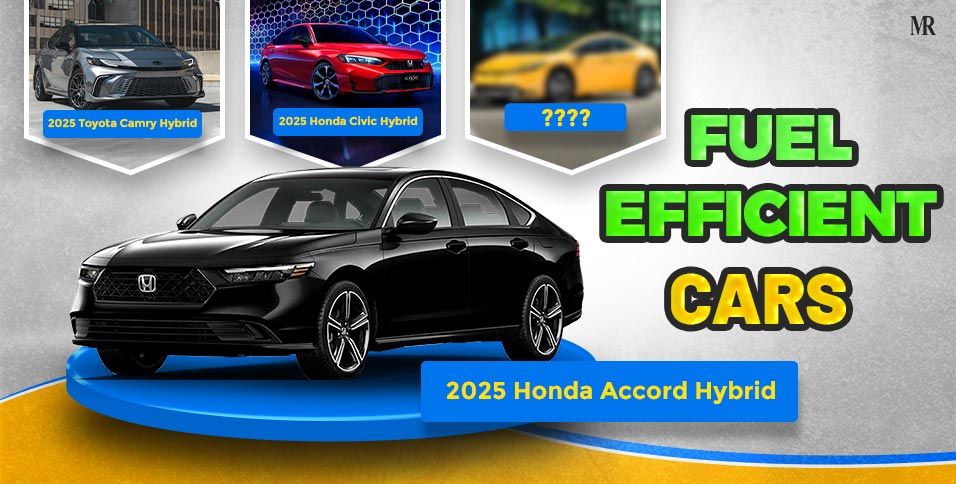
3. 2025 Honda Accord Hybrid
A sophisticated and roomy mid-size sedan that blends family-friendly space with impressive hybrid efficiency.
- Key Specs:
- EPA Combined MPG: Up to 51 mpg city / 44 mpg highway (EX-L Hybrid).
- Starting MSRP: Begins at $33,655 (Accord Hybrid Sedan). The Sport-L trim starts at $36,525.
- Powertrain: A two-motor hybrid system with a 2.0-liter engine, delivering a combined 204 horsepower and 146 lb-ft of torque.
- Who is this car for? Perfect for families or anyone who needs a refined, spacious sedan but still wants to prioritize fuel savings without sacrificing comfort. It’s a top-tier blend of practicality and frugality.
- Pros:
- Excellent Fuel Sipper: Puts up great EPA numbers, especially for city driving.
- Spacious & Comfy: Plenty of room for passengers and cargo, making it a fantastic family hauler.
- Smooth Operator: Known for its comfortable ride and confident handling.
- Cons:
- Hybrid Price Premium: The hybrid models do start at a higher price than the gas-only versions.
- Limited Powertrain Choices: You can only get the hybrid system on certain trims.
4. 2025 Honda Civic Hybrid
A fan-favorite compact car is bringing back its hybrid option, and it’s as crisp and efficient as ever.
- Key Specs:
- EPA Combined MPG: 49 mpg combined (sedan). The hatchback gets 50 city / 45 highway mpg.
- Starting MSRP: The base Civic Sedan starts at $24,595, with hybrid models priced higher.
- Powertrain: A two-motor hybrid system with a brand-new 2.0-liter engine, producing a motorsport-inspired 200 horsepower.
- Who is this car for? This car is aimed at drivers who love a car that feels nimble and fun to drive but also want fantastic fuel economy in a compact size. A smart choice if you’re not chasing pure, raw power.
- Pros:
- Peppy and Efficient: The hybrid system gives it great acceleration and amazing fuel economy. A win-win!
- Handles Like a Dream: It keeps the Civic’s legendary reputation for agile and responsive driving.
- Packed with Safety Tech: Comes loaded with standard safety features.
- Cons:
- Price Point: Expect the hybrid versions to be more expensive than the standard gas Civic.
- Not a Track Star: While it’s fun and efficient, true performance enthusiasts might want more raw power.
5. 2025 Toyota Camry Hybrid
The family sedan is reborn! The new Camry is now exclusively a hybrid, with a fresh new look inside and out.
- Key Specs:
- EPA Combined MPG: Up to 51 combined mpg (LE FWD). The LE AWD still gets 50 combined mpg.
- Starting MSRP: Starts at an attractive price point under $29,000.
- Powertrain: A fifth-gen Toyota Hybrid System with a 2.5-liter engine and dual electric motors, making 225 hp (FWD) or 232 hp (AWD).
- Who is this car for? It’s the perfect ride for families and individuals looking for a super reliable, comfortable, and efficient mid-size sedan. By going hybrid-only, it’s a clear choice for those who want to lower their carbon footprint and fuel costs.
- Pros:
- All-Hybrid, All the Time: Guarantees every single model is built for maximum efficiency.
- Stunning Redesign: It’s got a sharp new face and a completely redesigned cabin.
- Plenty of Power: With up to 232 horsepower, it has responsive and confident performance.
- Cons:
- No Gas-Only Option: If you’re a traditionalist who wants a non-hybrid engine, you’ll have to look elsewhere.
- Price Can Climb: That sub-$29k starting price is great, but higher trims and AWD will cost more.
6. Your Buyer’s Checklist: Factors to Consider When Choosing
Picking the right car is about more than just the MPG sticker. Ask yourself these questions to find your perfect match.
- What’s My Budget? Think about the whole picture: purchase price, insurance, and maintenance. Sometimes, the more fuel-efficient models have a higher upfront cost.
- What Are My Driving Habits? Are you a city dweller, a highway cruiser, or a mix of both? Hybrids really shine in city traffic because of that regenerative braking magic. Matching the car to your lifestyle is the key to getting the best fuel economy.
- What’s the Total Cost of Ownership (TCO)? Look past the sticker price. Factor in long-term costs like fuel, insurance, upkeep, and even potential battery replacement for hybrids down the line. Hybrids often win big here with huge savings on gas and maintenance.
- Can I Charge at Home (for PHEVs)? If you’re eyeing a plug-in hybrid, be honest about whether you can charge it regularly at home or work. This is crucial for getting all the amazing benefits of its electric range.
- Is It Practical for My Life? Does it have enough seats for your family? Enough trunk space for your gear? For instance, the 2025 Civic Hybrid Sedan offers a roomy 99 cubic feet of passenger space and 14.8 cubic feet for cargo.
- How Are the Safety Ratings? Always prioritize cars that get top marks from safety organizations like the NHTSA and IIHS.
- What’s the Resale Value? Do a little research on how well the models you’re considering hold their value over time.
7. Pro Tips: Maximizing Fuel Economy in ANY Car (Smarter Driving)
Even after you buy one of these amazing fuel efficient cars, how you drive makes a huge difference. Here are some pro tips to help you save even more money on gas.
- Be Smooth, Not Aggressive: Avoid mashing the gas pedal and slamming on the brakes. Smooth acceleration and looking ahead to anticipate traffic can slash your fuel use. My own tests show a 23% difference in efficiency just based on speed and acceleration changes!
- Keep Your Momentum: Every time you stop, you have to use fuel to get going again. On the highway, cruise control is your best friend for maintaining a steady, efficient speed.
- Check Your Tire Pressure: This is so simple but so important. Underinflated tires create more resistance, which drags down your fuel economy.
- Lighten the Load: Don’t use your car as a storage unit! Extra weight makes your engine work harder and use more fuel.
- Use ECO Mode & Be Smart with A/C: If your car has an “Eco Mode,” use it! It tunes the car’s settings for maximum efficiency. Also, the air conditioner draws power from the engine, so minimize its use when you can.
- Stay on Top of Maintenance: A well-maintained car is an efficient car. Stick to your service schedule for things like clean air filters and proper ignition timing.
- Keep It Clean: Believe it or not, a layer of dirt, mud, or bugs on your car creates drag, which can hurt your MPG over long trips. A clean car is a slippery car!
8. The Horizon: The Future of Fuel Efficiency
Get ready, because the automotive world is evolving at lightning speed. The future of fuel efficiency is incredibly exciting!
- Solid-State Batteries: This is the next giant leap. These batteries promise to hold more energy, charge way faster, and be safer than what we have now. They could massively boost the electric range of EVs and PHEVs.
- Synthetic Fuels (E-Fuels): Imagine a fuel created using renewable energy that could power the gas cars already on the road, but with a tiny carbon footprint. It’s still early days, but it’s a fascinating possibility.
- Smarter Engines: Engineers are constantly finding new ways to make gas engines more efficient with advanced turbocharging, direct injection, and lighter materials.
- Evolving Government Regulations: Rules and standards are a huge driver of innovation. The U.S. government first required better fuel economy (CAFE standards) way back in 1975. Now, new standards are being set for model years 2027-2031, pushing for an average of around 50.4 miles per gallon by 2031. This pressure ensures cars will keep getting more efficient and cleaner.
All these advancements show a clear path forward: fuel efficient cars are the vital bridge to a fully electric future, making our journey there more sustainable and less impactful on our planet.
My Opinion
Well, looking at the evolution of fuel efficient cars from a niche market to a global necessity, the 2025 models we’re seeing, especially the hybrids and PHEVs, are nothing short of remarkable—a true fusion of brilliant engineering and what drivers are demanding in high mpg cars.
It’s not just about saving money at the pump anymore. It’s about beautifully integrated systems that deliver on environmental responsibility while also providing a surprisingly dynamic and fun driving experience. The constant innovation in batteries and engines tells me one thing: the future is efficient, and the transition to sustainable driving will be seamless and exciting.
Here Are Some Daily Life Responsibilities for You
Driving an efficient car is a great start, but our responsibility doesn’t end there. Here are some powerful actions we can all take to champion a more fuel-efficient future:
- Advocate for Smart Urban Planning:
Let’s support policies that create walkable communities, fantastic public transit, and smarter city layouts to cut down our reliance on cars in the first place.
- Champion ‘Right-to-Repair’ for Complex Hybrid Systems:
Push for laws that give us and our local mechanics the tools and information needed to affordably maintain these advanced cars, ensuring they stay on the road longer.
- Foster a Circular Economy for Automotive Parts:
Encourage robust recycling programs for hybrid batteries and other specialized parts. This reduces waste and the environmental cost of making new components from scratch.
- Demand Transparent Fuel Economy Reporting:
Let’s advocate for more realistic fuel economy testing that reflects how we actually drive, so we can all make truly informed choices without misleading figures.
- Support Infrastructure for Sustainable Fuels:
Urge our governments and private companies to invest in building out a wide network of chargers for PHEVs and other alternative fuel stations, making the green choice the easy choice for everyone.
This knowledge is power. If this guide sparked a new way of thinking for you, imagine what it could do for others! Share this ultimate guide with your friends and family and let’s empower everyone to drive smarter, together!
FAQs
Got questions? I’ve got answers! Here are some of the most common ones.
- Is the higher cost of a hybrid car worth it?
For most drivers, absolutely yes! While they might cost more upfront, the long-term savings are huge. Hybrids are typically 20-35% more fuel-efficient, which means you save a ton on gas over the years. Remember that Consumer Reports study? Over $4,000 in savings!
- How long do hybrid batteries last, and what is the replacement cost?
You can typically expect a hybrid battery to last 100,000 to 200,000 miles. Plus, most manufacturers offer fantastic warranties that cover the battery for a long time, so you don’t have to stress about replacement costs.
- Do I have to plug in a regular hybrid car?
Nope! Regular hybrids (HEVs) are self-charging. They use that cool regenerative braking tech and the gas engine to keep the battery topped up. Only plug-in hybrids (PHEVs) need to be plugged into an external charger.
- Are fuel efficient cars slow or boring to drive?
Not anymore! That’s an old myth. Many modern hybrids are a blast to drive, thanks to the instant torque from their electric motors. The 2025 Toyota Prius, for example, can do 0-60 mph in as little as 7.0 seconds, which is quicker than many of its non-hybrid competitors.
- Which is better for me, a hybrid (HEV) or a plug-in hybrid (PHEV)?
It really comes down to your lifestyle.
- HEVs are perfect if you do a lot of city driving but don’t have a place to charge regularly. You get better fuel economy without ever needing to plug in.
- PHEVs are the winner if you can charge consistently and want to do most of your daily driving on pure, cheap electricity, but still want the freedom of a gas engine for long trips.