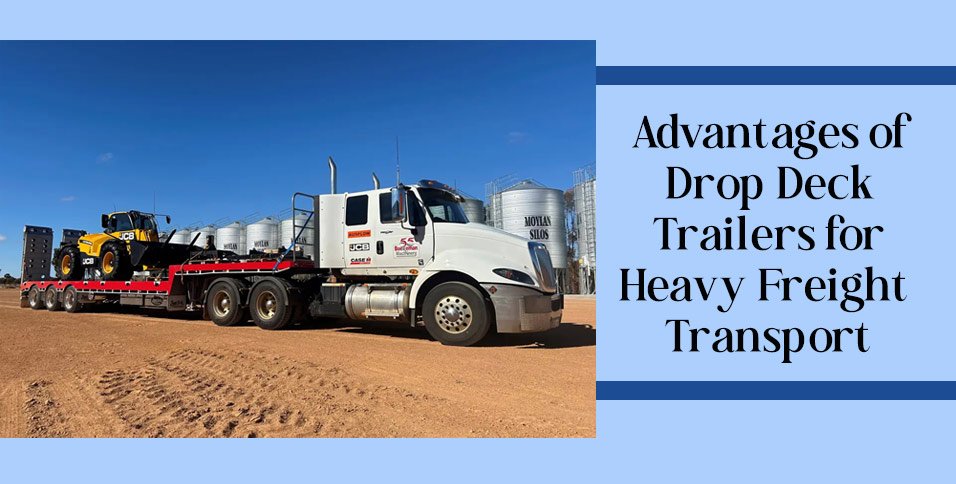
If machinery moves keep going to a subcontractor, the trailer configuration is usually the reason. Flat-tops have a fixed loading height that pushes oversized freight above legal clearance thresholds on standard routes, and when that happens, the job goes elsewhere. For an operator running a mixed fleet, that is not a minor inconvenience. It is a recurring revenue gap.
A drop deck resolves that constraint directly. This article covers what the lower deck height gives you in operational terms: what freight becomes viable, how compliance changes, and what to consider before speccing one for your fleet.
Height Clearance Is Where Flat-Tops Run Out of Road
Standard flat-top trailers load freight at a deck height of around 1,350mm to 1,500mm above ground level. On loads that already sit tall, including excavators, compressors, and large agricultural headers, that loading height pushes the combined transport height past the 4.3-metre legal limit that applies on most Australian roads. At that point, the operator is looking at a pilot vehicle requirement, an oversize permit, or a route that adds hours to avoid low bridges and overhead infrastructure.
The practical consequence is straightforward: jobs that should be routine become logistically complicated, or they don’t get quoted at all. A drop deck reduces the loading surface to around 800mm to 900mm above ground, recovering 500mm to 600mm of usable height clearance without changing the freight. That is the difference between a standard run and a permit job on a significant proportion of heavy plant moves.
What the Lower Deck Height Actually Unlocks
The primary gain from a drop deck is freight viability. Equipment that exceeds height limits on a flat-top, including mid-sized excavators, skid steers, large pumping units, and conveyor sections, loads within legal dimensions on a drop deck without modification to the freight or the route. For operators running construction or mining services work, that covers a wide portion of the machinery moves that come up regularly.
The structural advantage extends beyond height compliance. A lower loading surface positions heavy freight closer to the road, which lowers the centre of gravity of the loaded combination. On long hauls and unsealed roads, that translates directly to improved stability and reduced load shift in transit. It also reduces the gradient that freight needs to travel during loading, which matters on wheeled plant that has to drive on under its own power.
Loading efficiency is a secondary but real operational benefit. Shallower ramp angles reduce the time and risk involved in getting mobile plant onto the deck, and the reduced movement during transit means less time securing and re-checking loads at rest stops. Over the course of a working week, those incremental gains add up across the schedule.
Compliance and Route Planning Get Simpler
Height compliance on oversize freight is not just a regulatory matter. It directly affects how quickly a job can be quoted, scheduled, and moved. When a load sits within legal limits without a permit, the logistics chain shortens considerably. There are no permit processing delays, no prescribed routes to negotiate around infrastructure constraints, and no dependence on pilot vehicle availability before the truck can roll.
For an operator quoting competitive work, that simplicity has a direct commercial value. A drop deck configuration that keeps standard plant moves within the 4.3-metre height envelope means jobs can be committed to and scheduled with confidence. Route planning becomes a matter of distance and timing rather than clearance mapping and permit sequencing.
Manufacturers that engineer to Australian road standards and offer configuration options to match specific freight tasks make that compliance outcome more reliable. Bruce Rock Engineering builds flat-top and drop deck trailers to suit a range of freight tasks, with configuration options that can be matched to an operator’s specific load types and route requirements before the order is placed.
What to Look for When Speccing a Drop Deck
The configuration decisions on a drop deck matter as much as the decision to buy one. Deck height determines which freight categories the trailer can handle within legal limits, and load rating determines what gross mass the trailer can carry on each axle group. Getting either wrong means the trailer doesn’t solve the problem it was purchased to solve.
Suspension type is a practical specification with operational consequences. Air-bag suspension provides a smoother ride profile for sensitive freight and allows ride height adjustment at the loading point, which is useful when matching deck height to a loading dock or ramp. Spring suspension is more suited to rough terrain and typically requires less maintenance in demanding conditions. The right choice depends on where the trailer runs and what it carries.
Step configuration, specifically the height and length of the well between the gooseneck and the rear section, determines how tall and how long a piece of equipment can be loaded without clearance issues at the transition points. This is the specification conversation to have with a manufacturer before purchase. A trailer built to a general standard rather than a specific freight task will always be a compromise in practice.
Getting the Spec Right Is the Next Step
A drop deck doesn’t change the size of a fleet. It changes the range of work that fleet can take on. For operators who are regularly moving heavy plant and consistently routing that work to subcontractors, the trailer is the limiting factor, not the opportunity.
If the freight is there and those jobs keep coming up, the case for adding a drop deck is already established. The remaining question is configuration, and that is a conversation worth having with a manufacturer before committing to a specification.