Mirror Review
May 28, 2026
The U.S. Department of War officially announced a five-year, $9.69 billion blanket purchase agreement with Dell Federal Systems on May 27, 2026. This major Pentagon software contract consolidates Microsoft software licenses, cloud subscriptions, and software assurance across the military.
The single-award, firm-fixed-price contract streamlines technology procurement for the Department of War, the Intelligence Community, and the U.S. Coast Guard. By centralizing these purchases, the military eliminates redundant IT spending and establishes a unified system for its enterprise software needs.
Instead of individual branches cutting separate deals, the Pentagon is using its collective purchasing power to lower costs and standardize its digital infrastructure.
Inside the Multi-Billion Dollar Dell Pentagon Deal
Under the newly awarded Department of War Enterprise Software Agreement II (ESA II), Dell Federal Systems will act as the primary supplier for the military’s vast Microsoft ecosystem. Dell won the massive contract through a competitive bidding process managed by the Naval Information Warfare Center Pacific.
Government officials evaluated the competing vendors based on technical capacity, comparison to General Services Administration schedule pricing, and overall value to the department. Dell Federal Systems emerged at the top of the evaluation due to its competitive pricing and its long-standing status as a major buyer of Windows PC licenses.
The agreement relies heavily on Dell’s established logistics and supply chain capabilities to service millions of military personnel worldwide. Rather than allocating new funds, this vehicle pools existing IT budgets from various defense branches into a single, organized purchasing channel.
Financial and Operational Details:
The scale of this agreement makes it one of the largest technology procurement programs in recent military history. The structure of the deal includes several specific parameters:
- Total Estimated Value: $9,690,000,000 over a five-year ordering period.
- Contract Type: Single-award, firm-fixed-price blanket purchase agreement.
- Administrative Lead: The Department of the Navy is managing the contract vehicle on behalf of the entire defense enterprise.
- Target Audience: The Department of War, the Intelligence Community, and the U.S. Coast Guard.
- Core Offerings: Microsoft 365 tier licenses, Windows Enterprise Operating System, Office Professional Plus, and specialized hybrid cloud capabilities.
Modernizing Military Tech and Driving Efficiency
The primary goal of this massive Pentagon software contract is to simplify a fragmented procurement system that previously caused delays and administrative overlap. Defense officials want a highly secure, uniform environment that allows different branches of the military to communicate effortlessly.
During a briefing at the Pentagon, Department of Defense Chief Information Officer Kirsten Davies explained the broader operational goals of the contract:
“By providing enterprise access to Microsoft 365 advanced cloud subscriptions and critical on premises licensing, this CETA acts as part of the digital connective tissue essential for Combined Joint All-Domain Command and Control, CJADC2. This ensures our war fighters have the tools for just in time data sharing, supports our pivot to AI and data analytics, and undergirds uninterrupted operational continuity for our most sensitive and disconnected environments.”
The mention of disconnected environments is critical. The contract specifically includes specialized software bundles, such as the “Disconnected No Cloud Access” license. This ensures that troops operating in remote areas or high-security zones without internet connectivity can still use essential Microsoft tools safely.
Additionally, this Pentagon software contract includes a limited scope for Microsoft Azure to help transition specific operational workloads over to the Joint Warfighting Cloud Capability contract.
The Pentagon’s growing focus on AI infrastructure and advanced computing also aligns with broader U.S. investments in next-generation systems like the Supercomputer Doudna initiative and other AI contracts.
Financial Savings for the Pentagon
The Pentagon is currently facing intense pressure from Capitol Hill to pass a clean financial audit, especially as the department requests a $1.5 trillion budget for fiscal year 2027. Demonstrating fiscal responsibility is a top priority for defense leadership.
According to CIO Kirsten Davies, consolidating these fragmented IT budgets into a single vehicle will save the Pentagon roughly $422 million annually. Officials expect these savings to increase even further as more sub-agencies fully integrate their IT services into the contract.
Barry Tanner, who is currently performing the duties of the chief information officer for the Department of the Navy, spoke highly of the teamwork involved in creating the agreement:
“This really is a game changer. It’s the culmination of lessons we’ve learned over the last five years, the successes that have been built for all of the services. It improves capability while driving efficiency across the department.”
| Metric | Details |
| Annual Expected Savings | $422 Million |
| Primary Contract Goal | Eliminate software licensing redundancies |
| Governance Standards | DFARS 208.74 and DOD Directive 8470.01E |
| Cybersecurity Focus | Implementation of enterprise-wide security standards |
Historical Context of Major Pentagon Contracts
Large-scale tech consolidation has been an ongoing struggle for the U.S. military. For over a decade, the Pentagon tried to modernize its systems through various massive software initiatives. Past efforts frequently stalled due to legal challenges from competing tech firms, bureaucratic red tape, and shifting political priorities.
Historically, U.S. military contracts for software were distributed across hundreds of individual vendors, creating a patchwork of incompatible systems. This fragmented approach made global cybersecurity compliance almost impossible to enforce. By moving toward massive enterprise software agreements, the military is mimicking corporate America’s approach to cloud and software procurement.
This contract also highlights the evolving nature of Microsoft Pentagon deals. Microsoft has long been the foundational software layer for government offices, but the military’s rapid pivot toward cloud subscriptions and artificial intelligence required a more flexible, enterprise-wide licensing model.
Utilizing Dell as the fulfillment partner allows the government to leverage commercial distribution networks to deploy these software tools quickly.
Political Ties and Corporate Connections
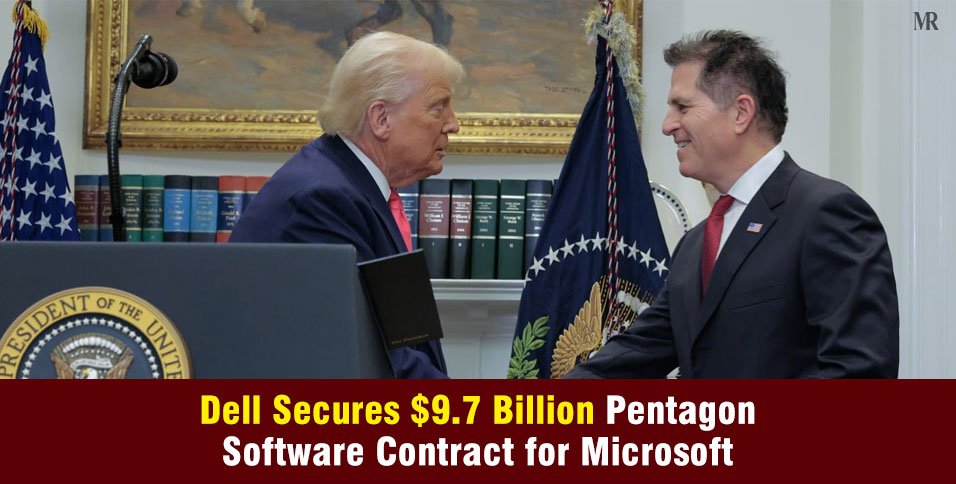
The timing of the massive award has drawn attention from industry analysts due to the visible relationship between Dell leadership and the White House. Last year, Michael Dell, the founder and CEO of Dell Technologies, pledged $6.25 billion to fund investment accounts for children, widely known as “Trump accounts“.
President Donald Trump has spoken favorably of the tech company in public. At a recent Mother’s Day event at the White House, President Trump openly praised the Dell family for their multi-billion dollar donation and encouraged the public to “go out and buy a Dell”.
Michael Dell has maintained an active role in federal technology initiatives, joining President Trump’s Council of Advisors on Science and Technology. Following the 2024 election, Dell publicly congratulated the President, stating that he looks forward to continued progress and opportunity under his leadership.
While defense officials emphasize that the contract was awarded solely based on cost, value, and technical evaluation, the political backdrop adds an interesting layer of context to this massive commercial transaction.
The contract also comes during a transformative period for the company following recent workforce restructuring efforts covered in the Dell Layoffs of 2026.
Other Notable Military Allocations
The Department of War’s May 27 announcement included several other major defense allocations alongside the massive Dell software agreement. These awards span various military branches:
- The Boeing Company: Awarded an $854.6 million contract modification for the production and delivery of four P-8A Lot 13 aircraft for Foreign Military Sales customers, along with software integration and hardware updates.
- Stantec-JMT JV: Received a $150 million contract for multi-disciplined architect-engineer services to support coastal storm risk management for the Charleston Peninsula in South Carolina.
- Fuse Integration Inc.: Awarded a $96 million firm-fixed-price order for the production, engineering, and testing of KRAKEN systems to support advanced tactical edge networks.
- North End Group LLC: Secured a maximum $68.9 million contract to manufacture trousers for the Air Force, Marine Corps, and Defense Logistics Agency.
Looking Ahead
As the five-year ordering period begins, the focus shifts to how quickly the Navy and Dell can deploy these standardized software suites across the global military infrastructure. The success of this transition will serve as a test case for future Pentagon software deals.
If Dell delivers the promised $422 million in annual savings, it will likely validate this centralized procurement model for other areas of government spending.
Ultimately, this historic Pentagon software contract reflects a broader institutional push toward digital readiness, tighter data security, and fiscal accountability.
By bridging the gap between legacy on-premises systems and advanced cloud environments, the military aims to maintain a decisive technological edge in an increasingly digital global landscape.
Maria Isabel Rodrigues