Mirror Review
May 28, 2026
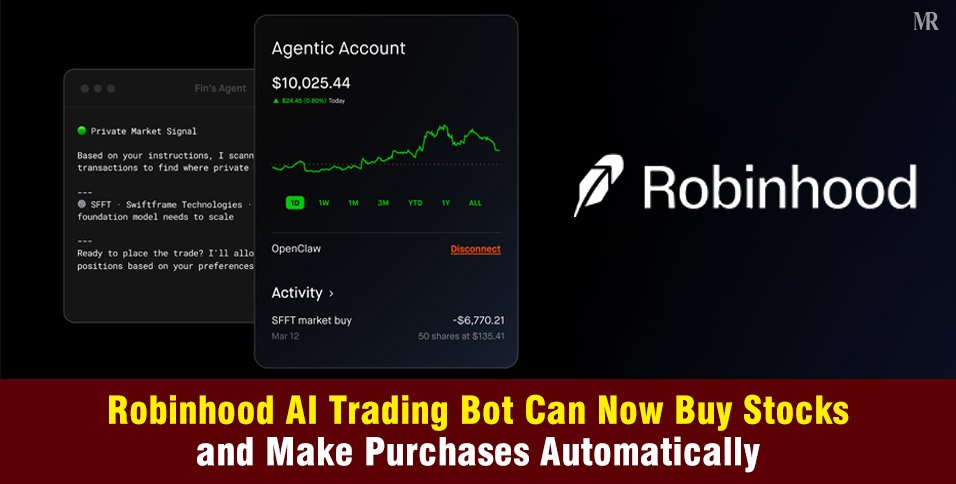
Robinhood officially launched Agentic Trading and the Agentic Credit Card, letting users connect third-party AI assistants to execute investment strategies and shopping tasks. This rollout marks one of the first major attempts to bring autonomous finance technology directly to everyday retail investors rather than just Wall Street institutions, reflecting the broader agentic AI transformations happening. By deploying these new tools, the platform allows artificial intelligence to manage portfolios and scan for consumer deals with minimal human involvement.
The launch of the new Robinhood AI trading bot changes the way ordinary people interact with financial markets and online commerce. Here is a look at how this technology works, the security guardrails in place, and what it means for the future of finance.
What is Robinhood Agentic Trading?
For years, quantitative funds and large hedge funds used automated systems to execute rapid trades and balance portfolios. Retail investors, however, mostly managed their accounts by making manual choices.
The introduction of Robinhood agentic trading changes this dynamic by putting automated strategy creation into the hands of ordinary account holders.
Instead of writing complex code or using unofficial workarounds, users can connect their AI assistants to Robinhood using Model Context Protocol (MCP) servers. MCP serves as an open standard that lets AI software receive, understand, and execute direct financial commands.
Once connected, the Robinhood AI trading app handles several advanced investing tasks:
- Portfolio Rebalancing: The bot can analyze current holdings for concentration risk, identify if an investor is over or underweight in a specific sector, and execute trades to hit target allocations.
- Thematic Investing: Investors tracking a specific trend, like semiconductors, can instruct the bot to build an initial portfolio, monitor the industry for analyst upgrades, and adjust positions automatically.
- Active Strategy Execution: Traders can set up the bot to backtest a mean reversion strategy against historical data and then deploy it to buy oversold stocks automatically.
“Our mission has always been to democratize finance for all, and now, that mission extends to AI agents,” said Vlad Tenev, CEO of Robinhood.
Shopping with Robinhood’s Agentic Credit Card
Beyond the stock market, Robinhood is introducing AI automation to daily commerce through the Agentic Credit Card. This feature connects AI assistants to Robinhood Banking servers, allowing them to search for deals and buy items automatically based on your specific rules.
To make this work, the platform assigns the AI a dedicated virtual card tied to the user’s Robinhood Gold Card. This virtual setup ensures the bot never sees the primary credit card number or private account details.
The system helps consumers save time on tedious online searches. For example:
- A sneaker collector can instruct the bot to buy a specific shoe size the moment the price drops below $300.
- A food enthusiast can task the agent with booking an exclusive restaurant reservation as soon as a table opens up.
- Small business owners can even use it to fill multi-item supply orders within a strict budget.
As an added incentive, all automated purchases made by the bot earn 3% cash back, matching the standard rewards of the physical Gold Card.
Robinhood’s Built-In Security and Risk Controls
Handing wallet and portfolio access over to an AI agent raises obvious safety questions. Less sophisticated traders could face heavy losses if a bot misinterprets instructions or reacts poorly to sudden market shifts. To address these risks, Robinhood designed the platform with a safety-first mindset and several built-in guardrails.
| Safety Feature | How It Protects the User |
| Isolated Accounts | Agentic trading accounts are completely separate from the main portfolio, limiting the bot’s access to only the funds you explicitly deposit. |
| Virtual Limits | Users can set strict monthly spending caps on the virtual credit card and delete the card instantly with a single tap. |
| Manual Approvals | An optional setting forces the AI agent to ask for human confirmation before finalizing any credit card purchase or stock trade. |
| Real-Time Feeds | The app sends instant push notifications for every transaction, maintaining a transparent, real-time profit and loss (P&L) tracker. |
| Fraud Review | If a transaction looks suspicious, the fraud-monitoring team can audit what the user instructed the bot to do versus what it actually performed to resolve disputes. |
Robinhood emphasizes that users bear ultimate responsibility for the actions of their AI assistants. Because AI models can occasionally make errors or act on outdated data, monitoring the real-time feed remains essential.
Market Impact and the Tech Learning Curve
The Robinhood AI trading bot rollout could heavily influence the broader financial ecosystem. Robinhood currently possesses 27.6 million funded accounts, alongside roughly 700,000 premium Gold Card customers. If a significant portion of this user base adopts autonomous tools, the volume and velocity of retail trading could shift dramatically.
While payment giants like Stripe and Ramp offer virtual cards for AI agents, Robinhood is the first major retail brand to bring this capability directly to the public. However, industry experts note that practical hurdles remain. Merchants must become comfortable accepting automated payments, and the industry still needs to clearly define legal liabilities for failed or glitchy AI transactions.
According to Abhishek Fatehpuria, a product VP at Robinhood, the initial wave of features targets tech-savvy early adopters. The company plans to learn from this initial audience before expanding the tools to the general public. Currently, the system only supports equities during its beta phase, but support for options, cryptocurrency, futures, and event contracts will arrive later in the year.
The Future of Agentic Finance
The launch of the Robinhood AI trading bot is a major turning point in personal finance, moving the industry from self-directed apps to autonomous financial assistants. While the technology is in a nascent phase, it highlights a future where software handles the time-consuming aspects of wealth management and retail shopping.
By balancing automation with strict user-controlled safety limits, the platform aims to make quantitative investing tools accessible to everyone. As the underlying models improve, Robinhood trading will likely continue to evolve, changing how the everyday public builds portfolios and spends money.
Maria Isabel Rodrigues