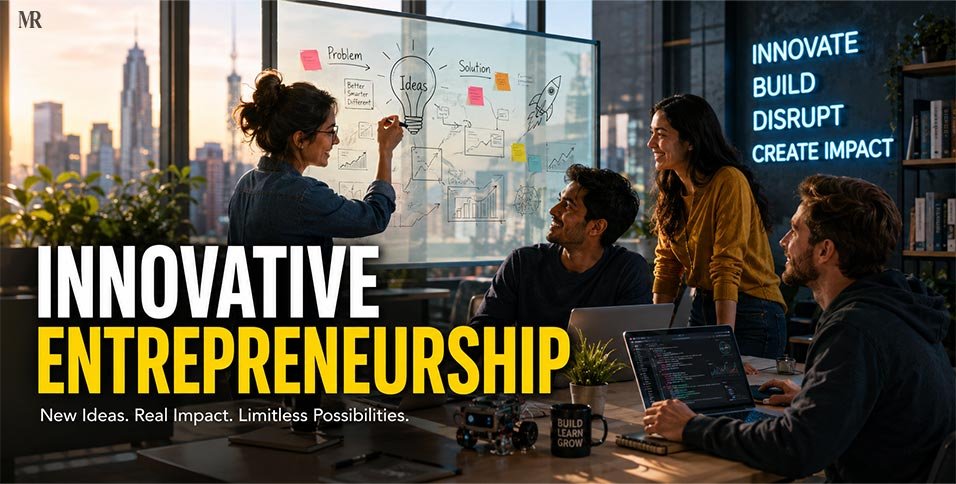
Industries don’t change on their own. People with new ideas, bold execution, and a willingness to challenge the status quo change them. That’s exactly what innovative entrepreneurship is about.
Innovative entrepreneurship is the practice of building businesses that introduce new products, technologies, processes, or business models to solve real problems in better ways. It goes beyond starting a company. It’s about creating change that didn’t exist before.
According to OECD, AI startups alone captured close to 61% of all global venture funding in 2025, attracting over $258 billion in investment, up more than 30% than 2023. That number tells you where the world is putting its money: on entrepreneurs who innovate.
This guide breaks down the meaning, types, examples, business models, and future of innovative entrepreneurship.
What Is Innovative Entrepreneurship?
Innovative entrepreneurship means creating new value and not just running a business. It involves building something that disrupts how an industry operates, solves a problem in a new way, or introduces a technology the market hasn’t seen before.
Unlike traditional entrepreneurship (which often replicates existing models), innovative entrepreneurship focuses on originality and disruption. The core goal is to create something that hasn’t been done before, or do something existing much better.
It shows up in four core forms:
- Product innovation — creating a new or significantly improved product
- Process innovation — making operations or systems more efficient
- Business model innovation — changing how a company monetizes or delivers value
- Technology-driven innovation — building on emerging tech like AI, biotech, or quantum computing
Key trait: Innovative entrepreneurs don’t just improve existing systems — they build new ones.
Why Innovative Entrepreneurship Dominates in 2026
Three forces are concentrating capital and competitive advantage in the hands of innovative enterprises, over other types of entrepreneurship, right now:
- Unprecedented capital flow:
According to Crunchbase, Q1 2026 shattered every historical funding record, deploying $300 billion in a single quarter across more than 6,000 startups. Innovative companies did not just attract this capital; they completely drove the expansion.
- AI as core infrastructure:
Enterprise AI revenue reached $37 billion in 2025, up more than 3x year-over-year. AI is no longer a feature; it’s the operating layer for modern businesses.
- Global startup ecosystems are scaling fast:
The US raised over $306 billion in H1 2025 alone. Concurrently, India, Singapore, and European deep tech hubs are producing globally competitive startups at an industrial scale.
Thus, businesses that rely on legacy models without innovating are being systematically displaced. Innovative entrepreneurship is the non-negotiable operating model for durable business growth in this decade.
Top 10 Types of Innovative Entrepreneurship With Examples
Each type represents a distinct innovation path. Here’s the definition, a current example with real data, and the competitive edge each one creates.
1. Technology Entrepreneurship
Technology Entrepreneurship consists of businesses built around advanced technology as the core product, such as AI systems, developer tools, advanced robotics, and critical cybersecurity infrastructure.
Example:
Skild AI raised $1.4 billion in January 2026, reaching a $14 billion valuation that tripled its market valuation from six months prior. The Pittsburgh startup is building a single, general-purpose AI brain designed to control any robot for any task without requiring custom reprogramming. Enterprise partners already include ABB Robotics, Universal Robots, Samsung, Foxconn, and Nvidia.
Why it works:
Technology entrepreneurship creates high defensibility. Once Skild’s model is embedded into a manufacturer’s production line, switching to a competitor means reconfiguring the entire system.
2. Product Innovation Entrepreneurship
Product Innovation Entrepreneurship consists of businesses that build genuinely new or dramatically improved physical or digital products, creating entirely new demand categories that did not previously exist.
Example:
xAI’s Grok expanded from launch to 64 million monthly active users in under two years. By early 2026, its US chatbot market share grew from 1.9% to 17.8%, marking a ninefold increase in 12 months. xAI raised $20 billion in January 2026 at a $230 billion valuation, and in February 2026, SpaceX acquired xAI to form a $1.25 trillion combined entity, the largest merger by valuation in history.
Why it works:
Product innovation that creates a new category builds brand authority before competitors can catch up. Grok didn’t improve chatbots. It built one with a distinct identity, real-time data, and a distribution channel (X’s 400M users) that no other model has.
3. Business Model Innovation Entrepreneurship
Business Model Innovation Entrepreneurship consists of businesses that disrupt how an industry charges, distributes, or structures its operations, rather than changing what it physically sells.
Example:
Stripe launched the world’s first AI foundation model for payments in May 2025, trained on billions of transactions and hundreds of payment signals. Businesses on Stripe grow at 7x the rate of S&P 500 companies. Stripe’s valuation reached $91.5 billion in February 2025, and it expanded into stablecoins (via the $1.1B Bridge acquisition), support for 125+ global payment methods, including UPI and Pix, and a full financial infrastructure layer.
Why it works:
Business model innovation builds infrastructure moats. Customers don’t switch payment stacks casually, especially when the stack now includes billing, fraud detection, tax compliance in 102 countries, and stablecoin rails.
4. Scientific & Research-Based Entrepreneurship
Scientific & Research-Based Entrepreneurship consists of businesses that commercialize deep scientific breakthroughs by turning lab-stage discoveries into viable commercial companies across biotechnology, pharmaceuticals, and deep tech.
Example:
Project Prometheus, co-founded by Jeff Bezos and Vik Bajaj in November 2025, launched with $6.2 billion and reached a $38 billion valuation before shipping a single product, signaling how much the market values scientifically grounded, physical-world AI innovation. The startup is building physical AI models trained on real-world experimental data, robotics interactions, and engineering workflows, targeting aerospace, automotive, semiconductor manufacturing, and drug development.
Why it works:
Research-based entrepreneurship creates near-uncopyable advantages. The data, proprietary models, and industrial partnerships built in this space take years to replicate.
5. Digital Innovation Entrepreneurship
Scientific & Research-Based Entrepreneurship consists of businesses that commercialize deep scientific breakthroughs by turning lab-stage discoveries into viable commercial companies across biotechnology, pharmaceuticals, and deep tech.
Example:
Perplexity AI grew from a $63 million ARR at the end of 2024 to targeting $656 million ARR in 2026. It reached 45 million monthly active users, processes 780 million queries per month, and hit a $21 billion valuation in early 2026. Perplexity returns cited, synthesized answers instead of web links, and it discontinued advertising entirely in February 2026 to bet exclusively on user subscriptions and enterprise contracts.
Why it works:
Digital innovation companies can scale globally without physical expansion. Onboarding millions of additional users does not require a linear increase in physical infrastructure or employee headcount.
6. Social Innovation Entrepreneurship
Social Innovation Entrepreneurship consists of businesses that apply entrepreneurial methods to solve systemic social or environmental problems, such as healthcare access, climate change, or education gaps, while maintaining a highly scalable commercial model.
Example:
Hippocratic AI raised $126 million at a $3.5 billion valuation in 2025, building AI safety models specifically for patient communication rather than diagnosis. Their models automate appointment follow-ups, medication adherence tracking, chronic care check-ins, and post-discharge support. This addresses a severe systemic gap: the US faces an industrial shortage of up to 450,000 registered nurses. The AI does not replace clinicians; it absorbs the administrative communication workload that frequently falls through the cracks.
Why it works:
Social innovation startups attract impact investors, government partnerships, and regulatory goodwill — three advantages purely commercial startups rarely access simultaneously.
7. Process Innovation Entrepreneurship
Process Innovation Entrepreneurship consists of businesses that completely redesign how industries operate through automated workflows, advanced logistics, or leaner production models, rather than modifying the underlying commercial product.
Example:
Waymo commercially launched driverless robotaxi operations and scaled to 500,000 weekly paid rides across 10 US cities by March 2026, a 10x increase from 50,000 weekly rides in May 2024. Revenue grew from $125 million (end-2024) to a $355 million annualized run rate by February 2026. In February 2026, Waymo raised $16 billion at a $126 billion valuation to expand into London, Tokyo, and 20+ additional cities.
Why it works:
Process innovation delivers immediate, measurable ROI. Every Waymo ride replaces a driver cost, and the cost per mile has already fallen from $1.50 in 2019 to $0.30 in 2026, an 80% reduction.
8. Infrastructure-Native AI Entrepreneurship
Real-World Example:
Crusoe Energy Systems builds modular, clean-powered data centers directly at the source of stranded energy, such as natural gas flaring sites and remote renewable energy grids. By using wasted energy to power the immense compute layers required for generative AI, they solve two problems at once: reducing industrial emissions and providing low-cost infrastructure for AI-native startups.
Why it works:
By co-locating data centers with power generation, they eliminate grid transmission bottlenecks, allowing them to secure massive long-term enterprise compute contracts with AI developers globally.
9. Deep Tech Material Entrepreneurship
Real-World Example:
Orbital Materials utilizes physical AI models trained on advanced chemical properties to design entirely new synthetic materials without relying on traditional trial-and-error lab testing. Their proprietary AI-designed filters are built specifically to remove “forever chemicals” (PFAS) from industrial water supplies, turning deep tech breakthroughs into commercial manufacturing solutions.
Why it works:
The intellectual property (IP) for newly generated molecules creates an immediate structural moat. Once a manufacturer integrates an Orbital compound into its production line, switching costs are incredibly high due to the unique chemical signatures.
10. Open-Source Ecosystem Entrepreneurship
Real-World Example:
Hugging Face operates the central repository and platform for the global AI developer community, hosting hundreds of thousands of open-source machine learning models and datasets. While the core platform is free for developers, the business monetizes through its “Enterprise Hub” and “Inference Endpoints,” charging corporations premium subscription fees for private security compliance, dedicated computing power, and cloud infrastructure management.
Why it works:
This model allows the digital innovation platform to scale its global network effects rapidly. Millions of developers naturally default to their architecture, creating a massive, organic B2B sales pipeline for their paid enterprise tier.
Core Traits of Innovative Entrepreneurs
The scale achieved by these enterprises is driven directly by specific operational habits shared by innovative entrepreneurs. These are not innate personality traits, but repeatable habits that appear consistently in high-growth founders:
- Problem-first thinking: They find a real, painful problem before building anything. The idea follows the problem and not the other way around.
- Scalability mindset from day one: They design for massive scale even at an early stage. Architecture decisions made at 100 users determine the growth ceiling at 100 million.
- High risk tolerance, low ego: They run experiments, accept failure as data, and kill beloved ideas when they don’t validate.
- Long-term vision with short feedback loops: They think in years but act in weeks, iterating fast toward a long-term thesis without losing momentum.
- Adaptability: When the market signals something different from the original plan, they pivot without abandoning the core mission.
The most successful innovative enterprises combine models. OpenAI, for example, runs consumer subscriptions alongside API usage pricing, a dual-engine model that generated over $20 billion in annualized revenue by the end of 2025.
Real Challenges Innovative Entrepreneurs Face
Despite massive market caps and record-breaking funding rounds, commercializing radical innovation introduces intense friction. Founders must overcome clear operational hurdles to build a durable enterprise:
- Slow Enterprise Adoption Cycles:
Large corporations require 6 to 18 months to evaluate, security-audit, and deploy genuinely new solutions. Waymo, for instance, navigated years of technical testing before securing regulatory clearance for public roads.
- High R&D Costs Prior to Revenue:
Research-heavy startups require an immense runway. Deep tech ventures like Project Prometheus raise billions of dollars to fund scientific development before shipping a single commercial product.
- Intense Regulatory Friction:
Autonomous systems, fintech, and biotechnology companies face complex compliance requirements that can delay commercial launches by years. Aurora Innovation launched commercially in April 2025, years after the core technology was physically built.
- Extreme Capital Concentration:
While funding totals are massive, access is hyper-focused. In Q1 2026, just four companies captured 63% of all global venture funding, leaving founders outside hot sectors like AI to compete for the remaining capital.
- Competition after proof of concept:
Once a market is proven, well-funded incumbents move fast. Perplexity proved AI search works; Google, Microsoft, and Apple responded immediately.
How to Become an Innovative Entrepreneur
There’s no single path to becoming an Innovative Entrepreneur, but there’s a repeatable process:
- Find a real, painful problem. Talk to potential users before building anything. The best innovative enterprises start with documented frustration, not inspiration.
- Map the gap in existing solutions. Understand not just what current solutions lack, but why those gaps exist, and why they haven’t been filled yet.
- Ask ‘why now?’ Why does this solution work in 2026 when it couldn’t five years ago? AI infrastructure, regulatory changes, new hardware, or behavior shifts usually answer this.
- Build an MVP that solves one thing well. Don’t build the full vision. Build the smallest version that validates your core assumption.
- Launch, measure, iterate. Real user behavior beats internal assumptions. Move fast, update your understanding, then update the product.
- Scale through technology, not headcount. Use AI, automation, and data to grow without linear cost increases. Perplexity serves 45M users with a team of under 100.
- Raise when you have traction. Investors back momentum. Come to the table with metrics, not just a deck.
The Future of Innovative Entrepreneurship
The future of Innovative Entrepreneurship is already being built. Here’s where it’s heading:
- Physical AI
In 2026, the hottest AI startups are the ones shifting from software AI to AI that interacts with the real world. Physical AI is expected to reshape manufacturing, logistics, healthcare, and construction faster than digital AI did.
- AI-native startups
Founders are building companies with AI as the core architectural layer rather than appending it to legacy software. Institutional investors like Bessemer Venture Partners have deployed over $1 billion into AI-native businesses, which operate, hire, and scale with fundamentally lower overhead than traditional software companies.
- Quantum commercialization
Deep tech enterprises like PsiQuantum ($1B raised) and Classiq ($110M Series C) are advancing toward real-world applications in pharma simulation, cryptography, and logistics optimization. Early commercial use cases are expected within this decade.
- Biotech + AI convergence
The integration of generative models with genomics is accelerating targeted drug discovery at cost structures that were completely impossible five years ago. In 2026, startups operating at this intersection represent some of the most heavily capitalized ventures globally.
- Decentralized innovation
Silicon Valley no longer holds a monopoly on breakthrough innovation. India currently hosts 61 active unicorns, Singapore captured 92% of Southeast Asia’s startup funding, and Europe’s Horizon Europe program is deploying €95 billion directly into deep tech, health, and climate ventures.
- The pattern is consistent: innovative entrepreneurship will continue defining what industries look like, how money flows, and which problems get solved.
End Note
Innovative entrepreneurship is the engine behind the companies that reshape how the world works. It’s not about clever ideas, it’s about identifying real problems and building genuinely new solutions that the market can’t ignore.
If you’re building something new: start with a real problem, validate early, build with innovation at the core, and scale through technology. The industries of tomorrow are being built right now by innovative entrepreneurs who refused to accept that things had to stay the same.
Maria Isabel Rodrigues
FAQs
- How do innovative entrepreneurship businesses make money?
Innovative startups monetize through SaaS subscriptions, usage-based pricing models, intellectual property (IP) licensing, platform transaction fees, and enterprise contracts. Most high-growth ventures combine two or more of these models.
- Is innovative entrepreneurship riskier than traditional entrepreneurship?
Yes, but the risk profile is completely different, rather than inherently worse. Traditional businesses face immediate competition and razor-thin profit margins in saturated markets. Innovative entrepreneurs face high early-stage technical uncertainty and market adoption challenges, but market winners face far less direct competition and command significantly higher valuations.