Mirror Review
April 09, 2026
Meta recently unveiled Muse Spark, the first AI model release from its newly formed Meta Superintelligence Labs.
Developed under the leadership of Alexandr Wang, Muse Spark marks Meta’s return to the frontier AI race following the underwhelming performance of Llama 4 last year.
In this article, Mirror Review explores how Meta’s Muse Spark functions as a multi-agent orchestrator and what it means for the future of personal superintelligence.
What is Muse Spark?
Muse Spark by Meta is a natively multimodal reasoning model designed to handle text, images, audio, and video. It is the first in a new series, internally code-named “Avocado,” built to power the next generation of Meta AI assistants. While the model is small and fast, it is capable of reasoning through complex questions in math, science, and health.
Key characteristics of this Meta new AI include:
- Multimodal Perception: It can see and understand the world through photos and videos rather than just reading text.
- Multi-Agent Orchestration: It can launch several sub-agents at once to solve different parts of a single problem.
- Efficiency: It achieves high performance using significantly less compute than previous models like Llama 4 Maverick.
How Good is Muse Spark?
According to Meta’s official technical reports, MSL Muse Spark offers highly competitive performance across multimodal perception, reasoning, and agentic tasks. Meta reports that their new training recipes allow this model to reach the same level of capability as previous midsize models, such as Llama 4 Maverick, while using over an order of magnitude less compute.
| Capability | Performance Notes |
| Multimodal Perception | Natively integrates visual information to identify objects, recognize entities, and understand STEM questions. |
| Reasoning Efficiency | Uses “Contemplating” mode to achieve 58% on Humanity’s Last Exam and 38% on FrontierScience Research. |
| Health Accuracy | Provides factual and comprehensive responses based on data curated by 1,000 physicians. |
| Scaling Trajectory | Demonstrates smooth and predictable growth in reliability and task generalization through reinforcement learning. |
Alexandr Wang acknowledged that while there are “rough edges” to polish, the model provides a powerful foundation for the larger versions currently in development.
Solving Problems with Multi-Agent Orchestration
The standout feature of Meta Superintelligence Lab‘s First Model is its “Contemplating” or “Thinking” mode. Instead of a single AI trying to do everything, this mode allows Muse Spark to act as a manager for a squad of AI agents.
“You can switch between modes depending on the task, and Meta AI can launch multiple subagents in parallel to tackle your question,” Meta explained.
For example, if you are planning a family trip, one agent can draft an itinerary while another compares hotel locations and a third finds kid-friendly activities. This parallel processing delivers a better, more comprehensive answer much faster than standard AI models.
Practical Applications for Everyday Users
Meta is integrating Muse Spark across its entire ecosystem, including Facebook, Instagram, Messenger, WhatsApp, and Ray-Ban Meta glasses.
- Shopping Mode: Users can get styling advice or find products based on inspiration from creators they already follow on Meta apps.
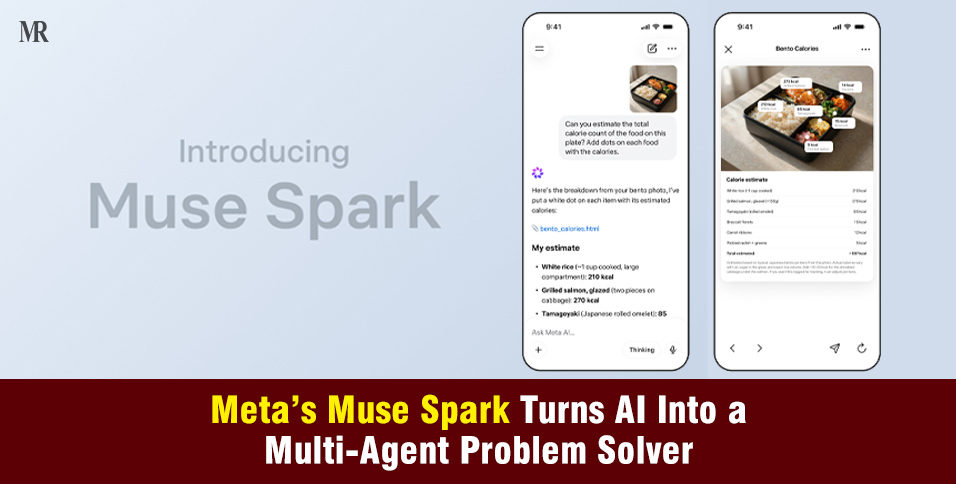
- Wellness and Health: By snapping a photo of an airport snack shelf, the AI can identify which items have the most protein. It can also generate interactive displays to explain which muscles are activated during specific exercises.
- Visual Coding: The model allows users to create custom mini-games, whimsical flight simulators, or website dashboards straight from a simple prompt.
The Path to Personal Superintelligence
The launch of Muse Spark represents a major win for Meta Superintelligence Labs. After investing $14.3 billion to bring in Alexandr Wang and overhauling their AI stack, Meta is moving away from its traditional open-source-only approach.
Muse Spark is currently proprietary, available via a private API to select partners, though Meta hopes to open-source future versions.
Furthermore, Mark Zuckerberg has set a clear goal for this trajectory. “We are on our way to personal superintelligence: an assistant that can help anyone, anywhere with the things that matter most to them,” the company stated.
Moreover, Meta is aggressively expanding its AI infrastructure, including recent deals to secure millions of AI chips to power its next-generation models.
End Note
Meta’s Muse Spark AI model is more than just a chatbot; it is a sophisticated reasoning engine that uses multiple agents to navigate the complexities of the real world.
By focusing on multimodal perception and efficient scaling, Meta has regained its seat at the table with the world’s most advanced AI labs.
As Muse Spark rolls out to billions of users, it brings the vision of a truly personal, proactive AI assistant closer to reality.
Maria Isabel Rodrigues