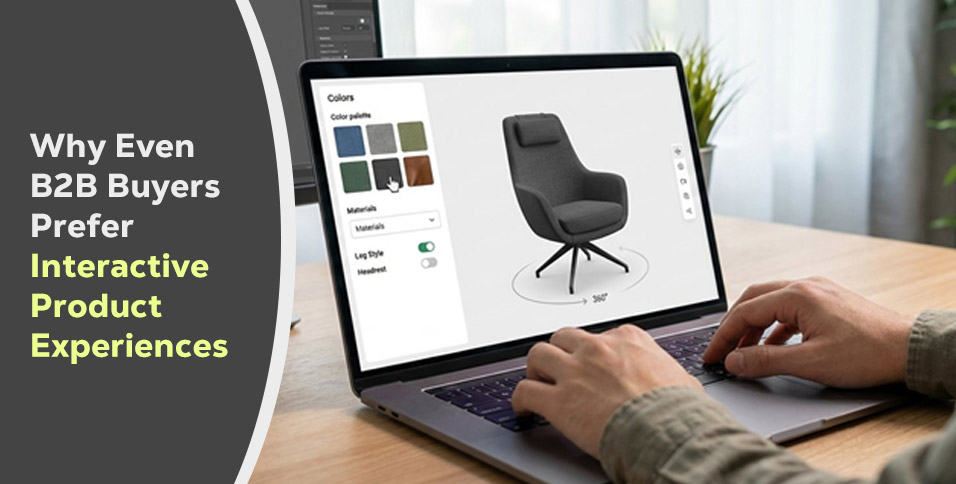
The expectations of B2B buyers have changed dramatically over the past decade. Decision-makers today are no longer satisfied with static product catalogs, PDF specifications, or long email threads discussing product variations.
Instead, they expect the same level of interactive and visual product experience they encounter in modern consumer eCommerce.
From configurable furniture systems to industrial equipment and modular construction products, B2B buyers increasingly prefer tools that allow them to explore, configure, and visualize products in real time.
For companies selling complex products, interactive product experiences are becoming a key driver of B2B sales efficiency.
The Shift Toward Digital Product Experiences in B2B
Traditionally, B2B purchasing processes relied heavily on manual communication between buyers, sales teams, and engineering departments.
A typical buying journey could involve:
- multiple specification documents
- lengthy email exchanges
- manually prepared quotes
- repeated revisions to product configurations
This process often slowed down decision-making and created unnecessary complexity.
Today, 3d configurators enable companies to deliver interactive product experiences that simplify the entire buying journey.
Instead of waiting for updates or revisions, buyers can explore product options themselves and immediately see the results.
Interactive Product Experiences Improve Decision-Making
One of the biggest challenges in B2B sales is helping customers understand complex product options.
Technical specifications alone rarely provide enough clarity.
Interactive product experiences allow buyers to:
- visualize product variations instantly
- explore materials, components, and configurations
- understand how options affect price and functionality
When buyers can see and interact with a product digitally, they gain confidence in their decisions.
This leads to faster purchasing cycles and fewer revisions later in the process.
Increasing B2B Sales Efficiency Through Automation
Another major advantage of interactive product experiences is their impact on sales efficiency.
Many B2B sales teams spend a significant amount of time on repetitive tasks such as:
- verifying product compatibility
- calculating pricing for custom configurations
- preparing detailed quotes
Modern real-time 3D configurator platformsautomate these tasks.
When a customer configures a product, the system can automatically:
- validate product rules
- update pricing in real time
- generate a quote instantly
This dramatically improves B2B sales efficiency by reducing manual work and accelerating the sales process.
Supporting Complex and Modular Products
Many industries sell products that consist of multiple components or modules.
Examples include:
- furniture systems
- kitchen and interior solutions
- industrial machinery
- building and construction products
Without digital tools, managing these variations can become extremely complicated.
Interactive product configuration systems allow companies to define product rules and modular structures so that customers can easily explore valid combinations.
This simplifies the sales process while ensuring technical accuracy.
Creating a Better Buying Experience for B2B Customers
B2B buyers are still consumers in their everyday lives. They are used to intuitive digital experiences when shopping online.
As a result, they now expect similar experiences in professional purchasing environments.
Interactive product experiences offer several benefits for B2B customers:
- clearer understanding of product options
- faster decision-making
- greater transparency in pricing
- more engaging and collaborative sales discussions
Companies that provide these experiences are more likely to stand out in competitive markets.
The Role of Product Experience in Modern B2B Sales
Product experience is becoming a central element of digital B2B strategies.
Instead of relying only on sales presentations or documentation, companies can allow buyers to interact directly with the product digitally.
This approach helps buyers evaluate options more effectively while also reducing the workload on sales teams.
A strong product experience ultimately creates a more efficient and satisfying purchasing journey for both sides.
Conclusion
Interactive product experiences are transforming the way complex products are sold in B2B markets.
By enabling buyers to explore, configure, and visualize products digitally, companies can significantly improve both customer engagement and B2B sales efficiency.
As digital sales channels continue to evolve, businesses that invest in interactive product technologies will be better positioned to simplify complex product sales and deliver the modern buying experiences that today’s B2B customers expect.