Mirror Review
January 08, 2026
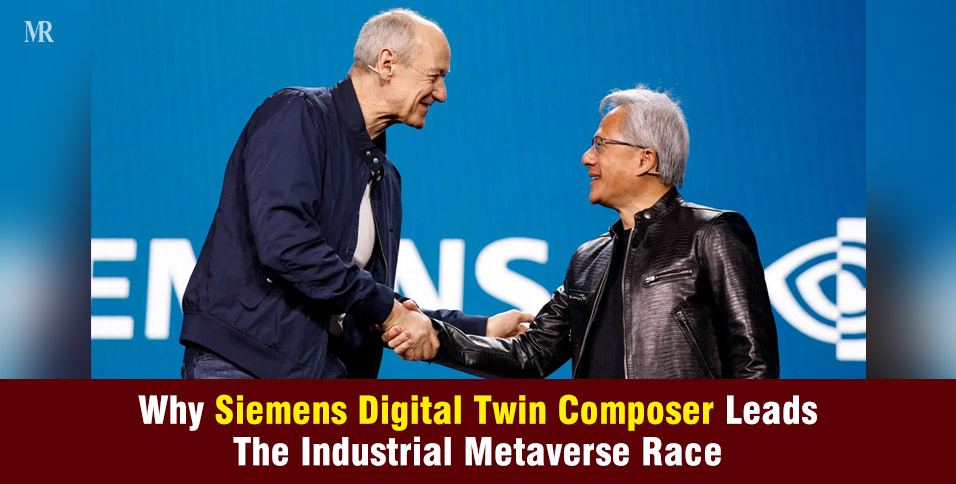
At the Consumer Electronics Show (CES) 2026, Siemens AG officially launched the Digital Twin Composer, a breakthrough software solution designed to build and operate Industrial Metaverse environments at scale.
By integrating NVIDIA Omniverse libraries and Siemens Xcelerator data, this platform allows global manufacturers like PepsiCo to simulate, test, and optimize entire production lines in a photorealistic virtual world before a single physical component is ever built.
This innovation effectively helps Siemens lead the Industrial Metaverse by providing the first unified “operating system” that turns industrial data into actionable, real-time intelligence.
As Siemens outlined in its official press release, the ambition goes far beyond visualization.
“Together, we are building the Industrial AI operating system, redefining how the physical world is designed, built, and run, to scale AI and create real-world impact,” said Roland Busch, President and CEO of Siemens AG.
What Is The Industrial Metaverse?
While the consumer metaverse often focuses on social interaction and gaming, the industrial metaverse is a persistent, immersive digital environment where machines, factories, and entire cities are mirrored with physics-level accuracy.
- The Industrial Metaverse is built on the foundation of the Digital Twin, which is a virtual replica of a physical asset. However, the Digital Twin Composer elevates this concept.
- In a standard setup, a digital twin might just be a 3D model. In the Siemens Industrial Metaverse, the twin is “alive.”
- It uses Real-Time Data (information sent instantly from sensors on the shop floor) and Physics-Based Simulation (software that understands gravity, heat, and friction) to predict exactly how a machine will behave.0
- This allows engineers to “time-travel” by simulating years of wear and tear in just a few minutes of virtual time.
The Power of the Siemens and NVIDIA Partnership
A critical reason the Digital Twin Composer leads the race is the expanded partnership between Siemens and NVIDIA. This collaboration has given birth to what industry experts call the Industrial AI Operating System.
By combining Siemens’ massive library of industrial data with NVIDIA’s Omniverse (a platform for building and operating metaverse applications), companies can achieve “photorealism.”
This isn’t just for show; it means the virtual factory looks and behaves exactly like the real one.
Founder and CEO of NVIDIA, Jensen Huang, said, “Our partnership with Siemens fuses the world’s leading industrial software with NVIDIA’s full-stack AI platform to close the gap between ideas and reality, empowering industries to simulate complex systems in software, then seamlessly automate and operate them in the physical world.”
For instance, GPU Acceleration (using powerful graphics processors to handle complex math) allows the Digital-Twin Composer to run simulations 2 to 10 times faster than previous methods.
This speed is what enables “Generative Simulation,” where the AI itself suggests the most efficient factory layout, rather than a human engineer having to guess and check.
Real-World Impact Of Digital Twin Composer: The PepsiCo Success Story
Siemens’ Digital Twin is already delivering measurable results in the Industrial Metaverse.
- Global giant PepsiCo has been a primary pilot partner, using the software to digitally transform its U.S. manufacturing facilities.
- By creating a high-fidelity digital twin of their production lines, PepsiCo identified up to 90% of potential issues before they even occurred in the physical world.
- This “digital-first” strategy resulted in a 20% increase in throughput (the amount of product moving through the system) and a 15% reduction in Capital Expenditure (CapEx).
- Simply put, they saved millions of dollars by failing in the virtual world so they could succeed in the real one.
This ability to validate investments in a risk-free environment is why the Siemens Digital Twin is the preferred tool for the world’s largest brands.
Breaking Down Technical Barriers with Industrial AI
Complexity has long been the enemy of digital transformation.
Previously, design teams, engineers, and factory operators worked in “silos,” using different software that didn’t talk to each other.
But the Digital Twin Composer solves this by acting as a Digital Thread.
This thread connects every stage of a product’s life. It integrates MES (Manufacturing Execution Systems), which manages the actual production on the floor, with PLC (Programmable Logic Controller) code, which is the “brains” that tell individual robots what to do.
By unifying these into one model, Siemens enables the use of Industrial Copilots.
These are AI assistants that help workers scan complex data using natural language, similar to how you might ask a smartphone for directions.
This makes the high-tech Industrial Metaverse accessible to everyday shop-floor workers, not just data scientists.
The Future of Adaptive Manufacturing
As we look toward the rest of 2026, Siemens is not slowing down.
- The company is using its own electronics factory in Erlangen, Germany, as a blueprint for the world’s first fully AI-driven, adaptive manufacturing site.
- In this “AI-Native” factory, the Digital Twin Composer will work with an “AI Brain” to continuously analyze operations.
- If the AI detects a way to save energy or speed up a robot arm, it tests that change in the Industrial Metaverse first.
- Once validated, the update is pushed to the physical machines automatically.
- This creates a closed loop where the virtual world and the physical world are constantly teaching each other, ensuring the factory is always running at peak efficiency.
End Note
The race for the Industrial Metaverse is no longer about who has the best vision, but who has the most functional tools.
With the launch of the Digital Twin Composer, Siemens has moved beyond the hype of virtual worlds and into the reality of industrial intelligence.
By providing a platform that reduces costs, increases sustainability, and empowers workers through AI, Siemens has solidified its position at the forefront of the next industrial revolution.
For manufacturers looking to thrive in an increasingly complex world, the message is clear: the future is being composed in the digital realm first.
Maria Isabel Rodrigues