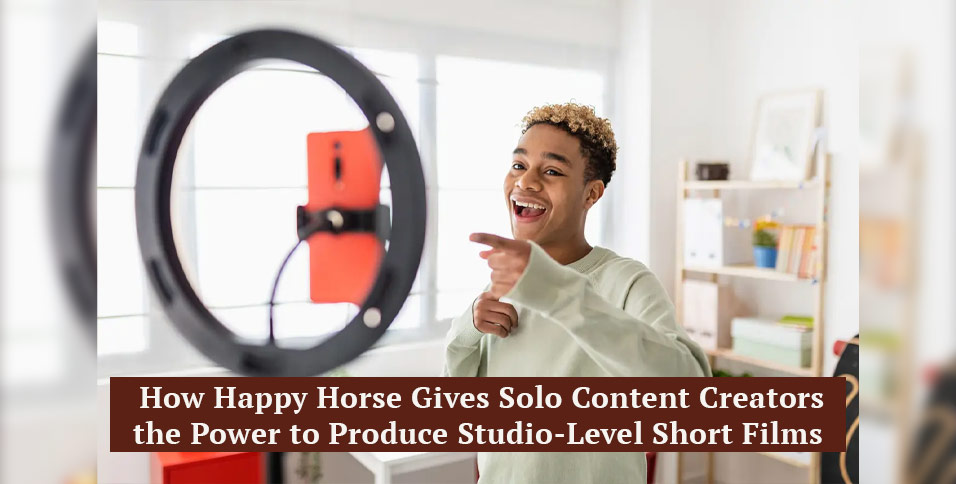
There’s a particular kind of frustration that lives in the gap between what a creative person can imagine and what they can actually produce alone. A filmmaker working solo knows this gap intimately. The story is clear in their head. The visual language is fully formed. They know exactly what the opening shot should look like, how the light should fall in a particular scene, what the rhythm of the edit should feel like. And then reality intervenes: they don’t have a crew, they don’t have a location budget, they don’t have actors available on the day the weather is right, and the equipment required to achieve the look they’re after costs more than they can justify for a project that may never have a distribution deal attached to it.
Short film has always been the training ground for filmmakers and the creative outlet for storytellers who haven’t yet broken through to larger-scale production. It’s also one of the most resource-constrained forms in all of creative media. The gap between the ambition that drives people to make short films and the resources typically available to make them is not a gap that closes easily. For most of filmmaking history, it simply had to be worked around — through creative constraints, through favors called in, through shooting in available light with whatever was on hand.
What AI video generation is introducing into this space is genuinely new, and the solo creators paying closest attention are beginning to understand what it makes possible.
The Studio Advantage, Demystified
When people talk about studio-level production, what they usually mean is a cluster of specific visual qualities: controlled, cinematic lighting; locations that serve the story rather than being whatever was available; the kind of establishing and atmospheric shots that give a film its sense of world and scale; visual effects and compositing that extend the physical production into spaces that couldn’t be filmed directly. These are the elements that separate a film that looks like it was made with resources from one that looks like it was made despite the absence of them.
Each of these elements has historically required either money — to hire the crew, rent the location, access the equipment — or an enormous investment of time and problem-solving to approximate on a minimal budget. Some talented low-budget filmmakers have found ways to achieve the visual qualities they’re after through ingenuity and constraint. Most haven’t, and the films they’ve made carry the visual signatures of their limitations even when the storytelling is strong.
AI generation addresses specific items in this list in ways that don’t require either the money or the elaborate workarounds.
What Becomes Possible
The applications that matter most for solo short film production fall into a few distinct categories. The first is establishing and world-building shots — the exterior views, the atmospheric environments, the glimpses of a world that give a film its sense of place and scale. These are often the shots that define a film’s visual ambition, and they’re also the shots that are hardest to obtain without a location budget. A story set in a decaying industrial landscape, or in a forest at a specific time of day, or in an urban environment with a very particular character, requires being in those places with the right equipment at the right time. AI generation decouples the creative requirement from the logistical one.
The second is transitional and atmospheric content — the visual material that lives between scenes, that punctuates the emotional arc of a story, that gives a film its texture and rhythm. This type of content is often what separates a film that feels fully realized from one that feels like a series of scenes that happen in sequence without a coherent visual world connecting them.
The third, and perhaps most significant for narrative filmmakers, is visual effects and environment extension. A scene that takes place in a space that doesn’t physically exist — a future city, a historical setting, an environment that would be prohibitively expensive to build or travel to — can be given visual context through generated footage that extends what was physically filmed into something larger.
The Creative Workflow Shift
Working with Happy Horse as part of a short film production changes the creative workflow in ways that take some adjustment. The traditional filmmaking process is organized around what can be planned and controlled: locations are scouted and locked, shot lists are built around what’s known to be achievable, schedules are constructed around fixed variables. AI generation introduces a different kind of process — one that’s more iterative and exploratory, where the visual material emerges through a dialogue between the filmmaker’s intention and the tool’s output.
This isn’t entirely unfamiliar to filmmakers who have worked in documentary or experimental forms, where the material often reveals itself through the making rather than being fully predetermined. But it requires a shift in how a production is planned and how the editing process is approached, since the relationship between generated footage and filmed footage needs to be worked out in real time rather than locked in advance.
The filmmakers who adapt to this most effectively tend to be the ones who hold their visual intentions clearly while remaining genuinely open to what the generation process reveals. First outputs are rarely exactly right, but they often point toward something better than the original intention — a visual approach that serves the story in ways that weren’t initially anticipated.
Short Film as a Format
It’s worth noting why short film in particular is a strong fit for this kind of production approach. A short film is a form defined by compression — by the discipline of telling something complete within tight constraints of time. That compression means every visual choice carries more weight than it would in a feature, and the atmospheric and world-building content that AI generation handles well is especially impactful in a short format where there’s no room for the visual context to develop gradually.
A five-minute short film that opens with a genuinely cinematic establishing shot — one that communicates a world and a mood with the clarity and visual quality of something that cost real money to produce — creates an immediate frame of expectation for the audience that changes how everything that follows is received. The visual credibility established in those first moments extends through the whole film. Solo creators who can produce that quality of opening material are working with a different set of possibilities than those who can’t.
The Long View for Independent Filmmaking
What AI generation represents for independent and solo filmmakers is not a technology that makes filmmaking easier in some generic sense — the craft of storytelling, the work of directing performance, the judgment required to assemble a film from its parts remain as demanding as they’ve always been. What it does is remove a specific class of barriers that have historically been about resources rather than craft, and allow the quality of the work to be determined more fully by the quality of the thinking and vision behind it.
For a solo creator who has always had strong visual instincts but has been consistently limited by the gap between those instincts and what they could produce alone, that shift matters. The story that was always there, waiting for the means to tell it properly, now has better tools to work with.
The gap between imagination and production has always defined independent filmmaking as much as anything else. It’s getting narrower — and for the creators who have been waiting on the other side of it, that’s a significant development.