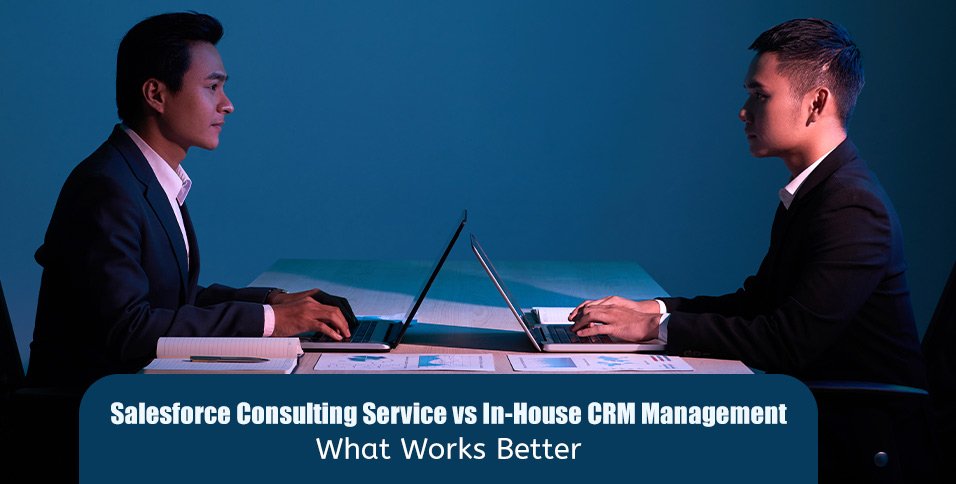
Salesforce consulting service means a specialized professional approach to designing, customizing, integrating, and optimizing Salesforce ecosystems in order to improve operational efficiency, customer engagement, and long-term business scalability. As customer relationship management becomes increasingly central to digital transformation, companies are facing a strategic question: should they rely on external Salesforce experts or build and manage CRM capabilities entirely in-house?
The answer is rarely absolute. Both models offer distinct advantages, and the right choice depends on organizational maturity, technical complexity, budget structure, and long-term business goals. Yet the debate itself reflects a deeper shift in enterprise technology: CRM systems are no longer just sales tools. They have evolved into core operational platforms that connect marketing, customer support, analytics, automation, and revenue operations into a unified ecosystem.
The Expanding Role of Salesforce in Modern Business
Salesforce has grown far beyond its origins as a cloud-based CRM. Today, it functions as a comprehensive enterprise platform supporting everything from AI-driven customer insights to workflow automation and omnichannel engagement.
Organizations use Salesforce to:
- Centralize customer data across departments
- Automate sales and marketing processes
- Build customer service ecosystems
- Integrate third-party applications
- Generate predictive business intelligence
This breadth creates both opportunity and complexity. A simple CRM deployment can quickly evolve into a highly interconnected environment involving APIs, custom applications, data pipelines, and compliance requirements.
As a result, CRM management is no longer just administrative work—it has become a strategic engineering discipline.
The Case for In-House CRM Management
For some companies, managing Salesforce internally offers a high degree of control and organizational alignment. Internal teams possess contextual knowledge about business operations, company culture, and customer workflows that external consultants may initially lack.
One major advantage of in-house management is continuity. Internal administrators and developers are deeply embedded within day-to-day operations and can respond quickly to evolving business needs. They also accumulate institutional knowledge over time, reducing dependency on third-party providers.
Another benefit is tighter integration with internal processes. In-house teams can collaborate directly with sales, marketing, and operations departments without communication barriers or contractual limitations.
However, this model also introduces significant challenges.
The Hidden Complexity of Internal Ownership
Salesforce ecosystems often grow faster than organizations anticipate. What begins as a manageable CRM implementation can evolve into a sophisticated enterprise platform requiring expertise in:
- Apex development
- Lightning component architecture
- Integration frameworks
- Data governance
- Security and compliance
- DevOps and release management
Maintaining this expertise internally is expensive and difficult. Skilled Salesforce architects and developers are in high demand globally, making recruitment and retention increasingly competitive.
Additionally, internal teams may become operationally reactive rather than strategically innovative. Instead of optimizing the platform, they often spend most of their time handling support requests, fixing workflows, and managing technical debt.
Over time, CRM environments can become fragmented and inefficient without dedicated architectural oversight.
Why Companies Turn to Salesforce Consulting Services
This is where external consulting partners become highly valuable. A salesforce consulting service provides specialized expertise, scalable delivery capacity, and cross-industry experience that many organizations struggle to maintain internally.
Consulting teams often bring:
- Certified Salesforce specialists
- Proven implementation methodologies
- Experience across multiple industries
- Advanced integration and automation expertise
- Scalable project delivery models
Because consultants work across diverse environments, they are frequently more familiar with emerging Salesforce capabilities, architectural best practices, and optimization strategies.
This external perspective can be transformative. Consultants often identify inefficiencies or architectural bottlenecks that internal teams no longer notice due to familiarity with legacy processes.
Speed vs Institutional Knowledge
One of the most important distinctions between the two approaches is speed.
Consulting firms can rapidly deploy experienced specialists to accelerate implementations, migrations, or large-scale transformations. This is especially valuable for organizations undergoing mergers, international expansion, or digital modernization initiatives.
In-house teams, by contrast, typically require more time to scale capabilities. Recruiting Salesforce talent, onboarding staff, and building expertise internally can delay critical initiatives.
Yet institutional knowledge remains a powerful advantage for internal teams. Consultants may understand Salesforce deeply, but internal employees often understand the business itself more comprehensively.
The most successful organizations recognize that CRM effectiveness depends on balancing both dimensions: technical expertise and business context.
Security, Governance, and Compliance
As CRM platforms increasingly store sensitive customer and operational data, governance has become a critical consideration.
Internal teams may provide greater perceived control over data access and compliance management. However, experienced consulting partners often bring mature governance frameworks that improve security posture and operational discipline.
A professional salesforce consulting service typically incorporates:
- Role-based access models
- Secure integration practices
- Audit-ready deployment pipelines
- Regulatory compliance expertise
- Data quality and lifecycle governance
This is particularly important for industries such as healthcare, finance, and insurance, where compliance failures can create serious legal and operational risks.
The Hybrid Model: Emerging as the Preferred Strategy
Increasingly, organizations are moving toward hybrid CRM operating models rather than choosing one approach exclusively.
In this structure:
- Internal teams manage daily operations, user support, and business alignment
- External consultants handle architecture, large implementations, integrations, and optimization initiatives
This model combines the strengths of both approaches while reducing their weaknesses. Internal stakeholders maintain strategic ownership, while external specialists provide scalability and advanced expertise when needed.
Hybrid models also reduce long-term dependency risks. Instead of outsourcing the entire CRM function, companies retain internal knowledge while leveraging external innovation.
CRM as a Long-Term Business Asset
One of the biggest misconceptions about Salesforce is treating it as a static software implementation. In reality, CRM ecosystems are living operational infrastructures that continuously evolve alongside the business.
New products, customer expectations, regulations, and sales strategies all require ongoing platform adaptation. Organizations that fail to evolve their CRM environments often experience declining adoption, process inefficiencies, and fragmented customer experiences.
This is why strategic governance matters more than simple administration. Whether managed internally or externally, Salesforce must be approached as a long-term business asset rather than a one-time deployment project.
Conclusion
The question is not simply whether a company should choose consultants or internal CRM teams. The more important question is how an organization can build a Salesforce ecosystem that remains scalable, secure, adaptable, and aligned with business goals over time.
In-house CRM management offers deep organizational context and operational continuity, while external consulting services provide advanced technical expertise, scalability, and strategic perspective. For many modern enterprises, the optimal solution lies in combining both approaches into a collaborative operating model.
As Salesforce environments become increasingly sophisticated, experienced partners can play a decisive role in helping organizations navigate complexity and accelerate transformation. In that context, companies such as Andersen salesforce consulting service providers demonstrate how deep engineering expertise and business-oriented CRM strategy can work together to create sustainable digital growth.