The modern world runs on the products of oil refineries.
From the fuel in your car to the plastic in your phone, almost everything around us begins its life as crude oil before undergoing a massive industrial transformation.
But what exactly happens behind those towering silver columns and vast network of pipes?
Oil refineries are the heart of the global energy sector, turning raw, unusable “black gold” into the lifeblood of the global economy.
In this guide, we’ll explore how these massive complexes work, where they are located, and why they remain a cornerstone of modern geopolitics.
1. What is an Oil Refinery?
An oil refinery is an industrial process plant where crude oil is transformed and refined into useful products. When Crude oil is pulled from the ground, it is a mixture of hydrocarbons that cannot be used in its raw state.
The primary purpose of an oil refinery is to “crack” these long-form molecules into specific outputs, such as:
- Petrol (Gasoline) for passenger vehicles.
- Diesel for heavy machinery and transport.
- Jet Fuel for aviation.
- Heating Oil for residential and industrial use.
- Liquefied Petroleum Gas (LPG) for cooking and heating.
2. How Oil Refining Works: Crude Oil Refining Process
Refining is a high-tech game of chemistry and physics. While the facilities look complex, the process generally follows three main steps:
I. Distillation
Crude oil is heated in a distillation tower. Since different components of oil have different boiling points, they rise to different levels of the tower. Light products like butane rise to the top, while heavier products like residuals settle at the bottom.
II. Cracking
To meet high demand for gasoline, heavier, less valuable fractions are “cracked” into smaller molecules using heat, pressure, or catalysts. This ensures nothing from the barrel of oil goes to waste.
III. Treating & Blending
In the final stage, impurities like sulfur are removed to meet environmental standards. The resulting fluids are then blended to create the specific octane ratings we see at the gas station.
3. Types of Oil Refineries
Not all oil refineries are built the same. They are generally categorized by their “complexity” and the products they can create:
- Topping Refineries: The simplest type; they only perform basic distillation.
- Hydroskimming Refineries: More complex, these can remove sulfur and produce high-octane gasoline.
- Complex Refineries: These facilities have secondary conversion units (like cokers) that allow them to process “heavy” crude into high-value light products.
4. Main Products of an Oil Refinery
Oil refineries do far more than just produce fuel. They create a wide spectrum of products that power industries, transportation, and everyday life.
Primary Fuel Products
- Petrol (Gasoline): Used in passenger vehicles worldwide
- Diesel: Powers trucks, buses, and heavy machinery
- Jet Fuel: Essential for global aviation networks
- Marine Fuel: Used in large cargo ships and tankers
Secondary & Industrial Products
- Liquefied Petroleum Gas (LPG): Used for cooking and heating
- Naphtha: A key feedstock for petrochemical production
- Kerosene: Used in lighting and heating applications
Petrochemical Feedstocks
These are critical for manufacturing:
- Plastics
- Synthetic rubber
- Fertilizers
- Textiles
Heavy Products
- Bitumen (Asphalt): Used in road construction
- Lubricating Oils: Used in engines and industrial machines
- Fuel Oil: Used in power plants and industrial boilers
5. Where Are The Major Oil Refineries?
The global oil refining capacity is highly concentrated in major economic hubs, based on:
- Proximity to crude oil reserves
- Logistical access
- Massive domestic demand centers
Key global hubs include:
| Country | Capacity (million bpd) | Share of Global Capacity |
| China | 18.48 | 17.8% |
| United States | 18.43 | 17.7% |
| Russia | 6.80 | 6.6% |
| India | 5.80 | 5.6% |
| South Korea | 3.50 | 3.4% |
| Saudi Arabia | 3.29 | 3.2% |
The locations in this list of Global Oil Refining Capacity by Country are profoundly influential. For example, South Korea operates heavily export-oriented coastal complexes, processing imported crude and shipping refined fuels internationally.
In developing regions, facilities like the Dangote Refinery in Nigeria, positioned in Lagos with an initial processing capacity of 650,000 barrels per day and expanding to 1.4 million barrels per day, seek to position nations as major global refining hubs while intentionally reducing localized fuel imports across Africa.
The geographical distribution of assets reveals that while Europe and North America possess legacy infrastructures, the net additions and expansion of facilities are leaning heavily toward the Asia Pacific and Middle East regions.
6. Largest Oil Refineries in the World
To understand the global scale of petroleum operations, one must examine single-site facilities and mega-complexes that dwarf standard operations.
| Name of refinery | Name of company | Location | Barrels per calendar day |
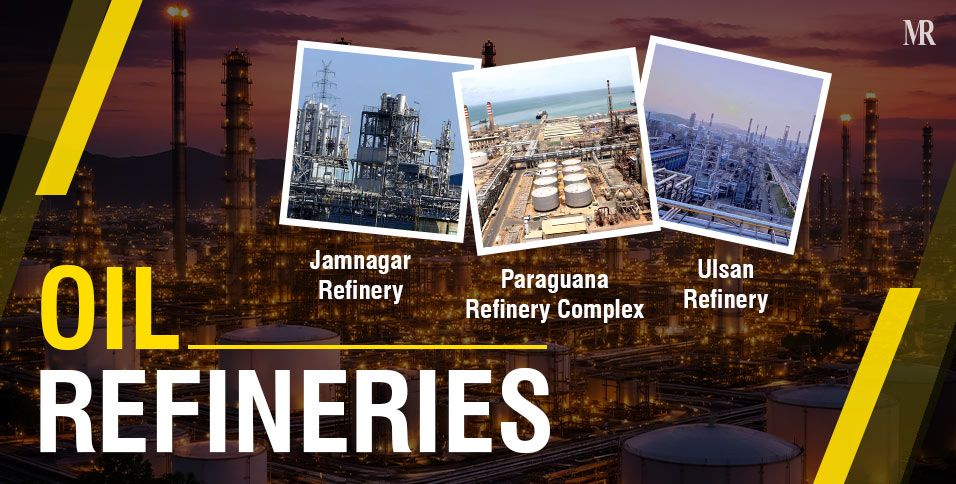
| 1. Jamnagar Refinery | Reliance Industries | Jamnagar, India | 1,240,000 |
| 2. Paraguana Refinery Complex | PDVSA | Falcón, Venezuela | 940,000 |
| 3. Ulsan Refinery | SK Energy | Ulsan, South Korea | 840,000 |
| 4. Ruwais Refinery | ADNOC | Abu Dhabi, UAE | 817,000 |
| 5. Yeosu Refinery | GS Caltex | Yeosu, South Korea | 730,000 |
The largest oil refinery in the world is the Jamnagar Refinery complex in Gujarat, India, owned by Mukesh Ambani’s Reliance Industries Limited. The site features an installed aggregate refining capacity of 1.24 million barrels per day, far exceeding any other single location. This facility is renowned for housing some of the world’s largest processing units, including fluidized catalytic crackers, cokers, and the world’s largest refinery off-gas cracker complex with an ethylene capacity of 1.7 million metric tonnes per annum.
Jamnagar holds the highest Nelson Complexity Index in the world at twenty-one point one, enabling it to process heavy crudes into products that meet strict global environmental norms.
7. Largest Oil Refineries in the US
When it comes to the largest oil refineries in the United States, these facilities dominate in scale and processing capacity, primarily concentrated along the Gulf Coast, where infrastructure and crude access are strongest.
| Refinery Name | Company | Location | Capacity (barrels per day) |
| 1. Port Arthur Refinery | Motiva Enterprises | Port Arthur, Texas | 730,000 |
| 2. Galveston Bay Refinery | Marathon Petroleum | Texas City, Texas | 631,000 |
| 3. Beaumont Refinery | ExxonMobil | Beaumont, Texas | 630,000 |
| 4. Garyville Refinery | Marathon Petroleum | Garyville, Louisiana | 606,000 |
| 5. Baytown Refinery | ExxonMobil | Baytown, Texas | 584,000 |
While most of the largest U.S. refineries are on the Gulf Coast, oil refineries in California are crucial for local fuel supply, yet ongoing closures are tightening supply and increasing energy concerns.
8. Global Refinery Infrastructure Under Attack
The global oil refining network is no longer just an economic asset; it has become a battlefield.
Amid the escalating 2026 Middle East conflict, oil refineries and energy infrastructure across the Gulf region are increasingly being targeted through coordinated drone and missile strikes.
These are not isolated incidents or industrial accidents, but deliberate attempts to disrupt global energy supply chains.
Key Global Refinery Infrastructure Under Attack Includes:
- Kuwait (Mina Al-Ahmadi Refinery): Fires triggered by repeated drone strikes led to partial shutdowns of key processing units.
- Saudi Arabia (Ras Tanura): One of the world’s largest oil export hubs faced attacks that caused temporary operational disruptions and price volatility.
- UAE (Ruwais Refinery): A major refining complex experienced shutdowns following drone threats, raising concerns about supply continuity.
- Bahrain (Bapco Refinery): Missile strikes caused explosions and fires at storage facilities, impacting regional fuel distribution.
- Iran (South Pars Gas Facilities): Strategic strikes targeted core energy processing infrastructure, escalating the conflict further.
- Iraq (Rumaila region): Energy installations were hit, contributing to sharp declines in oil export capacity.
- Kharg Island: Iran’s primary oil export terminal has faced heightened threat levels and military attention, as it handles a majority of the country’s crude exports, making it a critical vulnerability in the conflict.
Why Refineries Are Prime Targets
Modern warfare has expanded beyond military bases to include economic infrastructure. Oil refinery explosions were planned because they:
- Sit at the center of global fuel supply chains
- Are difficult and time-consuming to repair once damaged
- Have immediate ripple effects on oil prices and inflation
- Serve as leverage points in geopolitical power struggles
Global Impact
The targeting of refinery infrastructure has far-reaching consequences beyond the Middle East:
- Oil price volatility driven by supply disruptions
- Shipping risks around critical chokepoints like the Strait of Hormuz
- Energy insecurity in import-dependent economies
- Increased insurance and operational costs for oil transport and refining
Analysts estimate that over 20 major oil and gas facilities have been targeted since the conflict escalated, marking a shift toward what experts now call “energy warfare.”
9. Environmental Impact & The Future
Oil refineries sit at the center of one of the most complex challenges of our time: balancing energy demand with environmental responsibility.
These facilities are among the largest industrial sources of carbon dioxide (CO₂), sulfur oxides (SOx), and nitrogen oxides (NOx) emissions. In addition, refining processes generate wastewater and particulate matter that require strict treatment before release.
As global climate policies tighten, refinery operators are being pushed to fundamentally rethink how they operate.
Key Environmental Challenges
- High greenhouse gas emissions
- Air pollution affecting nearby communities
- Water contamination risks
- Energy-intensive operations
How the Industry is Adapting
1. Moving Towards Renewable Fuels
Traditional refineries are being retrofitted to produce:
- Renewable diesel
- Sustainable aviation fuel (SAF)
These fuels are derived from vegetable oils, waste fats, and biomass, significantly lowering lifecycle emissions.
2. Carbon Capture & Storage (CCS)
Refineries are deploying systems to capture CO₂ emissions at the source and store them underground, preventing atmospheric release.
3. Green Hydrogen Integration
Hydrogen is already used in refining, but the shift is toward green hydrogen produced using renewable energy instead of fossil fuels.
4. Digital Optimization
AI and advanced analytics are improving:
- Energy efficiency
- Predictive maintenance
- Emission control
While some refineries are shutting down, especially in regions with declining fuel demand, others are adapting to survive in a low-carbon economy.
End Note
Oil refineries remain one of the most critical yet least understood pillars of the modern economy.
They are assets that influence global trade, national security, and energy independence.
Even as the world moves toward cleaner energy, the demand for refined products like aviation fuel and petrochemical feedstocks continues to anchor their relevance.
The real story is not about decline, but transformation.
The refineries of the future will not only process crude oil, but they will also integrate renewable feedstocks, capture carbon, and operate as intelligent, low-emission systems.
Understanding how they work today is essential to understanding how the global energy system will evolve tomorrow.
Maria Isabel Rodrigues
FAQs
- How many oil refineries does the US have?
The United States has approximately 132 operational oil refineries, depending on maintenance cycles and temporary shutdowns. It is the world’s largest refining hub by throughput, with a strong concentration along the Gulf Coast, particularly in Texas and Louisiana.
- Who is the biggest oil refinery in the US?
The largest oil refinery in the United States is the Motiva Port Arthur Refinery in Texas, operated by Motiva Enterprises. It has a refining capacity of over 730,000 barrels per day, making it one of the largest single-site refineries globally.
- Why are oil refineries shutting down?
Oil refineries are shutting down due to environmental regulations, high costs, and the shift to cleaner energy. In the 2026 Middle East conflict, many are also facing temporary closures from drone attacks, supply disruptions, and security risks.
- What are some recent oil refinery explosions?
Recent oil refinery explosions are largely due to drone and missile strikes during the 2026 Middle East conflict. Major incidents include attacks on Kuwait’s Mina Al-Ahmadi, Saudi Arabia’s Ras Tanura, and the UAE’s Ruwais refinery, aimed at disrupting global oil supply.