Mirror Review
June 04, 2026
Google announced to restore 19 billion gallons of water every year by 2030 through its expanded global sustainability projects. The company currently manages 165 active projects across 97 distinct watersheds to protect local water supplies. This target means the company plans to replenish more water than its data centers consume globally.
The Google water replenishment initiative comes at a time when public concern over the environmental footprint of artificial intelligence and data infrastructure is growing excessively.
Why The Need for Google’s Water Replenishment Initiatives
The digital systems we use every day depend entirely on massive data center networks. These centers keep services like Search, Google Maps, online banking, and emergency systems running around the clock.
However, running thousands of computer servers generates an incredible amount of heat. Tech companies use water cooling because it cuts data center energy use by roughly 10% compared to air cooling.
To address the environmental impact of this process, the company is scaling up its Google water replenishment initiatives to protect the communities that host its AI infrastructure.
Understanding Google Water Stewardship Commitments
There are five major Google water stewardship commitments. These goals aim to reduce the company’s local environmental footprint and ensure that growing digital services do not deplete community resources.
1. Net-Positive Water Restorations:
The primary goal is for Google to replenish water at a higher volume than it consumes across its offices and data centers by 2030. The projected 19 billion gallons of annual restored water is more than double what the company consumed in 2024. This volume can supply the entire city of Los Angeles with water for more than 40 days. In 2025 alone, the company successfully returned over 7 billion gallons to local ecosystems.
2. Funding Public Utility Infrastructure:
Many local water utilities operate with limited budgets. The company has committed more than $500 million toward municipal water, wastewater, and water reuse systems. These funds go directly to utility partners to help fix leaky pipes and upgrade aging public supply lines.
3. Adopting Air Cooling in At-Risk Regions:
Google uses data models to evaluate the health of local watersheds before building new facilities. If an environment shows high water stress, the company installs air-cooling systems or uses recycled water instead of fresh water. For example, the company built data centers in Texas that use advanced air-cooling technologies to prevent local water depletion.
4. Public Transparency and Reporting:
To keep communities informed, the company shares its annual water use data openly. It was the first major cloud provider to disclose these metrics publicly.
5. Utilizing Reclaimed Wastewater Alternatives:
Instead of tapping into local drinking water supplies, the company looks for alternative sources like treated industrial wastewater. A long-standing project in Douglas County, Georgia, successfully routes treated municipal wastewater to cool the local data center campus.
Why Data Centers Need Water and Why Public Concern is Rising
A standard mid-sized data center uses roughly 300,000 gallons of water every single day. This consumption matches the daily water needs of about 1,000 average American households. As tech companies build larger facilities to handle advanced AI workloads, local populations worry about the safety of their water tables.
A recent Gallup poll showed that over 70% of Americans oppose having a data center built in their local neighborhood. Among those who object, 18% specifically point to excess water consumption as their primary concern. Independent researchers also argue that official corporate metrics sometimes miss indirect water usage, which can make the real environmental footprint seem smaller than it is.
Google points out that all U.S. data centers combined use less than 1% of the water that Americans pour onto their lawns each year. Even so, corporate leadership acknowledges that public concern is valid and requires direct corporate action.
Ben Townsend, Google’s Head of Infrastructure Strategy and Sustainability, spoke to The Verge about the necessity of these clear commitments:
“We think it’s really important to sort of put a blueprint out there that communities can reference, so if somebody else comes and says, ‘we’d like to build a data center there,’ a community can say, ‘well, here are five different things that really put the community and the watershed first. Are you doing these?’”
Regional Breakdown of New Water Infrastructure Investments
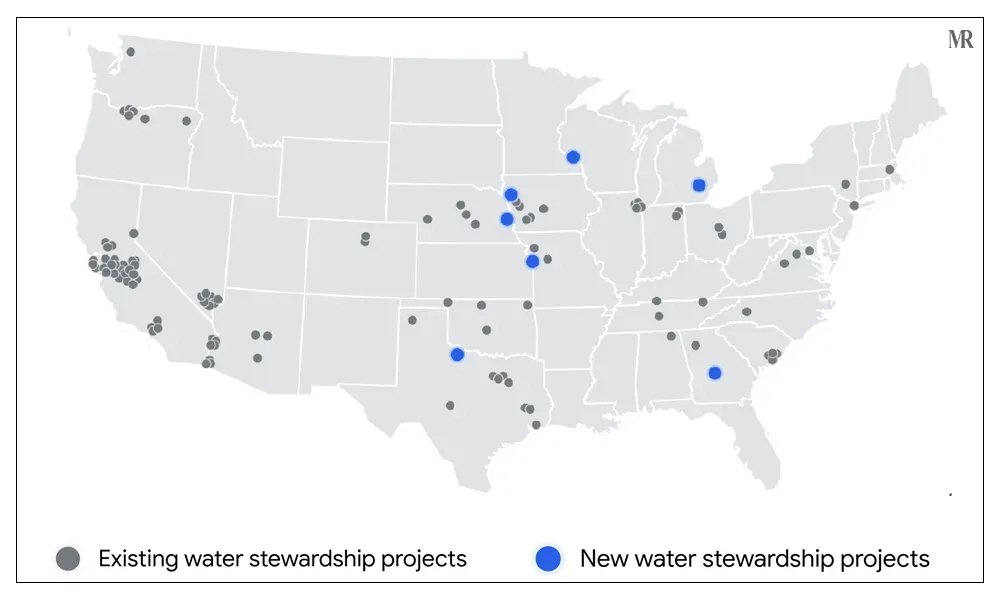
To support its sustainability goals, Google announced a new $17 million investment distributed across seven U.S. states. These projects focus on restoring natural wetlands, updating utility infrastructure, and helping agriculture conserve water.
| State | Partner Organization | Project Scope & Environmental Focus |
| Georgia | Ducks Unlimited | Enhancing natural wetlands at the Flint River Wildlife Management Area. |
| Iowa | Great Outdoors Foundation / Dept. of Agriculture | Assisting western Iowa farmers in converting 5,000 acres into perennial hay and pasture systems to lower fertilizer runoff and protect water quality. |
| Michigan | Huron River Watershed Council | Expanding green infrastructure using native plants to absorb stormwater and prevent local flooding. |
| Minnesota | Trust for Public Land | Restoring 84 acres of floodplain forest along the Zumbro River to naturalize the waterway. |
| Missouri | Bridging the Gap / Heartland Conservation Alliance | Restoring 98 acres of wetlands near the Blue River to improve local wildlife habitats and filter water. |
| Nebraska | Metropolitan Utilities District | Funding a water line leak detection program in Omaha to stop clean water loss. |
| Texas | Texas Water Impact Fund | Supporting community water infrastructure, quality, and public access across the state. |
Future Progress Through the Water Replenishment RFI
Beyond these immediate investments, Google is reviewing more than 700 additional proposals through a formal Request for Information (RFI). This global search focuses on identifying new engineering solutions, nature-based conservation methods, and farm-level agricultural practices.
The corporate review evaluates projects that improve soil health, reduce irrigation demands, and fix broken local water cycles. The company plans to select and fund the best proposals from this list in the coming months to expand its ecological restoration work.
End Note
The rapid growth of the digital economy makes water conservation an urgent priority for technology companies, especially as governments and industry leaders continue pushing large-scale energy and AI infrastructure expansion plans, including recent Trump energy pledge proposals.
While cooling infrastructure remains necessary to keep major web applications online, the Google water replenishment commitment shows a clear path forward for industrial accountability.
By restoring 19 billion gallons of water annually by 2030 and modernizing community infrastructure, it aims to prove that digital growth does not have to ruin local natural resources.
Yet, success will depend on the transparent tracking of these projects and continued cooperation with local utility managers.
Maria Isabel Rodrigues