Mirror Review
July 23, 2026
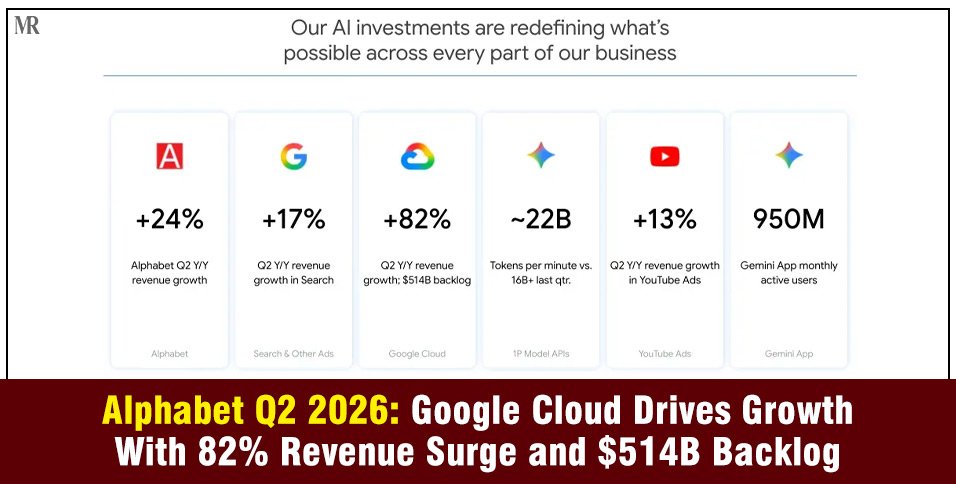
Alphabet reported second quarter revenue of $119.8 billion, up 24% year over year, while Google Cloud revenue jumped 82% to $24.8 billion. Alphabet also revealed a $514 billion Cloud backlog, highlighting sustained enterprise demand for AI infrastructure and cloud services.
Alongside strong Cloud performance, Alphabet expanded Gemini adoption, increased Search revenue, and announced higher capital spending to meet growing AI demand.
Together, these Alphabet Q2 2026 results show how Google’s long-term AI investments are translating into stronger financial performance and massive enterprise adoption.
What drove Alphabet Q2 2026 growth?
Alphabet Q2 2026 results reflected broad-based growth across the company’s businesses, with AI emerging as the biggest catalyst, as also seen in the previous quarter.
Alphabet reported $119.8 billion in revenue, up 24% year over year, marking its 12th consecutive quarter of double-digit revenue growth.
Operating income increased 30% to $40.8 billion, while operating margin expanded to 34%, showing that Alphabet continued to improve profitability even as it increased investments in AI.
Several business segments contributed to the strong quarter:
- Google Search & Other revenue grew 17%
- YouTube Ads increased 13%
- Google Services revenue rose 15% to $94.5 billion
- Google Cloud delivered the fastest growth, with revenue surging 82% to $24.8 billion
CEO Sundar Pichai attributed the performance to Alphabet’s long-term AI strategy in the Alphabet earnings transcript, stating:
“Our AI investments are redefining what’s possible across every part of our business,” Pichai said, adding that the company’s AI products are creating measurable value for consumers, enterprise customers, and partners.
Why Google Cloud became the biggest growth engine
While Search remains Alphabet’s largest business, Google Cloud emerged as the company’s fastest-growing segment during Alphabet’s second quarter of 2026.
Cloud revenue climbed 82% year over year to $24.8 billion, nearly doubling from the previous year.
Even more notable was the company’s $514 billion Cloud backlog, which represents contracted business expected to generate future revenue.
According to Alphabet’s CEO Sundar Pichai, this growth was driven by rising demand for:
- AI infrastructure
- Enterprise AI solutions
- Core Google Cloud Platform (GCP) services
- Gemini-powered enterprise products
Moreover, the recently announced Google-Blackstone AI cloud company is designed to add large-scale AI compute capacity, helping meet the enterprise demand reflected in the growing Cloud backlog.
Google also highlighted three major factors behind Cloud’s expansion:
- Customer acquisition more than doubled year over year.
- Existing customers increased their cloud usage and exceeded spending commitments by more than 50%.
- Google Cloud Marketplace transactions grew more than seven times compared to last year.
The company’s enterprise momentum continued to strengthen, with nearly 90% of Fortune 100 companies now using Gemini Enterprise. Customers including PepsiCo, Intel, HSBC, Macy’s, Bell Canada, and SIGNAL IDUNA are deploying Google’s AI tools across analytics, customer engagement, cybersecurity, and business operations.
These numbers suggest Google Cloud is evolving beyond a traditional infrastructure provider into a comprehensive enterprise AI platform.
How Gemini and AI are accelerating Cloud adoption
Artificial intelligence remained the central theme throughout the Alphabet Q2 2026 earnings transcript. Rather than positioning Gemini as a standalone chatbot, Google showcased it as the technology powering nearly every Cloud offering.
Gemini Enterprise is now integrated across Google Workspace, cybersecurity, data analytics, and enterprise AI platforms, making it easier for businesses to build AI agents, automate workflows, and manage large-scale deployments.
In the Alphabet earnings report, the company also reported several milestones that highlight growing AI adoption:
- More than 9 million developers build with Gemini models every month.
- Google Model APIs now process approximately 22 billion tokens per minute, up from 16 billion in the previous quarter.
- Nearly 500 Cloud customers each processed over 1 trillion AI tokens during the past year.
- More than 2,000 enterprises consumed over 100 billion tokens in the last 12 months.
Google also expanded its AI portfolio by introducing Gemini 3.6 Flash, Gemini 3.5 Flash-Lite, and Gemini 3.5 Flash Cyber, while confirming that Gemini 4 is already in development.
Furthermore, the latest Google Frozen v2 chip strategy aims to improve AI training efficiency while reducing the cost of running large language models at scale.
As Google builds more AI infrastructure, it is also investing in sustainability initiatives such as its water replenishment programs to help offset the environmental impact of expanding data centers.
These announcements indicate Alphabet is focusing on both high-performance AI models and cost-efficient deployment, a combination that appeals to enterprise customers seeking scalable AI solutions.
Search, YouTube, and Gemini continue to expand
Although Cloud captured most of the attention, Alphabet’s consumer businesses also posted healthy growth during the quarter.
Google Search revenue increased 17%, supported by wider adoption of AI Overviews and AI Mode. According to the company, AI Mode has now surpassed 1 billion monthly active users, while Google’s AI-powered search experiences continue to send billions of clicks to websites each week.
The Gemini app also continued its rapid expansion.
Google reported:
- 950 million monthly active users
- Daily active users have tripled over the past year
- New features such as Daily Brief and Gemini Spark are increasing user engagement.
Meanwhile, YouTube maintained its position as a leading platform for global events.
During the FIFA World Cup 2026, more than 1.7 billion unique viewers watched World Cup-related content on YouTube. The company also revealed that 140 million users interacted with its AI-powered Ask YouTube feature in June 2026, highlighting how conversational AI is becoming part of the viewing experience.
Together, these businesses continue generating the user engagement and advertising revenue that fund Alphabet’s expanding AI ecosystem.
Why Alphabet is spending more on AI infrastructure
Earlier this year, the company announced a major Alphabet stock sale to strengthen its financial position as AI infrastructure investments continued to accelerate.
Now, following its strong quarter, Alphabet increased its projected 2026 capital expenditures to between $195 billion and $205 billion, compared with its previous guidance of $180 billion to $190 billion. Much of that investment will support data centers, AI chips, networking, and compute capacity.
Chief Financial Officer Anat Ashkenazi explained the reasoning during the earnings call.
“We’re still in a supply-constrained environment… we are seeing very strong demand both from external cloud customers as well as across the business.”
Google is also expanding its AI infrastructure through technologies including:
- TPU 8t and TPU 8i accelerators
- NVIDIA Vera Rubin platform
- Virgo Network capable of connecting one million AI accelerators
- Axion CPUs delivering 30% better performance per dollar.
These investments reflect Alphabet’s strategy of building its own AI infrastructure to support future demand while reducing long-term dependence on third-party computing resources.
What investors should know from Alphabet Q2 2026 earnings?
The Alphabet Q2 2026 earnings results demonstrate that AI is becoming a meaningful driver of revenue rather than simply a source of higher costs.
Cloud delivered exceptional growth, enterprise AI adoption accelerated, and Search continued expanding despite increased competition. At the same time, higher capital expenditure guidance reminded investors that building AI infrastructure requires substantial long-term investment.
Although Alphabet exceeded revenue expectations, investor attention shifted toward the company’s larger spending plans, contributing to pressure on the stock following the earnings release.
For long-term investors, however, the quarter reinforced an important trend. Google’s AI ecosystem now spans consumer products, enterprise software, developer platforms, cloud infrastructure, and cybersecurity, giving the company multiple avenues for future growth.
End Note
The latest Alphabet Q2 2026 results further reinforce why Google continues to rank among the best companies for the future. The company’s biggest opportunity now lies not only in internet services, but also in becoming a leading provider of enterprise AI and cloud computing solutions.
Maria Isabel Rodrigues