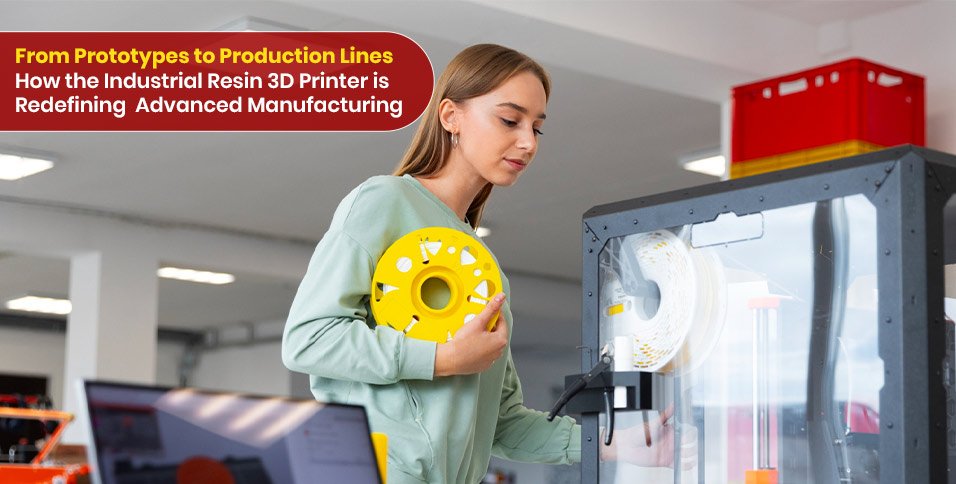
Manufacturers are under more pressure than ever to produce parts with clean surfaces, fine details, and reliable dimensions. At the same time, many desktop-grade resin printers have reached their limit when factories need larger build capacity, stable batch output, and production-level control. This is where the industrial resin 3D printer is gaining attention as more than a tool for visual prototypes.
For years, resin 3D printing was often seen as a way to make display models or early design samples. That view is changing. With stronger SLA systems, better process control, and more complete workflows, resin 3D printing is becoming part of real manufacturing, from dental production and casting patterns to electronic micro-molds and detailed industrial components.
Resin 3D Printing Is Moving Past Its Old Image
The old idea was simple: resin 3D printing is good for parts that look nice, but not for serious production. That may have been true for many small machines used in design studios, but it no longer describes the full market.
Manufacturers now expect 3D printing systems to do more than create a smooth model for presentation. They need repeatable output, predictable part quality, larger build areas, and a workflow that can fit into daily production. A beautiful first print is not enough if the second, tenth, or hundredth part cannot meet the same standard.
This is why industrial SLA technology is becoming more important. It keeps the strong surface quality and fine detail that resin printing is known for, but adds the stability and capacity needed for higher-value production work.
Why Desktop Resin Printers Hit a Ceiling
Desktop resin printers can be useful for designers, engineers, and small teams. They are often affordable and can produce sharp details on small parts. But when the goal moves from one prototype to repeated production, limitations become clear.
Common challenges include:
Small build size
Manual resin handling
Slower production workflow
Inconsistent results across batches
More dependence on operator skill
Difficulty printing many parts with the same quality
Limited control over post-processing
Higher risk of dimensional variation on larger prints
These issues do not make desktop printers useless. They simply show why production teams need a different class of equipment when resin printing becomes part of manufacturing.
In advanced manufacturing, a machine must support repeatability. It must work in a planned process, not only as a one-time experiment.
The Shift From Visual Models to End-Use Production Support
The biggest change in resin 3D printing is not only better machines. It is the way factories are using them.
A prototype is usually made to show shape, design, or fit. It helps a team understand whether an idea is worth moving forward. Production support is different. It may involve printing parts that guide assembly, support casting, assist tooling, validate dimensions, or move directly into qualified end-use applications.
SLA resin printing is especially valuable where smooth surfaces and small details matter. This includes parts with thin walls, fine edges, complex curves, tiny features, and shapes that are difficult to make with traditional tooling.
For manufacturers, the benefit is speed with control. Instead of waiting for a mold, fixture, or external supplier, teams can move from digital design to physical part much faster. When the equipment is stable enough, this speed can support real production planning.
Equipment Evolution: What Makes Industrial SLA Different
The move from prototype printing to production printing depends on the machine’s internal systems. Industrial SLA equipment must manage laser movement, resin behavior, recoating, curing, temperature, software control, and post-processing with much more discipline than a small office printer.
In simple terms, industrial SLA is not only about making the printer bigger. It is about making the whole process more stable.
Laser Control Systems for Fine and Stable Curing
In SLA printing, a laser cures liquid resin layer by layer. The accuracy of that laser matters because it affects the shape, edge quality, and fine details of the part.
A good laser control system helps the machine cure resin in a controlled way across the build area. This becomes more important when printing larger parts or many parts in one batch. If the laser system is not stable, one area of the print may perform differently from another.
For production teams, this can lead to fit problems, extra finishing work, or rejected parts. Better laser control supports more predictable results, which is one reason industrial SLA systems are becoming more relevant for advanced manufacturing.
Resin Recoating for Consistent Layer Formation
Every layer in an SLA print needs a smooth resin surface before the next layer is cured. This step may sound simple, but it has a major effect on part quality.
If recoating is uneven, the print may show surface marks, layer defects, or small dimensional errors. These issues can be especially serious when producing detailed parts or printing multiple items in one build.
Industrial systems are designed to manage this step more carefully. Better recoating helps the printer maintain consistent layer thickness and stable part geometry. In batch production, this can reduce variation between parts.
Large-Format Printing Without Losing Detail
One of the hardest parts of industrial SLA printing is scale. Printing a small detailed object is one challenge. Printing larger objects, or many small objects at once, while keeping detail across the entire build platform is a bigger challenge.
Factories need this balance. They want larger build capacity, but they do not want to lose the fine finish and accuracy that make SLA valuable in the first place.
This is why large-format SLA systems must be judged by more than build size. Buyers should also look at how well the machine controls accuracy, surface quality, curing, and repeatability across the full platform.
Automated Post-Processing and Workflow Control
Printing is only one part of resin 3D manufacturing. After printing, parts usually need washing, curing, drying, support removal, and inspection. If these steps are inconsistent, the final part quality can change even when the print itself is good.
A production workflow needs post-processing to be controlled and repeatable. This is especially important when parts are used in dental, aerospace casting, electronics, or tooling-related work.
Better post-processing control can help manufacturers achieve:
More predictable final strength
Better surface consistency
Less manual handling
Lower risk of operator error
Faster movement from print to inspection
More stable batch quality
For production teams, this matters because the goal is not only to print parts. The goal is to deliver parts that meet the same standard again and again.
Why Dimensional Consistency Matters More Than One Perfect Sample
A prototype only needs to prove that an idea can work. A production batch must prove that the process can be trusted.
This is why dimensional consistency is so important. One perfect sample may impress a design team, but it does not guarantee a stable manufacturing process. A factory needs confidence that the next batch will match the previous batch, especially when parts are used for assembly, casting, medical workflows, or electronics.
For production teams, consistency is the difference between a useful process and a risky experiment.
Industrial resin 3D printing becomes valuable when it can reduce that risk. When print results are stable, teams can plan production schedules, estimate costs, and build stronger quality control systems around the process.
Industrial resin 3D printing is growing because many industries need detail, accuracy, and smooth surfaces. Its value is not limited to one field. The strongest applications are often found where traditional methods are too slow, too expensive, or limited by tooling.
Dental Manufacturing: Crowns, Models, and Surgical Guides
Dentistry helped show how resin 3D printing can move into repeatable production. Dental work often requires custom shapes, close fit, and smooth surfaces. This makes SLA technology useful for dental models, surgical guides, aligner models, and crown-related workflows where suitable materials and approved processes are used.
The key point is not only customization. It is repeatability. Dental labs need many parts that are different in shape but consistent in quality. Industrial resin printing supports this type of workflow because it can combine digital design with batch production.
Aerospace Investment Casting: Precision Patterns for Complex Parts
In aerospace manufacturing, part geometry can be complex, and surface quality can affect downstream processes. Resin SLA printing can support investment casting by producing detailed patterns or master models for complex parts.
This does not mean resin parts replace metal aerospace parts. Instead, SLA can support the process before the metal part is made. A smooth and accurate pattern can help improve casting preparation, reduce manual model-making work, and support complex shapes that would be difficult to form with traditional methods.
For aerospace suppliers, this can shorten development time while keeping fine geometry under control.
Electronics: Micro-Molds and Connector Development
Electronics manufacturing often works with very small details. Connectors, housings, micro-molds, testing fixtures, and assembly aids may need clean edges and accurate dimensions.
Industrial resin printing is useful here because SLA can produce fine features and smooth surfaces. For connector development or micro-mold workflows, this level of detail can help engineering teams test designs before moving to full tooling.
It can also support faster design changes. When a small feature needs adjustment, the team can update the digital file and print a new version without waiting for traditional tooling changes.
Industrial Design and Product Validation
Resin 3D printing still has an important role in design, but that role has become deeper. It is no longer only about creating a model that looks good in a meeting.
Industrial design teams use high-quality resin prints to test fit, shape, ergonomics, assembly, and user interaction. A smooth and accurate part can help teams understand how the final product may feel and function.
This is useful before investing in molds or mass production. It helps reduce design risk and gives decision-makers more confidence before moving forward.
Mold and Tooling Support
In mold-related work, resin SLA printing can support master patterns, casting aids, tooling models, and verification parts. It can help teams check form, fit, and fine details before committing to expensive tooling steps.
For complex parts, this can reduce development pressure. Engineers can test ideas earlier, identify issues faster, and improve the tooling process before large investments are made.
Industrial SLA vs. Desktop Resin Printing
The difference between desktop resin printing and industrial SLA is not only price. It is the level of control, capacity, and production readiness.
Area
Desktop Resin Printer
Industrial SLA Resin Printer
Main purpose
Small prototypes and visual models
Production support, batch printing, and large-format applications
Build capacity
Usually limited
Designed for larger parts or multiple parts per build
Process control
Often more manual
Built for more stable workflow control
Batch quality
Can vary with operator skill
Designed for stronger repeatability
Detail across large areas
May become harder to maintain
Better suited for detailed large-format output
Post-processing
Often handled separately by hand
Easier to connect with controlled production steps
Best environment
Design desk, studio, small lab
Factory, service bureau, dental lab, engineering center
This does not mean desktop systems have no value. They are still useful for early design work and small samples. But production-line use requires another level of reliability. Once a company depends on resin printing for real output, the equipment must support volume, quality, and repeatability at the same time.
In a smart factory, 3D printing should not sit alone in the corner. It needs to connect with design software, material planning, production scheduling, post-processing, inspection, and quality control.
This is where additive manufacturing solutions become important. A factory does not only need a printer. It needs a complete process that helps teams move from digital design to qualified parts with fewer delays and less confusion.
For SLA printing, this means the company should think about the full workflow:
How files are prepared
Which materials are used
How parts are printed
How parts are washed and cured
How supports are removed
How dimensions are checked
How batches are recorded
How results are repeated over time
When these steps are connected, resin 3D printing becomes more than a fast prototyping tool. It becomes part of the factory’s production system.
What Buyers Should Evaluate Before Choosing an Industrial Resin 3D Printer
Choosing an industrial resin printer is not only about asking which machine has the largest build size. A larger machine is useful only if it can also provide stable accuracy, controlled curing, and repeatable results.
Purchasing teams should look at the machine from a production point of view. The right question is not simply, “Can it print this part?” The better question is, “Can it print this part again and again at the quality level we need?”
Important points to review include:
Required build size
Monthly production volume
Surface finish expectations
Dimensional tolerance needs
Resin material options
Laser and optical system stability
Recoating performance
Software workflow
Post-processing requirements
Operator training
Maintenance support
Quality inspection process
Batch tracking and documentation
The best equipment choice depends on the company’s real workload. A dental lab, aerospace supplier, electronics manufacturer, and product design team may all need SLA printing, but they may not need the same machine setup.
Why Material Choice Matters
SLA resin printing depends heavily on material selection. The printer may create the shape, but the resin affects the final behavior of the part.
Some resins are designed for visual models. Others are made for heat resistance, casting, dental use, toughness, flexibility, or engineering validation. The wrong material can lead to weak parts, poor fit, surface problems, or failure during post-processing.
For production use, material selection should be tested and documented. Teams need to understand how the resin performs after printing, washing, curing, aging, and real use. This is especially important for industries with strict quality needs.
A strong industrial SLA workflow treats material as part of the system, not as a simple consumable.
The Role of Quality Control in Production SLA
As resin 3D printing moves into production, quality control becomes more important. It is not enough to check whether a part looks correct. Teams need a process for measuring and confirming results.
This may include checking dimensions, surface quality, curing results, batch records, and part performance. In some industries, documentation may also be required to prove that the process followed approved steps.
Quality control helps manufacturers identify problems early. It also helps them improve the process over time. When teams understand why a print succeeds or fails, they can reduce waste and improve production confidence.
This is another reason industrial SLA should be seen as part of a wider workflow. The printer is important, but the inspection and control process around it are just as important.
The Macro View: Additive Manufacturing Is Becoming Part of the Whole Factory
Industrial resin 3D printing is no longer limited to making attractive prototypes. It is becoming part of advanced manufacturing because it can support detailed parts, stable batches, faster design changes, casting workflows, dental production, electronics, tooling, and product validation.
The larger shift is about integration. Additive manufacturing becomes more valuable when it is connected to the full production chain. That includes design, material selection, printing, post-processing, inspection, and final use.
For smart factories, the goal is not to use 3D printing as a separate experiment. The goal is to make it part of a flexible, digital, and reliable manufacturing system. When industrial SLA is used this way, it can help manufacturers move faster while still meeting the quality demands of modern production.
Final Thoughts
The industrial resin 3D printer is changing how manufacturers think about SLA technology. It is still useful for prototypes, but its role is now much wider. With better equipment control, larger build capacity, stable recoating, improved post-processing, and stronger workflow integration, resin 3D printing can support serious production needs.
For companies that require fine detail, smooth surfaces, and repeatable output, industrial SLA is becoming a practical production tool. The real value comes when the printer is not treated as a standalone machine, but as part of a complete manufacturing process built for quality, speed, and consistency.
Is resin 3D printing only used for prototypes?
No. Resin 3D printing is still useful for prototypes, but industrial SLA systems can also support production-related parts, casting patterns, dental workflows, tooling models, and detailed manufacturing aids.
What makes an industrial resin 3D printer different from a desktop resin printer?
An industrial resin printer is designed for larger build capacity, stronger process control, more stable output, and better repeatability across batches. Desktop systems are useful for small samples, but they are not always suitable for production-level workflows.
Why is SLA technology used for high-detail applications?
SLA technology can produce smooth surfaces and fine details. This makes it useful for parts that need clean edges, small features, accurate shapes, and a high-quality finish.
Which industries use industrial SLA resin printing?
Industrial SLA resin printing is used in dental, aerospace casting, electronics, industrial design, mold manufacturing, product development, and precision manufacturing. The best use depends on the part, material, and production requirements.
What should companies check before investing in SLA equipment?
Companies should review build size, production volume, surface finish needs, dimensional accuracy, material options, laser stability, recoating quality, post-processing workflow, training, maintenance, and quality control requirements.