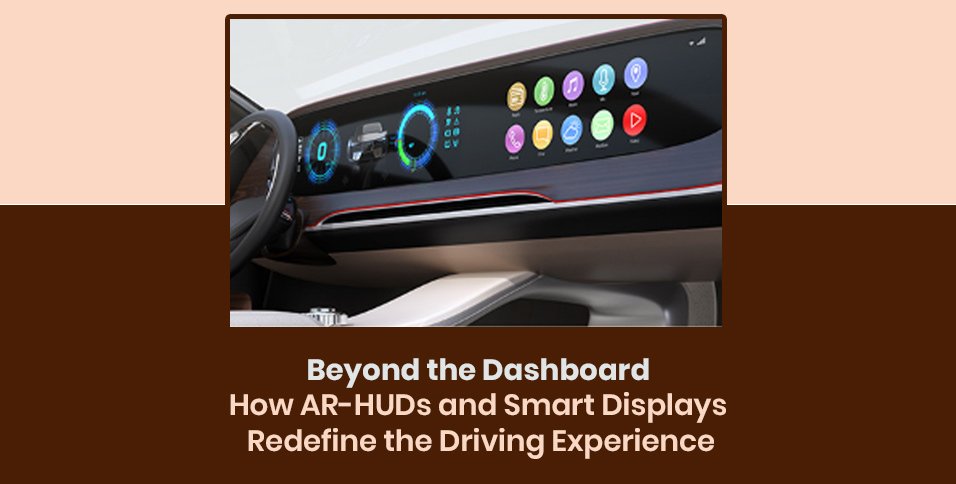
Today’s vehicle cabin isn’t just about mechanics and a simple dashboard. Today, the interior is shrinking to a fully digital space, with the driving data, entertainment, navigation, communication and safety alerts all being integrated into a single system. The changes are affecting the way drivers look at vehicles, particularly younger drivers who are more concerned with screen quality, interface design and connectivity than engine performance.
The vision of an automotive digital cockpit is becoming the focus with smarter vehicles. It combines several screens, smart interfaces and real-time data systems into an all-encompassing driving experience. In addition to AR-HUDs, hidden controls and multi-screen layouts, the car cabin is also becoming a connected digital universe, far more than a vehicle interior.
From Dashboard to Digital Cockpit: What Has Changed?
Traditional dashboards were designed for a simple purpose: show speed, fuel level, engine warnings, and basic vehicle status. The driver’s interaction was limited and mostly mechanical. Each function had a fixed place, and the system did not change based on user behavior or context.
Modern vehicles have completely transformed this setup. Today’s cockpit integrates digital instrument clusters, center touchscreens, passenger displays, AR-HUD systems, voice assistants, and smartphone connectivity. These components are not isolated anymore. They work together as a single ecosystem, sharing data and responding in real time.
This shift has turned the car interior into a connected control center. It now manages driving safety, entertainment, climate comfort, navigation, and vehicle settings simultaneously. The result is a more dynamic and intelligent driving environment that adapts to different situations and user needs.
What Is an AR-HUD and Why Does It Matter?
An AR-HUD, or Augmented Reality Head-Up Display, projects essential driving information directly into the driver’s forward field of view. Instead of looking down at the dashboard or center screen, the driver sees key information closer to the road. This reduces distraction and improves reaction time.
The importance of AR-HUD lies in how naturally it integrates information into real-world driving conditions. By aligning digital cues with the physical road, it helps drivers process information without shifting focus away from traffic.
AR-HUD information typically includes:
● Speed
● Navigation arrows
● Lane guidance
● Safety warnings
● Distance alerts
● Driving assistance prompts
● Road sign information
● Energy or range information in EVs
By keeping the driver’s attention forward, AR-HUD technology improves both convenience and safety in modern vehicles.
Multi-Screen Integration: The New Selling Point for Smart Cars
Modern vehicles are increasingly designed with multiple coordinated screens. These may include a digital instrument cluster, a central infotainment screen, a passenger display, rear-seat entertainment systems, and an AR-HUD. Instead of operating independently, these screens now function as one connected system.
Highly integrated automotive digital cockpits have become a key selling point for attracting young consumers.
This change is strongly influenced by user expectations. Younger drivers are already used to smartphones, tablets, and gaming devices. They expect fast response, smooth transitions, and visually clear interfaces inside cars as well. A well-designed cockpit now plays a major role in shaping how premium and modern a vehicle feels, even before evaluating traditional factors like powertrain or handling.
How Smart Displays Blend Driving and Entertainment
Smart displays in modern vehicles are no longer limited to navigation or music control. They now act as central hubs for nearly every vehicle function. Drivers and passengers can control climate settings, seat adjustments, navigation, driving modes, charging information, and entertainment systems through connected screens.
The key challenge is balance. The system must provide rich entertainment options without interfering with driving safety. The driver’s display must remain focused on essential driving information, while passengers and rear-seat screens can access more interactive content.
Smart displays may connect:
● Navigation
● Music and media
● Climate control
● Vehicle settings
● Charging information
● Seat functions
● Smartphone connection
● Rear-seat entertainment
● Driver assistance alerts
This integration creates a more flexible and personalized in-car experience, but it also requires careful design to avoid distraction.
Hidden Interactive Interfaces: Less Clutter, More Control
Modern electric vehicle interiors are shifting toward a minimal and clean design approach. Instead of physical buttons and switches, many functions are now hidden inside touch panels, voice systems, gesture controls, and adaptive menus.
This design approach makes the cabin look more premium and organized. However, it also changes how users interact with the vehicle. Functions that were once instantly accessible may now require screen navigation or voice commands.
The benefit is a cleaner and more futuristic cabin experience. The risk is usability during driving. If essential controls are not easy to find or operate quickly, it can affect both convenience and safety. This is why interface design plays a critical role in modern cockpit development.
The Balance Between Safety and Screen Experience
More screens and advanced visuals do not automatically improve the driving experience. The real value of a smart cockpit comes from how effectively it delivers the right information at the right time without overwhelming the driver.
Clear Information Priority
Critical information such as speed, warnings, and navigation must always be more visible and accessible than entertainment or secondary settings.
Driver Attention Protection
A well-designed cockpit minimizes unnecessary distractions. It avoids frequent pop-ups and reduces the need for constant visual switching while driving.
Simple Control Paths
Important functions should be accessible in minimal steps. Drivers should not need to navigate deep menus for common actions like adjusting climate or switching driving modes.
Voice and Touch Working Together
Voice control reduces physical interaction, while touchscreens remain important for detailed settings. A balanced combination improves usability and safety.
AR-HUD vs Traditional Dashboard Display
How AR-HUDs Change the Driver Information Flow
| Area | Traditional Dashboard Display | AR-HUD |
| Viewing position | Driver looks down at the dashboard | Information appears closer to the road view |
| Navigation | Shown on screen or cluster | Direction cues can appear in the forward view |
| Safety alerts | May require a quick glance down | Alerts can appear where the driver is already looking |
| Driving focus | More eye movement may be needed | Can reduce the need to look away |
| Visual experience | Limited to dashboard screen | Feels more connected with the road |
| Smart driving support | Basic warnings and icons | Can support richer driving guidance |
AR-HUD does not replace all displays in the vehicle. Instead, it works best as part of a complete system that includes the instrument cluster, central infotainment screen, and advanced driver assistance systems.
Why Young Consumers Care About Digital Cockpits
Younger car buyers often evaluate vehicles in the same way they evaluate digital devices. Screen responsiveness, interface design, app integration, and visual quality strongly influence their perception of a car.
For many of them, the cockpit experience is part of the brand identity. A well-designed digital interface can make a vehicle feel more advanced and premium even before considering technical specifications like engine power or battery range.
This shift in expectations has pushed automakers to treat in-car digital experience as a core design priority rather than a secondary feature.
The Role of Software in the Smart Cockpit
A smart cockpit is not just a hardware system made of screens and displays. It is fundamentally driven by software. Every interaction, animation, data update, and control flow depends on software integration.
The software layer connects navigation, voice assistance, media systems, driver alerts, and vehicle controls into one unified interface. It determines how fast the system responds, how intuitive the menus feel, and how smoothly different components communicate with each other.
Without strong software design, even advanced hardware can feel slow, disconnected, or difficult to use.
Why E/E Architecture Is the Hidden Foundation
Behind every smart cockpit is a complex electrical and electronic (E/E) architecture. This system connects sensors, control units, displays, communication modules, and vehicle functions into a unified network.
A weak architecture can limit performance, causing delays, integration issues, and software instability. On the other hand, a strong E/E system enables faster processing, smoother updates, and better coordination between different vehicle systems.
EV Engineering: The Backbone Behind Smart Cockpit
Integration
Advanced cockpit systems depend heavily on vehicle-level engineering. Screen design alone is not enough. It requires deep integration between hardware, software, power systems, communication networks, and vehicle control units.
This capability relies on deep expertise in EV engineering.
In electric vehicles, the cockpit is closely connected to battery data, range estimation, charging systems, driver assistance features, and energy management systems. This makes engineering integration essential for ensuring accuracy, performance, and system stability.
What Automakers Should Consider Before Designing a Smart Cockpit
● Driver information priority
● Screen size and placement
● AR-HUD viewing quality
● Multi-screen coordination
● Passenger entertainment needs
● Voice control quality
● Touch response speed
● Hidden interface usability
● Over-the-air update support
● Safety alert design
● E/E architecture compatibility
● Software and hardware integration
● Production cost and reliability
● Testing under different lighting conditions
A successful cockpit design must balance user experience, safety, and technical feasibility rather than focusing only on visual complexity.
Future Trend: The Cockpit Will Become More Personalized
Future vehicle cockpits will likely adapt to individual drivers in more advanced ways. Seat positions, screen layouts, navigation preferences, entertainment options, and climate settings may automatically adjust based on user profiles.
As artificial intelligence becomes more integrated into vehicles, the cockpit will evolve into a personalized digital companion that supports daily mobility rather than just a control interface.
Conclusion
AR-HUD systems, smart displays, hidden interfaces, and multi-screen integration are fundamentally reshaping how people interact with vehicles. The modern cockpit is no longer a simple information panel but a connected digital environment.
Ultimately, the best automotive digital systems will not be judged by the number of screens they include, but by how effectively they combine safety, usability, entertainment, and intelligent driving support into one seamless experience.
What is an automotive digital cockpit?
An automotive digital cockpit is the integrated digital interface inside a vehicle that includes screens, instrument clusters, HUD systems, voice control, navigation, entertainment, and vehicle settings.
What is an AR-HUD in a car?
An AR-HUD is a display system that projects driving information like speed, navigation, and alerts into the driver’s forward field of view.
Why are digital cockpits important in EVs?
Electric vehicles depend heavily on software and digital systems for battery management, range estimation, and charging control, making digital cockpits essential for user experience.
Do more screens make a car better?
Not necessarily. A better cockpit focuses on clarity, safety, responsiveness, and balanced interaction rather than screen quantity.
Why does E/E architecture matter for smart cockpits?
It connects all electronic systems in the vehicle, ensuring smooth communication between hardware, software, and user interfaces.