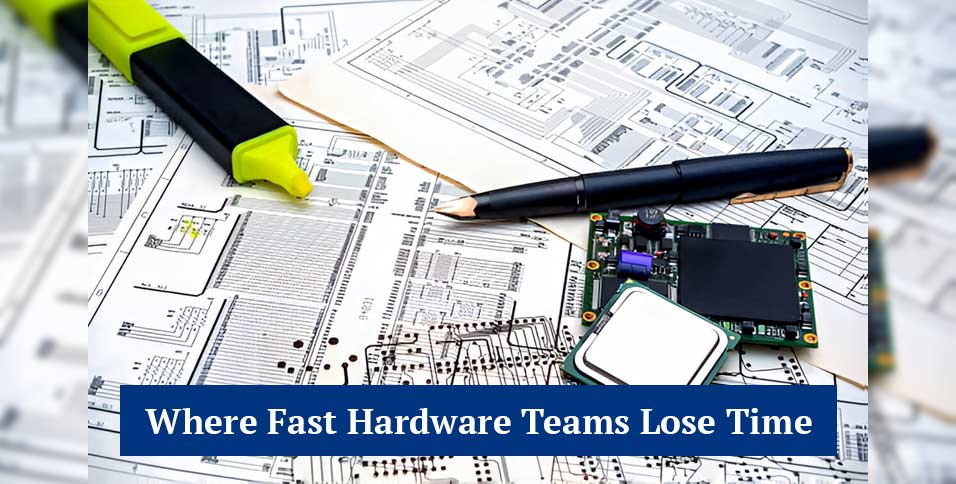
The first successful prototype can create false confidence
Fast hardware teams sometimes think the hardest part is getting the first prototype made. Once a part fits, an assembly works, or a demo is back on schedule, it feels as if momentum has been secured. The team moves on and assumes the manufacturing side is under control.
That is often where a different problem begins.
A first successful prototype proves that a part can be made. It does not prove that the team has a stable path for the next revision, the next short run, or the next round of testing. That gap often stays hidden until the schedule tightens and the same part starts returning in new forms.
Fast teams usually do not lose time on the first build. They lose it later, when growth exposes weak continuity between prototype, revision, and repeat production.
Speed starts breaking down when the work comes back
A fast team rarely stalls because one prototype takes too long. More often, the slowdown begins when version two arrives three days later, then version three the following week, and then a request for a handful of updated units comes in for testing, a customer review, or a pilot build.
At that point, speed is no longer about how quickly a file can be uploaded or quoted. It becomes a question of continuity. Does the context from the first build stay attached to the second one? Does the team still know which material was used, which surface mattered most, or which note on the drawing affected assembly? Does the supplier understand the job the same way this time?
If that continuity is weak, time starts disappearing in small but costly ways. Engineers repeat explanations that should already be clear. Parts are reviewed again because confidence in repeatability is lower than it should be. A revision that should have taken one cycle turns into two because the reasoning from the previous build was never carried forward.
The real test is not the first order
A company can live with a weak system longer than it expects because the first order often hides the weakness. One part ships. The result is usable. The deadline is met. From the outside, that looks like success.
The problem appears when the work stops being isolated. A fast hardware team does not live on first orders alone. It lives on revisions, repeated learning, and the need to keep technical decisions coherent over time. That is where a fragile system starts leaking time.
The second order is usually the real test. So is the first short run. So is the moment when the part is no longer only for internal use and now needs better finish, stronger consistency, or tighter interpretation. Those moments reveal whether the organization is still relying on individual effort to hold everything together or whether it has built a repeatable way of working.
Continuity matters more than teams expect
When companies talk about manufacturing speed, they often talk about turnaround in days. That matters, but real speed also depends on whether each new build starts from zero.
A team moves faster when important decisions travel with the work. The selected material should not have to be rediscovered. The finishing expectation should not have to be restated from memory. The reason behind a previous choice should not disappear between revisions. When that information survives, the team is building momentum. When it does not, the team is recreating momentum every time.
The most expensive delay in a hardware company is often not machine time. It is skilled internal time. When designers, engineers, and operators keep solving the same communication problem, the company may still look fast from the outside while quietly slowing down inside.
What changes as a team matures
Early speed often depends on improvisation. That is normal. A small team makes a quick decision, pushes a file out, solves the next issue, and keeps going. That flexibility is useful. The problem starts when the company keeps using the same pattern after the work becomes more exposed to repetition and variation.
As a team matures, manufacturing stops being only a purchasing task or a tactical action. It becomes part of execution discipline. The business needs a way to preserve context, maintain repeatability, and keep decisions from dissolving between one round and the next.
That does not mean every company needs the same supplier model. Some teams keep broad supplier access for flexibility. Others lean more on continuity and closer review once repeat builds start to matter more. That is one reason engineering-led providers such as Upside Parts can become more useful as projects move from quick prototypes into repeated plastic builds that need both speed and context.
Fast teams keep time by protecting meaning
The teams that hold their speed longest are not always the ones with the quickest first prototype. They are usually the ones that stop treating each build as an isolated event. They protect the meaning around the work, not just the file itself.
The real question for a growing hardware company is not whether it can move quickly once. It is whether it can keep moving quickly when the project starts coming back in harder forms. Fast hardware teams lose time where continuity breaks. They regain it when manufacturing becomes part of a stable operating system rather than a repeated scramble to recreate what the last build already taught them.