For Americans sports is not just entertainment, it’s a way of life! From thrilling last-minute touchdowns to buzzer-beating three-pointers, sports bring people together like nothing else. And with so many professional sports leagues to choose from, there’s always a game to watch and a team to root for.
In fact, the combined revenue of the Big 5 US sports leagues crossed $52.3 billion in the 2025-26 season, making American sports the most lucrative ecosystem in global athletics.
But have you ever wondered which sports bring in the big bucks?
Read on to take a look at the five most profitable sports leagues here in the US!
The Top 5 Most Profitable Sports Leagues In The US
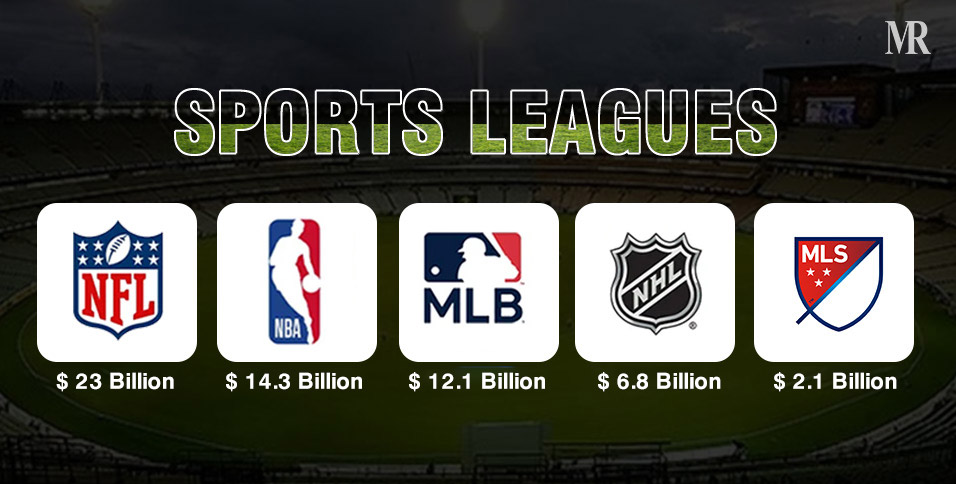
| Most Profitable Sports Leagues (USA) | Revenue | Most Profitable Team (Revenue 2025) |
| 1. National Football League (NFL) | $23 billion (2025) | Dallas Cowboys ($1.2B) |
| 2. National Basketball Association (NBA) | $14.3 billion (2025-26) | Golden State Warriors ($11B) |
| 3. Major League Baseball (MLB) | $12.1 billion (2024-25) | New York Yankees ($8B) |
| 4. National Hockey League (NHL) | $6.8 billion (2025-26) | Toronto Maple Leafs ($4.4B) |
| 5. Major League Soccer (MLS) | $2.1 billion (2024-25) | Los Angeles FC ($150M) |
1. NFL – National Football League

- Revenue (2023): $23 billion
- No. of teams: 32
- First season: 1920
- Founded in: 1920, Canton, Ohio, U.S.
- Commissioner: Roger Goodell
If you guessed that the NFL is the most popular sports in the world, then you can pat yourself on the back!
The National Football League (NFL) is a professional American football league made up of 32 teams, with an equal split between the American Football Conference (AFC) and the National Football Conference (NFC).
In 2025, the NFL league-wide revenue reached a record $23 billion, marking a year-over-year growth of more than14%. This surge has been powered largely by long-term media rights deals worth nearly $110 billion over 11 years, alongside record sponsorship income and international expansion.
In 2025, NFL team sponsorship revenue hit an all-time high of $2.5 billion, with ticketing, alcoholic beverage, telecom, financial services, and apparel brands accounting for over 60% of total sponsorship growth across the league.
The NFL’s most profitable and popular team, the Dallas Cowboys, became the most valuable sports franchise in the world, with a valuation of $13 billion, extending their lead for the 19th consecutive year.
Other highly valuable NFL teams include the Los Angeles Rams ($10.5B), New York Giants ($10.1B), New England Patriots ($9B), San Francisco 49ers ($8.6B), Philadelphia Eagles ($8.3B), Chicago Bears ($8.2B), New York Jets ($8.1B), and Las Vegas Raiders ($7.7B).
With all 32 NFL franchises now valued at over $5 billion, the NFL remains the most profitable sports league in America and the world.
2. NBA – National Basketball Association

- Revenue (2024): $14.3 Billion
- No. of teams: 30
- First season: 1946–47
- Founded in: 1946, New York, United States
- Commissioner: Adam Silver
The NBA is the second most popular American sports leagues, driven by high-profile players and intense global interest. For many sports fans across the country, basketball is their game of choice.
The NBA was founded on June 6, 1946, but officially formed on August 3, 1949. This was after a merger between the Basketball Association of America (BAA) and National Basketball League (NBL). In 1976, the NBA mer
ged with the American Basketball Association (ABA), which expanded the sports leagues by incorporating four new franchises.
For the 2025–26 season, the NBA is projected to generate $14.3 billionin league-wide revenue, representing a 12% year-over-year increase. This growth is being fueled primarily by the league’s new 11-year, $76 billion media rights deal with ESPN/ABC, NBC, and Amazon, which significantly boosts national broadcast revenue for all 30 franchises.
Under the new media agreements, each NBA team is expected to earn approximately $143 million annually from national TV rights, strengthening financial stability across both large- and small-market franchises.
Among individual teams, the Golden State Warriors remain the league’s financial benchmark, generating close to $880 million in annual revenue and holding a valuation of $11 billion, making them the most valuable NBA franchise in 2025.
Other highly valuable NBA teams include the Los Angeles Lakers ($10B), New York Knicks ($9.75B), Los Angeles Clippers ($7.5B), Boston Celtics ($6.7B), Chicago Bulls ($6B), and Houston Rockets ($5.9B).
With the average NBA franchise now valued at over $5.4 billion, and every team benefiting from escalating media, sponsorship, and international revenues, the NBA stands as one of the fastest-growing and most investor-attractive sports leagues in the world.
3. MLB – Major League Baseball

- Revenue (2024): $12.1 Billion
- No. of teams: 30
- First season: 1901
- Founded in: 1876, Cincinnati, Ohio, United States
- Commissioner: Robert Dean Manfred Jr
Baseball, known as America’s favorite pastime, is another highly profitable sports league. What makes this so interesting is that baseball isn’t exactly a popular sport around the world. Sure, it has fans, clubs and teams, but the majority of the action and fan base is located within the US.
The Major League Baseball (MLB) is the oldest professional sports league in the United States, featuring 30 teams across the U.S. and Canada, and represents the highest level of professional baseball in the world.
In 2024, MLB generated a record $12.1 billionin league-wide revenue, driven by improved attendance, higher ticket sales, and strong sponsorship growth. Attendance rose for the fourth consecutive season in 2025, supported by rule changes such as the pitch clock, which helped speed up the game and boost fan engagement.
The league’s most iconic and profitable franchise, the New York Yankees, remain MLB’s financial benchmark. In the latest valuations released in 2025, the Yankees were valued at approximately $8 billion, generating over $700 million in annual revenue, the highest in the league.
Other highly valued MLB teams include the Los Angeles Dodgers ($6.9B), Boston Red Sox ($4.8B), Chicago Cubs ($4.6B), San Francisco Giants ($4B), and New York Mets ($3.2B), highlighting the league’s continued dominance as one of the most profitable sports leagues.
4. NHL – National Hockey League

- Revenue (2024): $6.8 Billion
- No. of teams: 32
- First season: 1917–18
- Founded in: 1917, Montreal, Quebec, Canada
- Commissioner: Gary Bettman
The NHL ranks fourth in the most profitable sports leagues in the US and is considered the premier professional ice hockey league in the world.
NHL’s appeal lies in the high-speed action and fan loyalty, particularly in the northern US states and Canada. The NHL has also made great strides in growing its audience beyond traditional hockey markets, especially with its Winter Classic and outdoor games.
For the 2025–26 season, the NHL projects league-wide revenue of approximately $6.8 billion, according to Commissioner Gary Bettman. Sponsorship revenue alone now exceeds $1.4 billion annually, driven by jersey ads, helmet sponsorships, and digitally enhanced dasherboards.
Media rights remain a major growth driver. In 2025, the NHL finalized a new 12-year Canadian broadcast deal with Rogers Communications worth nearly $8 billion (USD equivalent), more than doubling the annual value of the league’s previous agreement.
The Toronto Maple Leafs continue to lead the league financially, ranking as the NHL’s most valuable franchise for the third straight year. In 2025, the Maple Leafs were valued at $4.4 billion, becoming one of only two NHL teams to surpass the $4 billion mark.
Overall, the NHL’s financial health has strengthened considerably. The average franchise valuation reached $2.2 billion in 2025, more than double its level from just three years earlier, and every NHL team was profitable in the most recently reported season. This is an achievement unmatched by most other profitable sports leagues in the US.
5. MLS – Major League Soccer

- Revenue (2023): $2.1 Billion
- No. of teams: 29
- First season: 1996
- Founded in: 1993, United States
- Commissioner: Don Garber
The MLS is one of the fastest-growing sports leagues in the US, driven by the rising popularity of soccer, especially among younger generations. While soccer is more globally popular in Europe than in the US, the MLS has seen tremendous growth in recent years, with increasing viewership, new franchises, and major signings like Lionel Messi to Inter Miami, boosting its profile.
As reported in 2025, MLS sponsorship revenue reached a record $665 million, representing a 13% year-over-year increase. League and club-level partnerships expanded rapidly, supported by jersey sponsorships, stadium naming-rights deals, and brand integrations tied to the Apple TV “MLS Season Pass” ecosystem.
From a valuation standpoint, MLS continues to see rapid appreciation. In 2025, Los Angeles FC (LAFC) remained the league’s most valuable franchise for the third consecutive year, valued at approximately $1.25 billion. Close behind, Inter Miami CF reached a valuation of $1.2 billion, driven by league-leading revenue of $180 million and operating income of $50 million, the highest in MLS.
The league’s average team valuation now stands at roughly $690 million, more than double its level in 2019.
With 29 teams, including new expansions, MLS continues to expand its footprint across the country, attracting a loyal and growing fan base.
Now that we have reached the end of our list on the Most Profitable Sports Leagues in the US, let’s take a look at the 2026 outlook on these sports leagues.
2026 Outlook on the 5 Most Profitable Sports Leagues
- Media Rights Are Now the Primary Growth Engine
By 2026, media rights, not just ticket sales, are the single biggest revenue driver across US sports. The NFL’s long-term broadcast deals worth nearly $110 billion, the NBA’s new $76 billion media agreement, and the NHL’s expanded Canadian rights deal have fundamentally reshaped league economics. Guaranteed broadcast income now provides predictable cash flow, insulating leagues from short-term fluctuations in attendance or performance.
- Franchise Valuations Are Decoupling From On-Field Success
In 2026, winning championships or prize money is no longer the sole determinant of a team’s financial value. Teams like the Dallas Cowboys, New York Yankees, Golden State Warriors, and Toronto Maple Leafs continue to dominate valuations due to market size, brand equity, stadium ownership, and media exposure even during average on-field seasons. This shift reflects sports franchises increasingly being viewed as long-term media and real-estate assets, rather than just competitive teams.
- Sponsorship Models Have Become More Sophisticated
Across all five leagues, sponsorship revenue has evolved beyond traditional jersey logos. Digital dashboards (NHL), naming-rights mega deals (MLB, MLS), helmet and uniform integrations (NFL, NHL), and data-driven ad targeting have expanded inventory without increasing game length. By 2026, sponsorship growth is being driven as much by technology and analytics as by audience size.
- Globalization Is No Longer Optional
International expansion is now a core strategy, not a side project. The NFL’s regular-season games in Europe, the NBA’s global fan base, MLB’s international series, and the NHL’s renewed Olympic participation are all aimed at unlocking non-US revenue streams. MLS stands to benefit the most in the short term, with the 2026 FIFA World Cup acting as a catalyst for sustained growth in attendance, sponsorships, and youth engagement.
- Profitability Gaps Are Widening Across Leagues
While leagues like the NFL and NHL now report profitability across nearly all franchises, others, especially MLS and MLB, still face uneven financial performance. In 2026, the gap between top-tier franchises and mid-market teams is widening, driven by differences in local media deals, stadium economics, streaming and ownership investment. This divergence is shaping future conversations around revenue sharing and competitive balance.
- The Business of Sports Is More Stable Than Ever
Despite economic uncertainty in other industries, US professional sports have emerged as one of the most resilient entertainment sectors. Long-term contracts, locked-in media revenue, and rising franchise values have made sports leagues increasingly attractive to institutional investors, private equity, and global ownership groups. By 2026, the biggest sporting events are no longer just cultural institutions, they are highly structured, capital-efficient businesses.
End Note
At the end of the day, the most popular sports leagues in America aren’t just about packed stadiums or championship rings anymore. They’re massive business ecosystems.
From the NFL’s media dominance to the NBA’s global pull, MLB’s legacy strength, the NHL’s steady profitability, and MLS’s rapid rise, each league is winning in its own way.
What really stands out in 2026 is how resilient and future-ready these leagues have become. Long-term media deals, smarter sponsorship models, and global expansion mean that even as fan habits change, the business of sports keeps growing stronger.
For fans, that means better experiences and more access. For investors and teams, it means stability in an unpredictable world.
And for the rest of us? It means the games we love aren’t going anywhere anytime soon.
If you found this breakdown insightful, feel free to share it with fellow sports enthusiasts who love understanding the game beyond the scoreboard!
Maria Isabel Rodrigues
FAQs
- What is a sports league?
Answer: A sports league is an organized group or association of teams or individuals that compete against each other in a particular sport. It typically operates over a set period, with teams playing a series of games or matches to determine rankings, standings, and ultimately, a champion. Examples include the NFL, NBA, and MLB.
- What are the big 5 sports leagues?
Answer: The National Football League (NFL), Major League Baseball (MLB), National Basketball Association (NBA), National Hockey League (NHL) and the Major League Soccer (MLS) are the big 5 sports leagues in the US.
- Which sports league makes the most money?
Answer: The NFL (National Football League) is the sports league that makes the most money, with league-wide revenue reaching approximately $23 billion in the 2024–25 season, the highest of any sports league in the world. All 32 NFL franchises are now valued at over $5 billion, with the average team valuation exceeding $6 billion.
- What sports makes the most money?
Answer: In 2026, American football remains the most profitable sport in the US, with the NFL generating a record $21.2 billion in revenue, followed by basketball’s NBA at a projected $14.3 billion for the 2025/26 season.