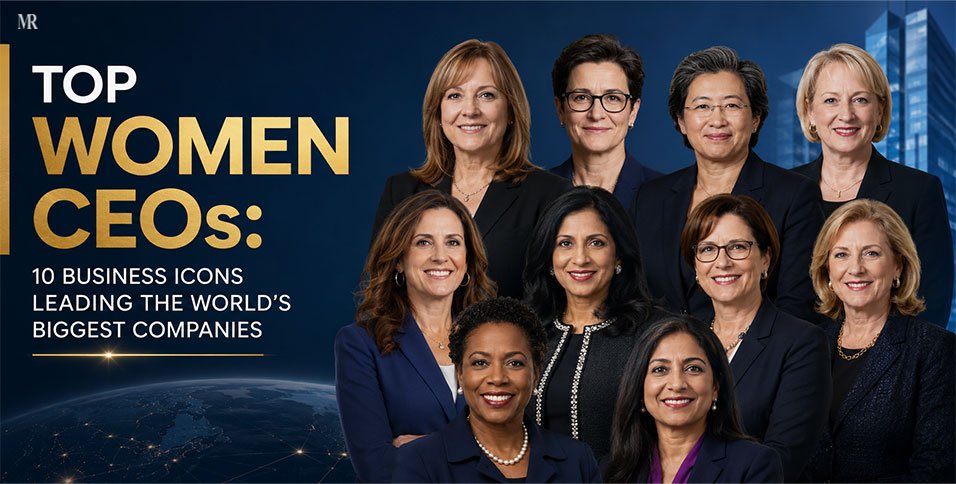
Women run a record 11% of Fortune 500 companies in 2026, marking a historic high for corporate leadership despite coming in a year of high-profile executive exits. Female executives currently manage global enterprises spanning automotive, banking, technology, luxury, healthcare, logistics, biotechnology, and defense.
Across these diverse sectors, women leaders are driving artificial intelligence initiatives, executing major corporate restructurings, and managing complex global supply chains. Their positions at the top of multinational corporations demonstrate a transformation in global business management and executive succession.
This list highlights 10 top women CEOs who have transformed their companies, broken industry barriers, and continue to shape the future of global business.
How We Selected These 10 Top Women CEOs
Evaluating executive leadership requires looking beyond broad popularity or public visibility. To assess the real impact of these corporate executives, our editorial analysis evaluates leadership performance across key operational metrics.
Ranking Factors Include:
- Leadership Impact: Execution of major corporate transformations, pivots, or turnarounds.
- Company Size and Global Influence: Revenue, market capitalization, and industry market share.
- Financial Performance: Revenue growth, profit margins, and shareholder value delivered during their tenure.
- Industry Innovation: Early adoption and deployment of critical technologies like AI, clean energy, and modern supply chain systems.
- Barrier-Breaking Achievements: Securing historic executive appointments within traditionally male-dominated sectors.
- Long-Term Business Transformation: Positioned the organization for multi-decade stability and competitiveness.
- Global Recognition: Performance metrics cited across peer-reviewed corporate indices and financial reporting.
Note: Because these top women CEOs lead companies across fundamentally different industries, this ranking is editorial rather than strictly numerical, evaluating overall influence on modern business leadership.
List of the Top 10 Women CEOs in the World
| CEO | Company | Industry | Became CEO | Why They’re Recognized |
| Mary Barra | General Motors | Automotive | 2014 | Leading GM’s EV and autonomous driving transformation |
| Jane Fraser | Citigroup | Banking | 2021 | First woman CEO of Citigroup; orchestrating major bank restructuring |
| Lisa Su | AMD | Semiconductors | 2014 | Revived AMD into an AI semiconductor powerhouse |
| Julie Sweet | Accenture | Consulting | 2019 | Driving AI-led corporate consulting and digital services growth |
| Gail Boudreaux | Elevance Health | Healthcare Insurance | 2017 | Expanded healthcare access and digital health integration |
| Leena Nair | Chanel | Luxury Fashion | 2022 | Bringing people-first leadership and operational focus to high fashion |
| Carol Tomé | UPS | Logistics | 2020 | Improved profitability and operational efficiency via “better, not bigger” strategy |
| Phebe Novakovic | General Dynamics | Defense & Aerospace | 2013 | One of the defense industry’s longest-serving and highest-performing CEOs |
| Thasunda Brown Duckett | TIAA | Financial Services | 2021 | Championing financial inclusion and retirement security solutions |
| Reshma Kewalramani | Vertex Pharmaceuticals | Biotechnology | 2020 | First woman CEO of a large publicly traded U.S. biotech company |
- Mary Barra
- Company: General Motors
- Industry: Automotive
Mary Barra became the first woman to lead a major global automaker, but her legacy extends far beyond breaking barriers. She has led General Motors through one of the industry’s biggest transformations, accelerating the company’s shift toward electric vehicles, autonomous driving, and software-defined mobility. By prioritizing innovation over legacy manufacturing, Barra has positioned GM to compete in the rapidly evolving future of transportation while maintaining its status as one of the world’s largest automakers.
- Jane Fraser
- Company: Citigroup
- Industry: Banking
Jane Fraser made history as the first woman to lead a major Wall Street bank, becoming a symbol of change in one of the world’s most traditional industries. Since taking over Citigroup, she has executed one of the bank’s most significant strategic restructurings in decades, streamlining global operations, exiting non-core consumer businesses, and sharpening Citi’s focus on institutional banking and wealth management. Her leadership continues to reshape the future of one of the world’s largest financial institutions.
- Lisa Su
- Company: AMD
- Industry: Semiconductors
Few CEOs have engineered a corporate comeback as remarkable as Dr. Lisa Su. After becoming CEO in 2014, she transformed AMD from a struggling chipmaker into one of the world’s most valuable semiconductor companies by driving breakthroughs in high-performance computing and AI processors. Her leadership not only revived AMD’s competitiveness but also helped redefine the global semiconductor race during the AI era.
- Julie Sweet
- Company: Accenture
- Industry: Consulting
Julie Sweet has redefined what a modern consulting company looks like in the age of artificial intelligence. As CEO of Accenture, she has positioned the firm as a global leader in AI, cloud computing, and enterprise digital transformation, while overseeing one of the world’s largest professional services workforces. Her ability to anticipate technology shifts has kept Accenture at the forefront of business innovation and has earned her a place among the top women CEOs.
- Gail Boudreaux
- Company: Elevance Health
- Industry: Healthcare Insurance
Gail Boudreaux has transformed Elevance Health from a traditional health insurer into a broader healthcare solutions company. By expanding the company’s capabilities through Carelon and advancing value-based care, she has strengthened its role across the healthcare ecosystem while improving access to integrated health services for millions of Americans. Her leadership reflects the growing convergence of healthcare, technology, and patient-centered care.
- Leena Nair
- Company: Chanel
- Industry: Luxury Fashion
Leena Nair brought a fresh perspective to one of the world’s most iconic luxury brands by becoming Chanel’s Global CEO after a distinguished career at Unilever. Rather than following a conventional luxury fashion path, she has championed people-first leadership, sustainability, and long-term brand stewardship while preserving Chanel’s exclusivity and global prestige. Her appointment also marked a significant milestone for diversity in the luxury industry.
- Carol Tomé
- Company: UPS
- Industry: Logistics
Carol Tomé transformed UPS by proving that sustainable growth comes from quality rather than volume. Through her “Better, Not Bigger” strategy, she improved profitability, expanded high-value healthcare logistics, and strengthened operational efficiency across one of the world’s largest delivery networks. Her disciplined leadership has helped UPS adapt to changing global supply chains while delivering long-term shareholder value. This is what solidifies her ranking among the top women CEOs.
- Phebe Novakovic
- Company: General Dynamics
- Industry: Defense & Aerospace
Phebe Novakovic has served as CEO of General Dynamics since 2013, making her one of the longest-serving female leaders in the global defense and aerospace sector. A former intelligence officer and Department of Defense official, she has overseen steady backlog growth across marine systems, combat vehicles, and Gulfstream business jets. Her focus on capital allocation and operational execution has consistently yielded strong returns for shareholders.
- Thasunda Brown Duckett
- Company: TIAA
- Industry: Financial Services
Thasunda Brown Duckett took the helm at TIAA in 2021, becoming one of only a few Black female CEOs in Fortune 500 history. She leads an organization managing trillions in assets for educators, healthcare workers, and public service employees. Her leadership centers on closing lifetime income gaps, advancing retirement readiness tools, and modernizing institutional financial services platforms.
- Reshma Kewalramani
- Company: Vertex Pharmaceuticals
- Industry: Biotechnology
Dr. Reshma Kewalramani became the first female CEO of a major publicly traded U.S. biotechnology firm in 2020. A physician by training, she has guided Vertex beyond its core cystic fibrosis treatments into groundbreaking gene-editing therapies, including treatments for sickle cell disease and transfusion-dependent beta-thalassemia. Her scientific expertise combined with clinical execution has established Vertex as an innovator in genomic medicine.
The Rise of Women CEOs in Fortune 500 Companies
| Year | Female CEOs | Share of Fortune 500 |
| 2021 | 41 | 8.2% |
| 2024 | 52 | 10.4% |
| 2026 | 56 | 11.2% |
Fortune 500 Female CEO Growth.
Female representation in Fortune 500 executive suites reached a historic peak of 55 women CEOs in 2026, as per Fortune. This milestone reflects four consecutive years where female executive presence exceeded 10%, driven by updated board succession models and broader talent development across legacy industries.
Data shows that executive appointments are expanding beyond traditional consumer sectors into heavy industrial manufacturing, semiconductors, defense, and capital markets.
In global markets like India, listed companies with female managing directors or CEOs increased 50.6% over six years, growing from 79 in 2021 to 119 in 2026.
While these gains indicate progress, executive succession across international indices remains gradual, with a significant share of appointments going to promoter-led boards rather than independent corporate hires.
Key Factors Driving Diverse Leadership Growth
Three primary structural factors account for the increased selection of women to top corporate roles.
- Expanded Executive Talent Pathways
Female leaders who reach the top job often possess more direct operational experience than male counterparts. A women’s power gap study series shows women are 32% more likely to serve as company president prior to becoming CEO, whereas male candidates move more frequently from division head or functional directorships.
- Focus on Operational Discipline and Resilience
Modern board nominating committees emphasize proven crisis management and operational discipline. Research during market shifts indicates that empathetic, collaborative management styles deliver measurable gains in employee retention and cross-departmental coordination.
- Building Early Leadership Exposure
Building a robust pipeline requires early career exposure and structured mentorship. Programs providing teenage girls and young professionals with direct access to female founders, board meetings, and executive decision-making expand career expectations long before candidates enter the corporate workforce.
Challenges Women CEOs Still Face
Female CEOs face ongoing structural hurdles, including the “glass cliff” phenomenon, shorter operational grace periods during corporate turnarounds, and underrepresentation in independent board appointments.
- The Glass Cliff Effect: Female leaders are statistically more likely to be appointed during periods of financial distress, operational crisis, or market restructuring, which increases execution difficulty and performance pressure.
- Disparate Grace Periods: Board evaluation frameworks often grant female CEOs shorter timeframes to execute long-term turnarounds compared to male executives in similar turnarounds.
- Pipeline Bottlenecks in Promoter Networks: In emerging markets, over 69% of female-led listed companies remain tied to founding families or promoter groups, reflecting limited access for non-promoter female executives.
- Workforce Retention Pressures: Recent workforce surveys reveal that nearly 40% of female corporate managers consider leaving their positions within two years due to work-life balance concerns and limited advancement options.
Future Leadership Trends
Corporate governance standards are shifting toward holistic performance metrics that combine technology adoption, human capital retention, and supply chain reliability.
- Practical AI Execution: Boards prioritize leaders who can implement artificial intelligence tools across core operations while managing workforce displacement.
- Diverse Board Committees: Increases in female-led audit and nominating committees (such as female audit committee leadership rising to 15%) directly correlate with higher female executive appointments.
- Intentional Succession Planning: Corporate governance frameworks are establishing concrete targets for gender representation across P&L leadership roles, ensuring qualified candidates are positioned for future CEO openings.
Final Thoughts
The most influential women CEOs on this list come from different industries, but they share one thing in common: they challenged expectations and proved that great leadership is built on vision and the courage to drive change. Their journeys show that the path to the CEO’s office is no longer defined by tradition, but by talent and determination.
If this list of the top women CEOs inspired you, share it with a young woman, student, or aspiring professional. Sometimes, seeing someone who has already broken the barrier is the first step toward believing you can too!
Maria Isabel Rodrigues