Most businesses begin with a simple goal: sell a product, make a profit, and grow. But every once in a while, an entrepreneur comes along with a different question.
What if buying something as simple as a pair of shoes could change someone else’s life?
That question changed Blake Mycoskie’s life, and eventually transformed millions of others.
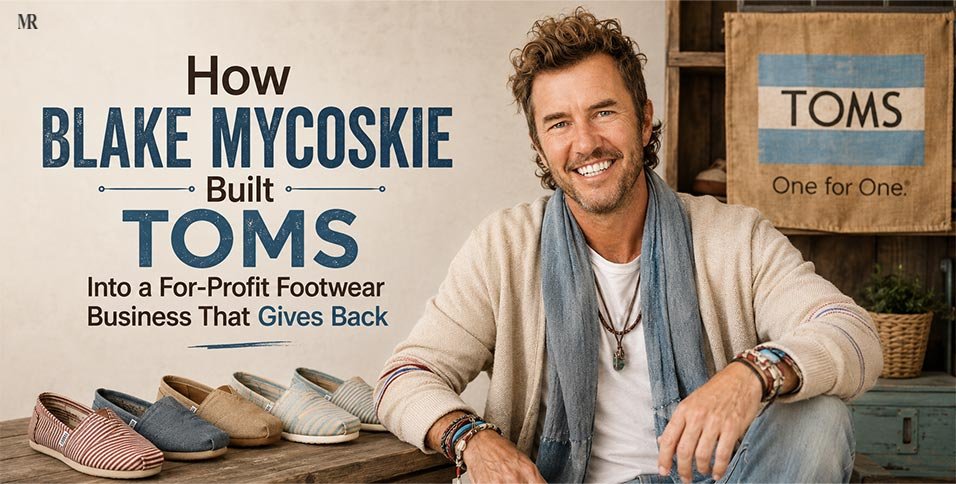
As the founder of TOMS (Tomorrow’s Shoes), Blake Mycoskie didn’t invent shoes. He didn’t discover a new manufacturing process. Instead, he reimagined what a business could stand for. His idea was surprisingly simple: for every pair of shoes sold, another pair would be given to a child in need.
It sounded idealistic. Many doubted whether such a company could survive. Yet TOMS became one of the world’s most recognized social enterprises, inspiring countless entrepreneurs to prove that profit and purpose don’t have to compete; they can work together.
The Blake Mycoskie story isn’t only about building a successful footwear brand. It’s about seeing a problem firsthand, daring to think differently, and creating a business model that encouraged an entire generation to rethink entrepreneurship.
Blake Mycoskie at a Glance
| Full Name | Blake Mycoskie |
| Born | August 26, 1976 |
| Birthplace | Arlington, Texas, USA |
| Nationality | American |
| Occupation | Entrepreneur, Author, Philanthropist |
| Known For | Founder of TOMS Shoes |
| Company Founded | TOMS (2006) |
| Famous Business Idea | One for One model |
| Education | Southern Methodist University (did not graduate) |
| Books | Start Something That Matters |
Blake Mycoskie’s Early Life: Where His Entrepreneurial Mindset Began
Long before he became the TOMS Shoes founder, Blake Mycoskie was simply a curious kid growing up in Arlington, Texas.
Born on August 26, 1976, he showed signs of entrepreneurship early. Whether it was finding creative ways to earn money or taking on leadership roles in school, he enjoyed solving problems and trying new ideas.
Unlike many entrepreneurs whose journeys begin in corporate boardrooms, Blake’s story started with experimentation. He wasn’t afraid of failure because every attempt taught him something valuable.
That willingness to take risks would later become one of his greatest strengths.
Blake Mycoskie’s Education
After graduating from high school, Blake enrolled at Southern Methodist University (SMU) in Dallas.
Business naturally attracted his interest, but he quickly realized something important. The classroom could teach theories, but the real world taught execution.
While studying, Blake became increasingly interested in launching ventures of his own rather than waiting until graduation to begin his career. Eventually, he decided to leave college and focus entirely on entrepreneurship.
The Blake Mycoskie education story reminds aspiring entrepreneurs that learning doesn’t always follow a traditional path. While higher education provides valuable knowledge, practical experience often teaches lessons that no textbook can fully capture.
Blake Mycoskie’s Early Businesses: Learning Before Leading
Before becoming TOMS founder, Blake launched several businesses that taught him how companies actually grow.
His first venture was EZ Laundry, a laundry pickup service designed for college students.
At first glance, it wasn’t a glamorous idea.
Students hated spending weekends doing laundry, so Blake created a service that collected dirty clothes, washed them, and returned them clean. It solved a genuine problem, and customers appreciated the convenience. More importantly, the business gave Blake firsthand experience in pricing, operations, customer satisfaction, logistics, and marketing.
After gaining confidence, Blake co-founded Mycoskie Media, an outdoor advertising company specializing in billboard advertising. The company expanded rapidly and was eventually sold, giving Blake both financial resources and greater confidence in his abilities. Unlike many first-time entrepreneurs who struggle to recover after setbacks, Blake viewed each venture as preparation for something larger.
These experiences would later prove invaluable when launching TOMS.
A Reality Show That Tested His Resilience
Many people are surprised to learn that Blake Mycoskie also appeared on the popular television competition The Amazing Race.
Alongside his sister Paige, he competed against teams from around the world in a series of physically demanding and mentally exhausting challenges.
Although they didn’t win the competition, the experience revealed qualities that would later define Blake’s leadership style.
- He learned to make decisions under pressure.
- He adapted quickly when plans changed.
- He communicated effectively during stressful situations.
- Most importantly, he discovered that perseverance often matters more than perfection.
Entrepreneurship works much the same way. Businesses rarely grow exactly as planned,
unexpected obstacles appear, markets change, and competitors emerge, but the ability to stay focused despite uncertainty often separates successful founders from everyone else.
The Trip That Changed Everything
By 2006, Blake had already built successful businesses. From the outside, it looked like he had achieved what many entrepreneurs dream about. But something was missing.
Blake Mycoskie wanted to experience the world beyond boardrooms and business meetings. So he traveled to Argentina.
Initially, it was simply another adventure. He explored local communities, met artisans, and immersed himself in a different culture. Then he encountered a volunteer who was distributing shoes to children living in poverty. As Blake observed the situation, he learned that many children couldn’t attend school consistently or play safely because they lacked proper footwear. Without shoes, they faced cuts, infections, parasites, and other preventable health problems.
The problem wasn’t invisible. It was simply overlooked.
For days, the images stayed with him. He couldn’t stop thinking about those children. He also realized another important truth: Traditional charity often depended on continuous donations.
- What happened when donations stopped?
- Could there be a more sustainable solution?
That question lingered throughout the remainder of his trip. Then inspiration struck.
- Instead of asking people to donate after buying products, why not make giving part of the purchase itself?
- What if every customer automatically helped someone else simply by making a purchase?
It was an idea so simple that many people wondered why no one had attempted it before.
The Birth of TOMS Shoes
Returning to California, Blake couldn’t shake the idea.
Inspired by the traditional Argentine alpargata, a lightweight canvas shoe worn throughout the country, he decided to create his own version for the American market.
But the shoe itself wasn’t the innovation. The mission was. Blake Mycoskie named the company TOMS, inspired by the phrase “Tomorrow’s Shoes.” It suggested that every purchase could contribute to a better tomorrow, not just for customers, but for children across the world.
From the very beginning, Blake made one promise that would define the company.
For every pair of shoes purchased, TOMS would give a new pair to a child in need.
That promise became known around the world as the One for One model.
People weren’t just purchasing shoes. They were buying into a story, a mission, and an opportunity to make a small but meaningful difference through everyday choices. That belief would soon transform TOMS from an unknown startup into one of the most recognizable social enterprises in the world.
How the One for One Model Made TOMS a Global Movement
When TOMS officially launched in 2006, Blake Mycoskie wasn’t backed by a massive advertising budget or decades of brand recognition. What he did have was a story that people wanted to share.
The first collection consisted of just a few hundred pairs of shoes inspired by the traditional Argentine alpargata. Blake hoped customers would appreciate the simple design, but he quickly realized they were buying into something much bigger than fashion.
Every pair represented a promise.
Instead of asking customers to make an additional donation at checkout, TOMS built generosity directly into its business. Every purchase meant a child somewhere in the world would receive a new pair of shoes. The buying experience became personal because customers could immediately see the impact of their decision.
Word spread rapidly through blogs, newspapers, television programs, and social media. People proudly shared why they had chosen TOMS, turning satisfied customers into passionate brand ambassadors. It wasn’t just another footwear company competing on price or style. It stood for a purpose that resonated with people who wanted their purchases to reflect their values.
Within a few years, TOMS had grown from a small startup into an internationally recognized brand. The company expanded into dozens of countries, and millions of pairs of shoes were distributed to children through partnerships with nonprofit organizations around the world.
For Blake, the rapid growth confirmed something he had believed from the beginning: customers weren’t simply looking for products; they were looking for businesses they could believe in.
When Success Brought New Questions
As TOMS became more successful, the company also found itself at the center of an important conversation.
Could giving away products unintentionally create new problems?
Some economists and development experts argued that regularly donating shoes could affect local shoemakers and small businesses in developing communities. Others questioned whether providing free products addressed the root causes of poverty or simply treated one visible symptom.
Instead of defending the company at all costs, Blake listened. That willingness to learn became one of the defining moments in the Blake Mycoskie business model. Blake understood that social entrepreneurship wasn’t about proving you were right. It was about creating meaningful, lasting impact.
As research and feedback accumulated, TOMS began to rethink how it could help communities in more sustainable ways.
The company expanded beyond shoe donations to support programs focused on clean water, safe childbirth, mental health, education, and economic opportunity. Rather than measuring success solely by the number of shoes donated, TOMS started investing in organizations that addressed broader community needs.
Reinventing the Business for a New Generation
Consumer expectations continued to change during the 2010s. People still valued companies with a social mission, but they also wanted greater transparency. They wanted to know where products were made, how employees were treated, and whether a company’s impact extended beyond a single charitable program.
Recognizing this shift, TOMS updated its giving strategy in 2019. Instead of following the original One for One model, the company committed to donating one-third of its profits to grassroots organizations working on issues such as equity, education, mental health, and community development.
For Blake Mycoskie, the evolution reinforced an important entrepreneurial lesson.
A successful company cannot remain attached to yesterday’s formula simply because it once worked. Businesses must adapt when customer expectations, research, and the world itself continue to evolve.
TOMS Shoes Today
Nearly two decades after its founding, TOMS continues to operate as a purpose-driven lifestyle brand while adapting to changing consumer expectations.
The company offers footwear, eyewear, and apparel, with sustainability and ethical sourcing playing a larger role in its product development. Its giving strategy has also evolved, supporting nonprofit partners that work directly with communities on issues ranging from mental health to access to opportunity.
Although the company has experienced both periods of rapid growth and significant challenges, including changes in ownership and restructuring, its original mission continues to influence its identity.
More importantly, the impact of TOMS Shoes’ history extends well beyond the company itself.
Many businesses that followed adopted similar purpose-driven models, proving that customers increasingly value organizations that contribute positively to society. While each company approaches social responsibility differently, TOMS helped normalize the idea that businesses could integrate giving into their core strategy rather than treating it as an occasional charitable activity.
Lessons Entrepreneurs Can Learn from Blake Mycoskie
Blake Mycoskie’s journey offers valuable lessons for anyone hoping to build a business that creates both financial and social value.
- The first lesson is to pay attention to real-world problems. TOMS wasn’t born from chasing market trends; it emerged because Blake noticed an issue that many others had overlooked. Great opportunities often begin with careful observation and genuine curiosity.
- The second lesson is that purpose can be a powerful competitive advantage. Products can often be copied, but an authentic mission is much harder to replicate. Customers remember how a brand makes them feel just as much as what it sells.
- Another important takeaway is the willingness to evolve. The original One for One model brought global attention to TOMS, but Blake and the company recognized that long-term impact required adapting their approach as they learned more. Successful entrepreneurs don’t cling to old ideas simply because they were once successful.
- Finally, Blake’s story reminds aspiring founders that entrepreneurship isn’t only about building wealth. The most enduring businesses often create value for customers, employees, communities, and society at the same time.
Final Thoughts
The Blake Mycoskie story proves that one meaningful idea can change far more than an industry.
What began as a simple observation during a trip to Argentina became a global movement that challenged how people think about business. Blake didn’t claim that companies should stop making profits. Instead, he showed that profits and purpose could work together when guided by a clear mission.
Not every entrepreneur will build the next TOMS, and not every business needs to follow the same model. But every founder can ask the question that started it all:
How can my business leave the world a little better than it found it?
Sometimes, the biggest companies don’t begin with the biggest ideas. They begin with someone who cares enough to solve one problem and dares to start!
Maria Isabel Rodrigues