Every time a solar farm comes online, a wind turbine begins spinning, or a hydropower plant sends electricity to millions of homes, there’s a renewable energy company behind it making that transition possible.
Renewable energy is energy generated from natural resources that are continuously replenished, making them a sustainable alternative to fossil fuels. Unlike coal, oil, and natural gas, renewable energy sources produce little to no greenhouse gas emissions during electricity generation, helping reduce carbon emissions and support the global transition to cleaner energy.
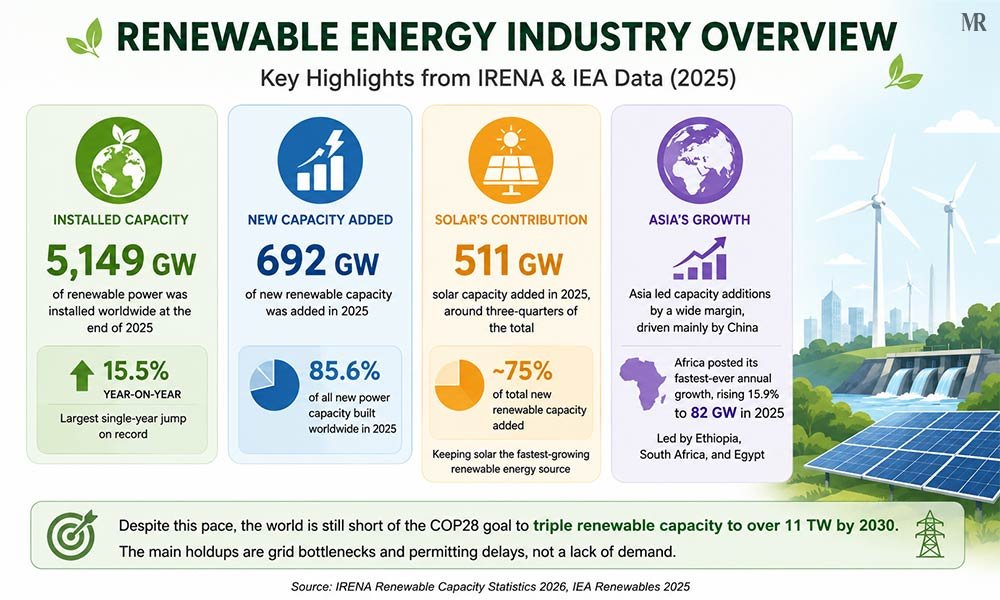
Renewable energy is no longer an emerging industry. It’s becoming the backbone of the global power system. According to IRENA’s Renewable Capacity Statistics 2026, renewables made up 85.6% of all new power capacity added worldwide in 2025.
This guide highlights the top renewable energy companies across every major sector, along with the trends shaping the renewable energy industry in 2026.
Why Renewable Energy Companies Matter
Before getting into the numbers, it’s worth asking why this group of the top renewable Energy companies gets so much attention in the first place.
A few forces are pushing renewable energy companies to the center of the global economy:
- Rising global electricity demand: Data centers, AI, and electrification of transport and heating are pushing power consumption higher every year.
- Climate goals: National and corporate net-zero targets depend on replacing fossil generation with wind, solar, hydropower, and other low-carbon sources.
- Energy security: Countries that generate their own solar, wind, or hydropower are less exposed to volatile fossil fuel prices and supply shocks.
- Falling renewable costs: Solar and wind are now among the cheapest ways to add new electricity generation in most parts of the world.
- Corporate net-zero commitments: A growing share of the world’s largest companies have pledged to run on renewable or carbon-free power, creating steady demand for the businesses covered in this guide.
With that context in place, here’s where the renewable energy industry actually stands in 2026.
Types of Renewable Energy
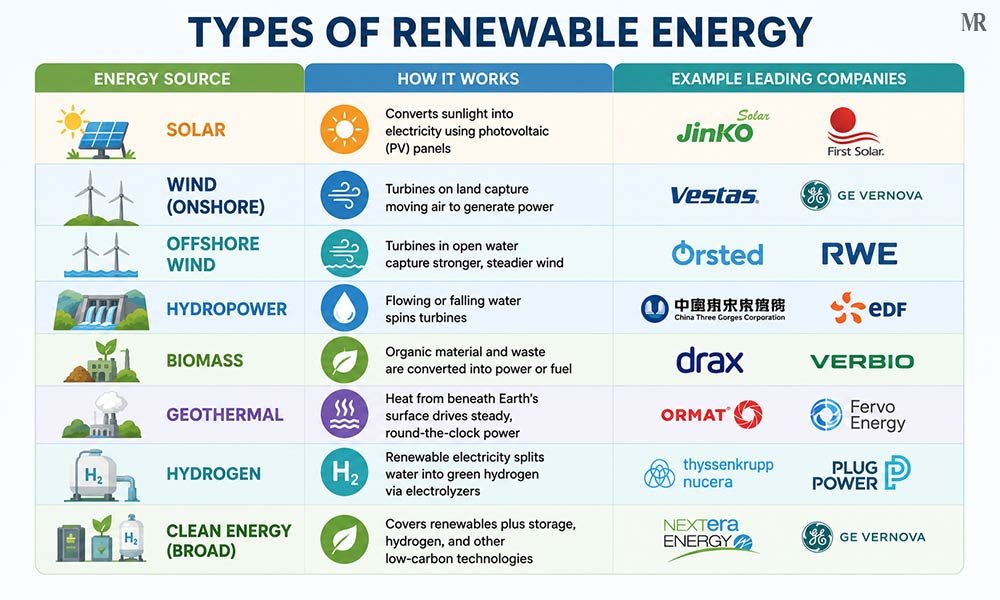
Before going deeper into each sector and its top renewable energy companies, here’s a quick reference for how every renewable energy source works and which companies lead it.
1. Solar Energy Companies
Solar energy converts sunlight directly into electricity using photovoltaic (PV) panels made of semiconductor cells. It works at any scale, from a few rooftop panels to a utility-scale solar farm feeding an entire grid.
Why it matters today:
Falling panel costs and record shipment volumes have made solar the cheapest way to add new electricity generation in most parts of the world, and it remains the single biggest driver of renewable energy growth in 2025.
Top companies:
JinkoSolar remained the world’s largest solar module shipper heading into 2026, targeting 75–85 GW of shipments for the year, even after thin margins from industry oversupply cut its 2025 revenue to roughly RMB 65.5 billion.
LONGi Green Energy is converting its entire domestic cell lineup to back-contact (BC) technology by the end of 2026, and Trina Solar was one of the few Chinese manufacturers to grow revenue in early 2026, up 17% year-on-year, partly on new perovskite-silicon tandem modules.
First Solar remains the leading US-based thin-film panel maker, giving it an edge under domestic-content rules, while Sungrow dominates the inverter and battery-storage side of the business, shipping 143 GW of inverters and 43 GWh of storage systems in 2025 alone.
Together, these solar energy companies keep outpacing every other source in the renewable energy sector.
2. Wind Energy Companies
Wind energy companies capture moving air with turbine blades connected to a generator, split mainly into onshore (land-based) and offshore installations.
Why it matters today:
Onshore wind is cheaper to build than almost any other new power source and still makes up most of the world’s wind capacity, with older turbines steadily being replaced by larger, more efficient ones.
Top companies:
Vestas is the world’s largest wind turbine maker, with more than 203 GW installed and roughly 19% global market share.
GE Vernova, spun off from General Electric in 2024, guided 2026 revenue toward $44–45 billion on a $59.3 billion order backlog, even as its wind unit works through near-term losses.
Goldwind leads China’s domestic market and ranks second worldwide with about 163 GW installed.
Nordex keeps winning large orders across Europe and the Middle East, and Suzlon remains India’s top wind turbine supplier, recently expanding through its Renom Energy acquisition.
3. Offshore Wind Companies
Offshore wind farms sit in open water on fixed-bottom foundations in shallow coastal areas, or on floating platforms in deeper water.
Why it matters today:
Ocean winds blow stronger and steadier than onshore winds, so a single offshore turbine can generate far more electricity, close to major coastal population centers that need it most.
Top companies:
Ørsted remains the world’s largest offshore wind developer, with about 10.2 GW installed and another 8.1 GW under construction across Europe, Asia-Pacific, and North America.
Siemens Gamesa supplies many of the turbines behind those projects, including 14 MW units deployed off Taiwan, while GE Vernova’s Haliade-X turbine, certified up to 14.7 MW, is pushing offshore capacity even higher.
RWE picked up 6.9 GW of new UK offshore capacity in the latest Allocation Round auction, cementing its place alongside Ørsted and Vestas as one of the offshore wind sector’s biggest names, even as US offshore projects face permitting setbacks.
4. Hydropower Companies
Hydropower uses flowing or falling water to spin turbines, through large dams, pumped-storage reservoirs that store energy for later release, or smaller run-of-river projects that need no dam at all.
Why it matters today:
Hydropower’s ability to ramp output up or down within seconds makes it the grid’s main balancing tool as more variable solar and wind come online, and it remains the single largest source of renewable electricity worldwide, supplying about 14% of global power.
Top companies:
China Three Gorges Corporation operates the Three Gorges Dam, the world’s biggest power station by installed capacity at 22,500 MW, and continues building out pumped storage as China develops over 300 GW of hydropower.
EDF runs roughly 22.7 GW of hydro capacity from France, increasingly paired with floating solar.
Statkraft’s Norwegian reservoirs can ramp output within seconds, making it one of Europe’s fastest-responding hydropower companies, while Brookfield Renewable and India’s NHPC extend the sector’s reach across the Americas and South Asia.
5. Biomass Energy Companies
Biomass energy companies convert organic material, such as wood pellets, crop residue, or municipal waste, into electricity, heat, or biofuel. Biogas plants, a close cousin, capture methane from decomposing waste to generate power or renewable natural gas.
Why it matters today:
Biomass and biogas give industries and grids a renewable source of power that doesn’t depend on weather, filling a role solar and wind can’t, though the sustainability of the feedstock supply remains a live debate.
Top companies:
Drax Group runs the UK’s largest renewable power station, supplying more than 5% of Britain’s electricity from biomass and reporting about $7.1 billion in trailing revenue.
Verbio, based in Germany, focuses on biomethane, biodiesel, and bioethanol made from farm residue, and posted a sharp earnings recovery through its 2025/26 fiscal year.
EnviTec Biogas operates more than 600 biogas and biomethane plants worldwide, while Green Plains and Gevo keep converting crops and waste into low-carbon fuel across North America, a smaller but steady corner of the renewable energy business.
6. Geothermal Energy Companies
Geothermal energy taps heat stored beneath Earth’s surface to generate steady, round-the-clock power, unlike solar and wind, which depend on sunlight or wind speed.
Why it matters today:
That reliability, typically 75–90% capacity factors versus 15–45% for solar and wind, is why data centers and heavy industry are increasingly signing geothermal power deals.
Top companies:
Ormat Technologies is the sector’s only vertically integrated, pure-play geothermal company, running about 3,400 MW of gross capacity worldwide.
Fervo Energy, a newer enhanced-geothermal (EGS) developer, completed its Nasdaq IPO in 2026 and is scaling its roughly 500 MW Cape Station project in Nevada. Kenya’s KenGen remains one of Africa’s largest geothermal operators, while New Zealand’s Contact Energy anchors the technology across the Pacific.
7. Hydrogen & Fuel Cell Companies
Green hydrogen is produced by splitting water using electricity from renewable sources, through machines called electrolyzers.
Why it matters today:
It’s one of the few realistic paths to decarbonizing industries that are hard to electrify directly, such as steel, shipping, and heavy trucking.
Top companies:
Thyssenkrupp Nucera holds one of the strongest positions in the sector, supplying electrolyzers for Saudi Arabia’s NEOM green hydrogen megaproject, now over 90% complete, though it trimmed 2026 revenue guidance to €450–550 million as demand slowed.
Nel ASA continues expanding its Norwegian manufacturing capacity toward 2 GW a year, ITM Power is delivering a 100 MW electrolyzer system for Shell, and Plug Power remains a major US fuel-cell and hydrogen-infrastructure supplier. Together, the group is racing to make green hydrogen commercially viable.
8. Clean Energy Companies
Clean energy is a broader category than renewable energy. Clean Energy companies include top renewable energy companies from solar, wind, and hydropower, but also technologies like green hydrogen, battery storage, and, in some definitions, nuclear power and carbon capture.
Why it matters today:
As grids add more intermittent solar and wind, companies that also offer storage, hydrogen, or firm power are becoming the ones utilities lean on to keep the lights on, since all of these technologies generate power with little to no carbon.
Top companies:
NextEra Energy is widely considered the largest clean energy company in the world by this broader measure, operating about 76 GW of wind, solar, and storage capacity through NextEra Energy Resources and its Florida Power & Light utility.
GE Vernova spans wind, grid technology, and gas turbines that together help generate roughly a quarter of the world’s electricity.
ACWA Power has become the developer of choice for power and desalination projects across the Middle East, while Brookfield Renewable and Enel Green Power extend the clean energy business model across the Americas and Europe.
2026 Renewable Energy Industry Outlook
Beyond the raw numbers, a few shifts are defining how the renewable energy sector operates day to day.
- Battery storage: Sungrow alone shipped 43 GWh of storage systems in 2025, helping grids balance power when the sun isn’t shining or the wind isn’t blowing.
- AI and smart grids: AI-powered energy management is helping utilities forecast demand and route power more efficiently, cutting transmission losses.
- Offshore wind: Growth is turning more selective. RWE and Ørsted are still winning auctions in Europe and Asia, but several US projects hit federal stop-work orders in late 2025.
- Hydrogen: Green hydrogen adoption is slower than earlier forecasts predicted, but industrial-scale projects like NEOM keep advancing.
- Geothermal: The sector is getting a second look, largely because data centers need steady, round-the-clock power that solar and wind alone can’t guarantee.
- Perovskites: Perovskite solar cells, including tandem perovskite-silicon modules, are entering commercial deployment for the first time.
Conclusion
Renewable energy companies aren’t one industry. They’re solar manufacturers racing on price, wind turbine makers building offshore giants, hydropower operators running century-old dams, and hydrogen startups betting on an industrial future.
What ties the top renewable energy companies together is scale: 692 GW added in a single year and 5,149 GW installed worldwide.
As the renewable energy market keeps expanding through 2026 and beyond, the companies covered here, across solar, wind, hydropower, biomass, geothermal, hydrogen, and clean energy broadly, are the ones setting the pace for how the world gets its power.
Maria Isabel Rodrigues