From the groceries in your kitchen to the shampoo in your shower, consumer goods companies shape how billions of people live every day.
You’ll often hear the terms FMCG (fast-moving consumer goods) and consumer goods used in the same breath. The two overlap a lot but aren’t identical. FMCG refers to products that sell fast and get used up quickly, like detergent or coffee. Consumer goods is the broader category, and it also include things you don’t replace every week, like a luxury skincare jar.
Every FMCG product is a consumer good, but not every consumer good is FMCG.
The largest consumer goods companies matter far more than their product labels suggest. They sit inside almost every household on the planet, and this industry also employs millions of people directly and through its retail networks, making it one of the steadier pillars of the global economy.
This list ranks the 10 biggest consumer goods companies in the world by market capitalization, which is a fair way to compare companies of different sizes because it reflects what investors think the business is worth right now, not just what it earned last year.
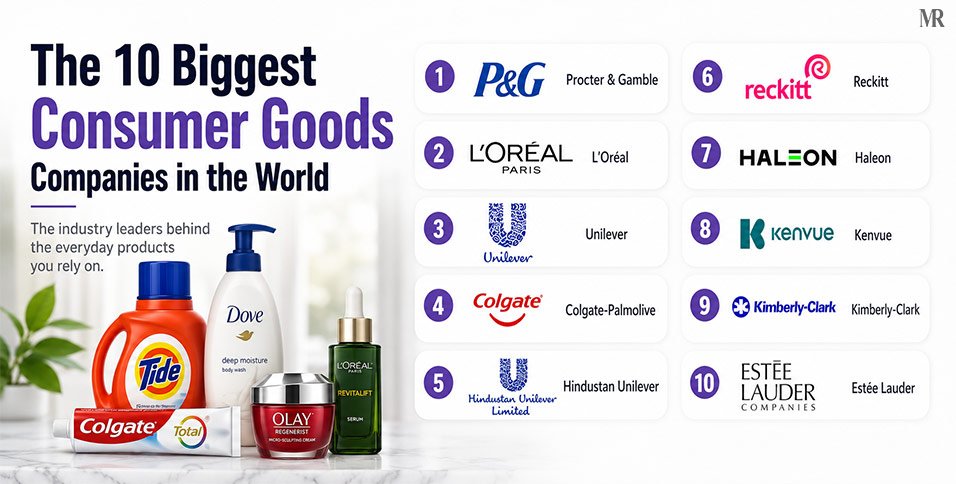
List of the 10 Biggest Consumer Goods Companies in the World (2026)
| Company | Country | Market Cap | Key Brands |
| 1. Procter & Gamble | USA | $347.00 billion | Tide, Pampers, Gillette, Ariel, Head & Shoulders, Olay |
| 2. L’Oréal | France | $235.67 billion | L’Oréal Paris, Maybelline, Lancôme, Garnier, Kérastase |
| 3. Unilever | UK | $130.39 billion | Dove, Knorr, Hellmann’s, Lux, Rexona, Vaseline |
| 4. Colgate-Palmolive | USA | $73.67 billion | Colgate, Palmolive, Softsoap, Tom’s of Maine, Hill’s Pet Nutrition |
| 5. Hindustan Unilever | India | $53.80 billion | Surf Excel, Lux, Dove, Lifebuoy, Horlicks, Rin |
| 6. Reckitt Benckiser | UK | $41.14 billion | Dettol, Lysol, Durex, Finish, Mucinex, Enfamil |
| 7. Haleon | UK | $40.72 billion | Sensodyne, Panadol, Voltaren, Centrum, Advil, Otrivin |
| 8. Kenvue | USA | $36.72 billion | Neutrogena, Tylenol, Listerine, Aveeno, Johnson’s, Band-Aid |
| 9. Kimberly-Clark | USA | $36.30 billion | Huggies, Kleenex, Scott, Kotex, Cottonelle |
| 10. Estée Lauder | USA | $29.13 billion | Estée Lauder, MAC Cosmetics, Clinique, La Mer, Aveda, Bobbi Brown |
1. Procter & Gamble
Market Cap: $347.00 billion
Founded: 1837
Headquarters: Cincinnati, Ohio, USA
CEO: Shailesh Jejurikar
Procter & Gamble holds the top spot among the biggest consumer goods companies, and it has held that spot for years. William Procter, a candle maker, and James Gamble, a soap maker, merged their small Cincinnati businesses in 1837. Almost two centuries later, P&G runs one of the widest product portfolios in the FMCG world, spanning laundry care, grooming, baby care, and oral health.
Jejurikar took over as CEO and President on January 1, 2026, succeeding Jon Moeller, who moved into the role of Executive Chairman. He previously served as Chief Operating Officer with deep operational experience across P&G’s fabric care and home care divisions.
P&G ranks first because of its scale and brand depth. Tide dominates the US laundry detergent market, Gillette leads global grooming, and Pampers is a household name in baby care across more than 70 countries. This diversity means P&G doesn’t depend on any single category to drive growth, giving it resilience that smaller consumer goods companies don’t have.
2. L’Oréal
Market Cap: $235.67 billion
Founded: 1909
Headquarters: Clichy, France
CEO: Nicolas Hieronimus
L’Oréal is the world’s largest cosmetics and beauty company, and it earns the number two spot on this list through sheer category dominance. Chemist Eugène Schueller founded the company in Paris in 1909 after developing a safer synthetic hair dye formula. That single product line grew into a beauty empire spanning skincare, haircare, makeup, and fragrance.
Hieronimus has led L’Oréal as CEO since 2021, continuing the company’s strategy of acquiring premium and niche beauty brands while expanding its dermatological beauty division.
L’Oréal’s strength lies in its four-division structure: Professional Products, Consumer Products, Luxe, and Dermatological Beauty. This lets the company sell shampoo at a supermarket and a $300 face cream at a department store under the same corporate roof. Few consumer goods companies serve both the mass market and the luxury market this effectively. Françoise Bettencourt Meyers, the granddaughter of the founder of L’Oréal, ranks second among the world’s richest women.
3. Unilever
Market Cap: $130.39 billion
Founded: 1929
Headquarters: London, UK
CEO: Fernando Fernandez
Unilever was formed in 1929 through the merger of British soap maker Lever Brothers and Dutch margarine producer Margarine Unie. Nearly a century later, it remains one of the biggest consumer goods companies on earth, with brands present in an estimated seven out of ten households worldwide.
Fernandez, who previously served as CFO, took over as CEO in 2026. He inherits a company mid-transformation: Unilever has been reshaping its portfolio, including a major proposed acquisition of McCormick’s flavor business, while continuing to invest in its core Beauty & Wellbeing, Personal Care, Home Care, and Nutrition segments.
Unilever also earns its rank among the biggest food companies in the world through Knorr, Hellmann’s, Lipton, and Marmite.
Moreover, Dove, Knorr, Hellmann’s, and Vaseline each lead their categories in dozens of markets, and the company’s distribution network in emerging markets, especially across Asia and Africa, gives it an edge many Western-focused competitors lack.
4. Colgate-Palmolive
Market Cap: $73.67 billion
Founded: 1806
Headquarters: New York City, USA
CEO: Noel Wallace
William Colgate started selling soap, candles, and starch in New York in 1806. The Colgate and Palmolive companies merged in 1928, and the modern corporate name was formally adopted in 1953. Today, Colgate-Palmolive is one of the most recognized names in oral care worldwide.
Wallace, who also chairs the board, has led the company as CEO since 2019, steering its focus on oral, personal, and home care, alongside its pet nutrition business under Hill’s.
Colgate-Palmolive ranks fourth on this list mainly because of its global grip on toothpaste and oral hygiene. Colgate toothpaste holds the top market share position in oral care across most of the world, a leadership position few competitors can match. The company also runs Hill’s Pet Nutrition, a premium pet food business that has become an increasingly important growth driver.
5. Hindustan Unilever
Market Cap: $53.80 billion
Founded: 1933 (as Lever Brothers India; renamed Hindustan Unilever in 2007)
Headquarters: Mumbai, India
CEO: Priya Nair
Hindustan Unilever, commonly called HUL, is Unilever’s Indian subsidiary and India’s largest FMCG company. It started as Lever Brothers India in 1933, became Hindustan Lever Limited after a 1956 merger, and took its current name in 2007.
Nair became CEO and Managing Director in August 2025, making her the first woman to lead the company. She joined HUL in 1995 and rose through sales, marketing, and home care leadership roles before taking the top job.
HUL makes the list of the biggest consumer goods companies because of its dominant grip on the Indian market, one of the largest and fastest-growing consumer bases in the world. Brands like Surf Excel, Lifebuoy, and Horlicks reach nine out of ten Indian households, according to the company. With over a billion people and rising disposable incomes, India gives HUL a long growth runway that few other markets can offer.
6. Reckitt
Market Cap: $41.14 billion
Founded: 1999 (formed by merger; earliest constituent business dates to 1819)
Headquarters: Slough, UK
CEO: Kris Licht
Reckitt was formed in 1999 when British company Reckitt & Colman merged with Dutch company Benckiser. Its roots trace back further still, to a starch mill that Isaac Reckitt rented in Hull, England, in 1840. The business rebranded simply as “Reckitt” in 2021, dropping the longer “Reckitt Benckiser” name.
Licht currently leads Reckitt as CEO, overseeing its three core segments: Hygiene, Health, and Nutrition.
Reckitt’s place among the largest consumer goods companies comes from its concentration in high-margin health and hygiene categories. Dettol and Lysol dominate the disinfectant category, a segment that saw sustained demand growth following heightened hygiene awareness in recent years. Its Nutrition arm, built around Enfamil infant formula, also gives it a foothold in a category with strong brand loyalty and repeat purchases.
7. Haleon
Market Cap: $40.72 billion
Founded: 2022 (spun off from GSK)
Headquarters: Weybridge, UK
CEO: Brian McNamara
Haleon is the youngest company on this list by corporate age, but its brands are anything but new. It launched on July 18, 2022, as an independent company after demerging from GSK, combining consumer health assets that GSK had built up through joint ventures with Pfizer and Novartis. Some of its core brands, like the apothecary lineage behind Sensodyne, trace back over 300 years.
McNamara has led Haleon as CEO since its launch, having been named CEO designate before the spinoff was finalized.
Haleon earns its spot through pure-play focus on consumer healthcare, a category that sits at the intersection of FMCG and pharma. Sensodyne leads the sensitive toothpaste category, Panadol is one of the most recognized pain relief brands outside the US, and Centrum anchors its vitamins and supplements business. This focused portfolio lets Haleon compete directly with healthcare-adjacent consumer goods companies without the distraction of unrelated product lines.
8. Kenvue
Market Cap: $36.72 billion
Founded: 2023 (spun off from Johnson & Johnson)
Headquarters: Summit, New Jersey, USA
CEO: Kirk Perry
Kenvue is Johnson & Johnson’s former consumer health division, spun off as an independent public company in 2023. It carries decades-old brands, including Tylenol, Band-Aid, and Listerine, that were already household names long before the spinoff.
Perry became Kenvue’s permanent CEO in November 2025, after first stepping in as interim CEO that July. He brings more than two decades of consumer goods experience from Procter & Gamble, along with leadership roles at Google and Circana.
Kenvue ranks among the biggest consumer goods companies on the strength of its self-care and skin health portfolio. Tylenol remains a top pain relief brand in the US, and Neutrogena and Aveeno lead large segments of the skincare market. Notably, Kimberly-Clark announced in late 2025 that it will acquire Kenvue in a deal worth approximately $48.7 billion, expected to close in the second half of 2026, a move that would create one of the largest consumer health companies in the world.
9. Kimberly-Clark
Market Cap: $36.30 billion
Founded: 1872
Headquarters: Irving, Texas, USA
CEO: Mike Hsu
Kimberly-Clark has been making paper and tissue products since 1872, long before “consumer goods” became an industry term. Over the decades, it expanded into diapers, feminine care, and household paper products, building a portfolio that touches nearly every home.
Hsu has served as Chairman and CEO, guiding the company through its “Powering Care” strategy, which emphasizes consumer-driven innovation and operational efficiency.
Kimberly-Clark earns its place through category leadership in tissue and absorbent hygiene products. Huggies and Kleenex each hold a number-one or number-two market share position in roughly 70 countries. The pending Kenvue acquisition, once it closes, would significantly expand Kimberly-Clark’s footprint into consumer health, positioning the combined company as a major force in both hygiene and wellness.
10. Estée Lauder
Market Cap: $29.13 billion
Founded: 1946
Headquarters: New York City, USA
CEO: Stéphane de La Faverie
Estée Lauder and her husband Joseph Lauder founded the company in 1946, starting with four skincare products sold out of a single beauty salon. The company has since grown into one of the world’s most prestigious beauty conglomerates under the late Leonard Lauder, with a brand portfolio spanning skincare, makeup, fragrance, and haircare.
De La Faverie became President and CEO in January 2025, after previously overseeing several major brands as Executive Group President. He has prioritized a turnaround strategy called “Beauty Reimagined,” focused on restoring sales growth and improving operating margins.
Estée Lauder rounds out this list through its position in prestige and luxury beauty, a segment that has consistently outpaced mass-market beauty growth. Its brand stable, including MAC Cosmetics, Clinique, and La Mer, gives it a strong hold on department store counters and travel retail worldwide, even as it works through recent margin pressure.
Consumer Goods Industry Outlook (2026)
The largest consumer goods companies aren’t just selling soap and shampoo anymore. Several forces are reshaping how this manufacturing industry operates, and they’re moving faster than they have in years.
1. AI in consumer goods
Artificial intelligence is moving beyond experimentation into everyday business operations. Consumer goods companies are using AI to improve demand forecasting, optimize supply chains, accelerate product innovation, and create personalized marketing campaigns. Deloitte found that productivity is now the top expected outcome of AI investments, while 74% of surveyed companies are simplifying their organizations to better support AI-enabled decision-making.
2. Sustainable packaging
Regulatory pressure and consumer demand are both pushing companies toward recyclable, refillable, and lower-plastic packaging. This is becoming a baseline expectation, especially in European and Indian markets where packaging waste rules have tightened.
3. Premiumization
Even with inflation squeezing household budgets, a meaningful share of consumers keep paying more for products they genuinely value. Industry data shows that brands offering more value for the price, regardless of whether that price is low or high, are winning market share. This is why companies like L’Oréal and Estée Lauder keep investing in premium and luxury lines instead of retreating to budget options.
4. Direct-to-consumer growth
More consumer goods companies are building their own e-commerce channels instead of relying entirely on retailers. This gives them direct access to purchase data, which matters more as digital shopping keeps growing its share of total retail.
5. Health-conscious consumers
Demand for wellness-oriented products, lower-sugar foods, supplements, and “clean” beauty formulations keeps climbing. This partly explains why companies like Haleon and Kenvue, both rooted in consumer health, continue attracting investor interest.
6. Personalization
Brands are using purchase data and AI-driven insights to tailor product recommendations, and even formulations, to individual consumers. Beauty and skincare brands have moved fastest here, but personalized nutrition and home care products are starting to follow the same pattern.
Conclusion
The biggest consumer goods companies in the world prove that everyday products can build extraordinary value. Procter & Gamble holds the top spot through brand breadth, L’Oréal dominates beauty at every price point, and Unilever’s global reach keeps it firmly in the top three. Further down the list, companies like Haleon and Kenvue show how a focused spinoff can create a major player almost overnight.
What ties these companies together is their willingness to keep innovating, whether that means adopting AI, rethinking packaging, or restructuring through mergers. The industry isn’t standing still, and the consumer goods companies that adapt fastest to AI, sustainability demands, and shifting consumer values will likely be the ones writing next year’s version of this list.
Maria Isabel Rodrigues