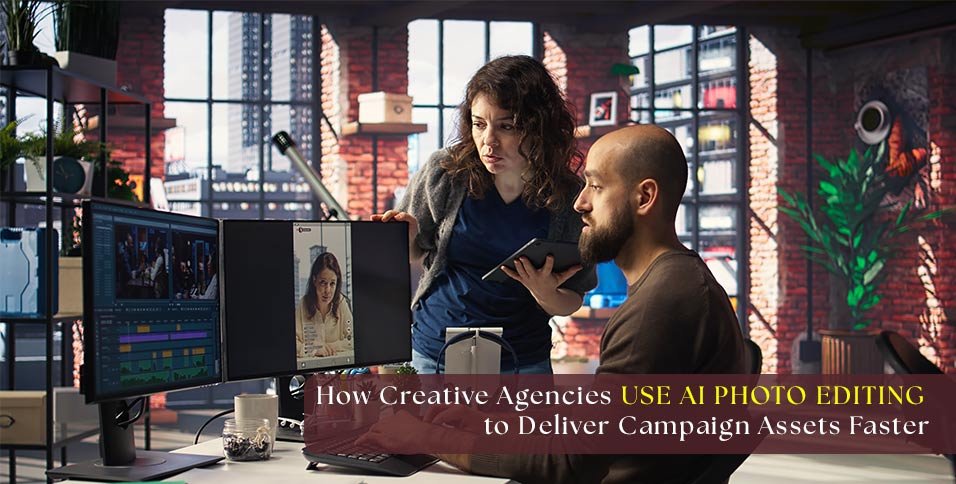
Advertising agencies are not short on ideas. The harder problem is turning those ideas into polished campaign assets fast enough for modern marketing.
A single campaign may need visuals for Meta ads, Google Display, LinkedIn, landing pages, email banners, pitch decks, short-form video thumbnails, and social media posts. Each channel needs different dimensions, different crops, and often several creative variations for testing.
That is why AI photo editing is becoming a practical advantage for agencies. It does not replace creative direction, brand strategy, or client judgment. It helps teams move from concept to usable assets faster.
Why campaign production has become a bottleneck
The traditional agency workflow still works, but it is slow:
- The client approves a campaign direction.
- The creative team builds initial visuals.
- Designers create channel-specific versions.
- The client requests revisions.
- The team adjusts images, backgrounds, crops, and layouts.
- Final assets are exported for multiple platforms.
This process becomes expensive when a campaign needs many variations. Performance marketing teams often need to test several backgrounds, product placements, visual moods, and call-to-action layouts. If each variation requires manual editing, agencies either move slowly or limit the number of tests.
That trade-off hurts results. Campaigns improve when teams can test more creative options, learn faster, and refresh assets before ad fatigue appears.
Where AI photo editing fits into agency work
AI photo editing is most useful in the production layer of the creative process. Agencies can use it to handle repetitive visual tasks while keeping humans in charge of concept, taste, and brand fit.
Common use cases include:
- Removing or replacing distracting backgrounds
- Enhancing product or lifestyle images
- Creating campaign-specific visual environments
- Expanding images for different ad ratios
- Producing fast mockups for client presentations
- Generating multiple ad creative variations
- Cleaning image details before final design work
- Preparing social, display, and landing-page visuals
For agencies building a faster photo editor AI workflow, tools such as PhotoEditorAI can help with background removal, image enhancement, campaign visuals, and ad creative variations in a single production process.
The value is not just speed. The bigger value is repeatability. A team can create a visual direction once, then adapt it across several platforms without rebuilding every asset manually.
AI should support creative quality, not flatten it
One concern is that AI-generated visuals can make campaigns look generic. That risk is real when teams use vague prompts or accept the first output.
Agencies should treat AI as a production assistant, not as a creative director. The best results usually come from clear human decisions:
- What is the campaign message?
- Who is the audience?
- What emotion should the visual create?
- What brand rules must be protected?
- Which product or person must remain accurate?
- Which platform is the asset designed for?
AI can accelerate the execution, but the creative team still needs to judge whether the image feels premium, trustworthy, persuasive, and on-brand.
Why prompt systems matter for agencies
A weak prompt creates random output. A strong prompt system creates reusable campaign directions.
Agencies should build prompt libraries for recurring asset types:
- Product hero ads
- Lifestyle campaign scenes
- Founder or spokesperson visuals
- Seasonal sale creative
- Landing-page hero images
- Social media thumbnails
- Email banner backgrounds
- Client pitch mockups
A reusable prompt library, supported by resources such as Banana Prompts, helps teams create more consistent campaign directions instead of starting every visual from scratch.
For example, an agency might create a prompt template for “premium SaaS launch visuals” or “high-energy fitness campaign backgrounds.” The team can then adjust the audience, product, colour palette, and platform format while keeping the creative standard consistent.
A practical AI workflow for campaign assets
A simple agency workflow can look like this:
1. Start with the campaign brief
Define the audience, offer, message, channel mix, and visual tone before generating images. AI works better when the strategy is clear.
2. Create a base visual direction
Build one or two strong visual concepts. These should reflect the campaign goal and brand identity, not just look impressive.
3. Generate controlled variations
Create variations by changing one variable at a time: background, lighting, crop, colour mood, product position, or scene type. This makes testing easier to interpret.
4. Apply human review
Check accuracy, brand fit, composition, readability, and platform rules. Remove anything that feels misleading or off-brand.
5. Export by channel
Prepare final versions for ad platforms, landing pages, email, and social media. Keep file names and dimensions organised so the media buying or marketing team can use them quickly.
6. Measure creative performance
Track click-through rate, conversion rate, cost per lead, engagement, and fatigue. The best agencies will not just create more visuals; they will learn which visuals perform.
The business advantage for agencies
AI photo editing gives agencies three practical advantages.
First, it reduces production time. Teams can move from brief to mockup faster, which helps during pitches and urgent campaign launches.
Second, it increases creative testing capacity. Instead of delivering two or three ad visuals, an agency can deliver a broader set of controlled variations.
Third, it improves profitability. If routine editing takes less time, designers and strategists can focus on higher-value work: messaging, creative direction, client communication, and performance analysis.
This does not mean agencies should automate everything. Clients still pay for judgment. AI simply gives creative teams more room to test, refine, and deliver.
Final takeaway
The agencies that benefit most from AI will not be the ones that use it randomly. They will be the ones that turn AI photo editing into a structured campaign production system.
For advertising teams, the future advantage is not only faster image editing. It is faster creative learning.
When agencies can produce better visual options, test them across channels, and improve campaigns with real performance data, AI becomes more than a tool. It becomes part of the agency’s operating model.