RPA promised lights-out efficiency, yet pilots often stall before they scale. Bots pile up, manual work drags on, and value leaks away.
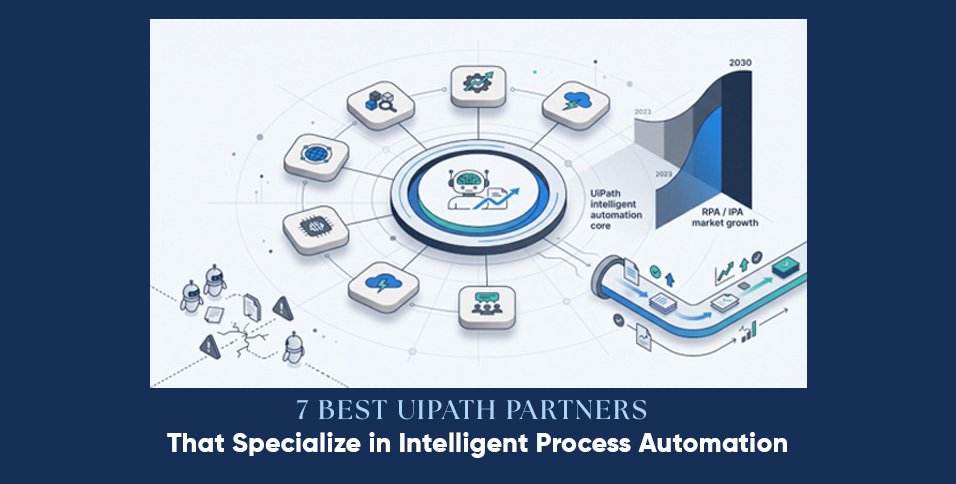
The stakes are growing. The RPA market weighed in at $2.94 billion in 2023 and is projected to hit $30.85 billion by 2030—a 39.9 percent CAGR that will reward companies who automate at pace, according to a CIOReview analysis.
Your partner choice is decisive. UiPath’s Diamond-tier firms sit in the top percentile for complex, end-to-end delivery. Below, we rank the seven you should shortlist—drawn from certifications, client outcomes, and awards such as EY’s 2023 Global Partner of the Year and Accenture’s Growth Product Partner of the Year.
Ready to see who rises to the top?
How we selected the 7 best UiPath IPA partners
We believe you should see exactly how this shortlist came together—not a black-box ranking. We began with every services firm that UiPath lists at Gold tier or higher, giving us a baseline of proven delivery experience plus at least ten certified developers on staff.
Next, we scored each provider against six weighted factors that drive automation success in 2026:
- UiPath partnership tier and certifications – 25 percent
- Depth of intelligent-automation projects – 20 percent
- AI and advanced-automation capability – 15 percent
- Customer satisfaction signals – 15 percent
- Geographic scale and delivery flexibility – 10 percent
- Proprietary accelerators and thought leadership – 10 percent
Each partner earned a 1-to-10 mark on every factor. We verified claims through public case studies, analyst reports, and UiPath’s partner directory. When two firms finished within two points, we broke the tie by looking at industry breadth. That detail matters: a boutique with standout healthcare projects can beat a generalist if you run hospitals, while a global bank needs proof across compliance, payments, and trade finance.
Our lens stayed fixed on intelligent process automation—the fusion of RPA with AI techniques like natural-language processing and computer vision that lets bots tackle the messy, exception-heavy 30 to 40 percent of work traditional scripts can’t touch.
One illustration of the bar we set is a 2025 Monstarlab case study: UiPath robots joined with a generative-AI document parser and cut inquiry-resolution time for a global workforce-services firm by 75 percent.
We also set three non-negotiable entry rules. A partner had to hold an active Gold tier (or higher), show AI-enabled work such as document understanding or process-mining analytics, and provide at least one post-2023 client reference or analyst mention. Technology-only ISVs and “registered” partners did not qualify.
The scoring surfaced a clear top seven. Five are global consultancies; two are specialist boutiques that punched above their size. Presenting them in rank order satisfies readers’ instinct to compare while keeping the method transparent.
Bottom line: objective weights, verifiable data, and a bias for fresh thinking over pure size. That framework underpins the list you’ll explore next.
1. Accenture – global scale with deep UiPath DNA
Accenture tops our list because no other partner matches its mix of delivery muscle and UiPath-specific expertise. This Diamond-tier alliance dates back to the earliest RPA days, and the firm keeps investing. In 2023 UiPath named Accenture Worldwide Growth Product Partner of the Year for driving adoption of modules such as Process Mining and Test Suite.
So what does that look like in practice? Picture hundreds of certified developers across fifty-plus countries. Uber tapped Accenture to stand up more than one hundred UiPath automations, saving $10 million a year and generating a 350 percent ROI in twelve months.
The real separator is the AI bench. Accenture’s automation labs build generative-AI copilots for UiPath Studio, while pre-trained anomaly-detection models slot straight into AI Center. Clients move past task automation to cognitive bots that read contracts, flag fraud, and trigger next-best actions on their own.
Accenture charges premium rates, yet enterprises seeking global, end-to-end transformation—especially in banking, telecom, or healthcare—rarely find a rival with the same playbook, governance depth, and cross-disciplinary talent. If your mandate is “automation everywhere,” this heavyweight can carry the load.
2. EY: redesigning processes, not just dropping bots
EY claims the runner-up spot because it approaches automation from a strategist’s viewpoint. While others rush to code, EY first dissects the process and regulatory landmines, then rebuilds the flow with UiPath at the core. That discipline paid off when UiPath named EY Global Partner of the Year, recognizing both delivery volume and technical leadership.
The Diamond badge is more than a logo. EY runs UiPath inside its own audit and tax lines, so the methods clients see have already survived high-stakes, real-world use. Example: EY streamlined SAP CRM and ERP tasks, raising accuracy, speed, and efficiency across one million transactions a year. Finance leaders appreciate the outcome; compliance teams value the audit trail.
EY excels at pairing deep domain knowledge—think IFRS rules, pharmaceutical validation, or complex tax codes—with the expanding UiPath stack. Recent projects combined Process Mining to spot bottlenecks with AI Center models that predict anomalies before bots stumble. The program improves every quarter instead of slowing as exceptions pile up.
Clients also value EY’s focus on capability transfer. Projects finish with a lightweight Center-of-Excellence playbook, internal champion coaching, and KPI dashboards that show ROI in plain English. You can keep scaling after the consultants leave.
Choose EY when governance, risk, and compliance top your agenda, or when you need to persuade a skeptical CFO that automation can be both forward-looking and audit-ready.
3. Infosys: industrial-strength automation with a cost-smart engine
Infosys blends two worlds that rarely coexist: Fortune-500 scale and offshore economics. The Indian giant sits in the Diamond tier yet keeps delivery costs in check through automation hubs in Bengaluru, Pune, Monterrey, and Kraków. That footprint matters when you need twenty bots built in parallel without draining the budget.
Clients turn to Infosys for depth across regulated industries. Need to automate complex steps that touch custom screens and legacy engines? Infosys has reference code for that. A leading chip maker used the firm to automate its Return Management Authorization process with UiPath, saving more than 10,000 hours a year and redeploying 42 employees to higher-value work.
Infosys relies on a hybrid toolkit. The team champions UiPath for enterprise orchestration but adds its own AssistEdge for attended desktop tasks or quick screen scrapes. Architects match the right hammer to each nail instead of forcing every job into one pattern.
Consultants also engage data-science teams. They plug Azure Cognitive Services or AWS AI into UiPath AI Center, then surface predictions in the same Orchestrator dashboard your ops staff already monitor. The option to toggle between rules-based bots and machine-learning models keeps total automation cost low.
Choose Infosys when you want solid governance, 24-hour follow-the-sun development, and price points your CFO will approve, particularly in banking, insurance, telecom, or any shop running on a patchwork of legacy cores.
4. Capgemini: orchestration expert for end-to-end automation
Capgemini spans management consulting, IT integration, and business-process outsourcing, so every UiPath project starts with one question: how will this bot fit the wider operating model? That perspective explains why the firm holds Diamond badges in multiple regions and why Everest Group repeatedly names Capgemini a Leader for intelligent automation services.
During engagements Capgemini rarely begins with code. Its Perform AI framework maps each finance, supply-chain, or customer-service touchpoint, then layers in UiPath Process Mining to reveal where time and money leak away. Once the data points the way, developers spin up unattended robots, attended desktop agents, or test-automation workflows.
Because Capgemini runs large BPO contracts, the team’s incentives align with yours. The firm’s Automated Finance Code tool, built on UiPath, speeds the month-end close by resolving code-creation volumes in real time and cutting errors and cycle time.
Capgemini also excels in public-sector and manufacturing programs that require multilingual support. Near-shore centers in Poland, Argentina, and Morocco let teams handle French, German, and Spanish processes without time-zone friction. If your roadmap crosses continents, that 24-hour loop of design, build, and run pays off.
Choose Capgemini when you need more than isolated bots, and when automation, analytics, and managed operations must work together under one accountable roof.
5. Ashling Partners: boutique precision with award-winning AI flair
Ashling Partners shows that size is no barrier to Diamond-tier impact. About 150 automation specialists stay laser-focused on UiPath, and the Chicago firm keeps adding trophies: Foundational Partner of the Year globally and Americas AI & Automation Partner of the Year. Those awards reflect hard results, not marketing polish.
Consider Dexcom’s order-processing revamp. Ashling combined UiPath robots with a machine-learning prioritization model, freeing 200,000 hours and cutting cycle time by 80 percent. Manufacturing clients share a similar story: bots now read dense material-test reports and update ERP systems before an engineer finishes morning coffee.
Enablement sets Ashling apart. Each engagement includes a “train-the-client” sprint where your analysts learn to tweak workflows and launch new ones through a lightweight center-of-excellence kit. Customers report near-perfect retention because they feel ownership, not dependency.
The boutique’s process-mining skill also stands out. Ashling holds Celonis Partner of the Year honors, proving opportunities are data-driven. Early-access FastTrack status for UiPath’s generative-AI features powers pilots such as chat-based HR onboarding assistants that write emails and trigger credential-setup bots automatically.
Choose Ashling when you want senior talent on every stand-up, rapid iteration, and measurable ROI within one or two quarters. Mid-market manufacturers, healthcare providers, and supply-chain teams will find a partner that speaks their language and delivers change without enterprise-consulting overhead.
6. Roboyo: pure-play automation pioneer pushing agentic AI boundaries
Roboyo is the largest specialist consultancy focused solely on intelligent automation. No ancillary SAP practice, no cloud hosting arm; the team delivers hyper-automation solutions day in and day out. That focus has kept Roboyo in UiPath’s Diamond club since 2018 and landed it on the vendor’s partner council.
Clients see the expertise quickly. For a global banking client, Roboyo deployed digital workers that processed data updates 60 times faster, trimming transaction times from five minutes to five seconds. Error rates dropped, audit flags vanished, and regulatory reports closed on schedule.
Roboyo Labs, the firm’s R&D hub, now trials “agentic” automation—workflows where large-language models decide the next step and UiPath robots execute it. Early pilots include an AI service-desk agent that triages emails, queries a knowledge base, and opens UiPath tickets without human routing. Customers move from task automation to outcome automation.
Roboyo operates across sixteen countries yet keeps teams nimble. Workshops feature senior architects, not a stream of junior coders. The cultural mix, strong in Germany, the United States, and Singapore, helps multinationals roll out consistent governance while respecting regional nuance.
Choose Roboyo if your RPA pilot hit a ceiling or if you want to explore autonomous processes that blend UiPath with generative AI. The firm’s pure-play DNA keeps every sprint centered on automation, not adjacent upsells.
7. Lydonia Technologies: agile mid-market ally with award-winning impact
Lydonia Technologies proves that a focused partner can outshine bigger names when speed and flexibility matter more than sheer headcount. The U.S. consultancy specializes in weaving UiPath into end-to-end transformation projects for mid-market and enterprise clients, earning UiPath’s Worldwide Impact Partner of the Year title in 2023.
Clients applaud the team’s “startup cadence.” Sprints rarely exceed two weeks, and workshops feature the same engineers who later deploy the bots. This tight loop delivers rapid time-to-value, helping customers apply intelligent automation for faster growth and higher profitability.
Lydonia’s core strength is blending UiPath with modern cloud and data stacks. Need invoice OCR through Document Understanding, ERP integration via REST APIs, and a chatbot front end? Cross-functional squads cover the entire chain without vendor finger-pointing. Deep automation expertise lets businesses scale confidently.
Choose Lydonia when you’re a fast-growing company that finds global systems integrators slow and pricey yet still wants certified UiPath talent plus a partner fluent in GenAI trends. Expect close attention, reusable bot components, and a delivery rhythm that matches your own pace.
Quick comparison: how the seven partners stack up
You’ve met each provider in detail, but it helps to see the essentials side by side. The grid below distills the six criteria we scored (tier, experience, AI depth, client kudos, global reach, and unique IP) into an at-a-glance view. A full star means the partner leads the field for that factor; empty space shows room to grow.
| Partner | UiPath tier | IPA project depth | AI & advanced automation | Client satisfaction | Global delivery | Proprietary accelerators |
| Accenture | ⭐⭐⭐⭐⭐ | ⭐⭐⭐⭐⭐ | ⭐⭐⭐⭐⭐ | ⭐⭐⭐⭐ | ⭐⭐⭐⭐⭐ | ⭐⭐⭐⭐⭐ |
| EY | ⭐⭐⭐⭐⭐ | ⭐⭐⭐⭐⭐ | ⭐⭐⭐⭐⭐ | ⭐⭐⭐⭐ | ⭐⭐⭐⭐⭐ | ⭐⭐⭐⭐ |
| Infosys | ⭐⭐⭐⭐⭐ | ⭐⭐⭐⭐⭐ | ⭐⭐⭐⭐⭐ | ⭐⭐⭐⭐ | ⭐⭐⭐⭐⭐ | ⭐⭐⭐⭐⭐ |
| Capgemini | ⭐⭐⭐⭐⭐ | ⭐⭐⭐⭐⭐ | ⭐⭐⭐⭐⭐ | ⭐⭐⭐⭐ | ⭐⭐⭐⭐⭐ | ⭐⭐⭐⭐ |
| Ashling Partners | ⭐⭐⭐⭐⭐ | ⭐⭐⭐⭐ | ⭐⭐⭐⭐⭐ | ⭐⭐⭐⭐⭐ | ⭐⭐⭐ | ⭐⭐⭐⭐ |
| Roboyo | ⭐⭐⭐⭐⭐ | ⭐⭐⭐⭐ | ⭐⭐⭐⭐⭐ | ⭐⭐⭐⭐⭐ | ⭐⭐⭐⭐ | ⭐⭐⭐⭐⭐ |
| Lydonia Technologies | ⭐⭐⭐⭐⭐ | ⭐⭐⭐ | ⭐⭐⭐⭐ | ⭐⭐⭐⭐⭐ | ⭐⭐⭐ | ⭐⭐⭐ |
The table isn’t a winner-takes-all leaderboard. Instead, use it to focus on the factors that matter most for your project:
- Need global coverage and large-scale delivery? The five-star footprints of Accenture or Capgemini will reassure your board.
- Looking for cutting-edge AI? Roboyo and Ashling match the giants, showing that creativity isn’t limited by team size.
- Budget and close collaboration top of mind? Lydonia’s smaller team still lands five stars for client happiness, underlining the value of personal attention.
Keep these trade-offs in view as we move to the buyer’s guide.
Buyer’s guide: choose the partner that fits your automation goals
Before sending a stack of RFPs, pause and get clear on what you need from automation. Too many projects stumble because teams chase flashy AI tricks and overlook the business problems right in front of them.
Start with three fundamentals:
- Outcome: Which business metric must move? Think invoice-to-cash days, claims accuracy, or developer velocity. Tie every decision to that north-star KPI.
- Scope: Are you piloting ten bots in one department, or revamping processes across continents? The answer decides whether you need boutique agility or a global control tower.
- Timeline: Do executives expect results this quarter, or is there room to build a center of excellence and manage change?
Put these points on one slide and share it. Until everyone agrees, don’t talk to partners. When you do, open with a test: ask each vendor to restate your goals in their own words. If they stumble, move on.
In the next subsection we’ll map those goals to the seven evaluation factors that separate a hype-heavy pitch from a partner who can deliver.
Match goals to partner strengths: seven questions to ask in every pitch
Your objectives are set, so test each contender through the same lens. The questions below mirror the six-factor scorecard plus one check on culture fit. Keep the tone conversational; you want stories and numbers, not canned slides.
- Tier and certifications
“How many UiPath-certified professionals will work on my project, and may I speak with one today?”
A Diamond badge is helpful, but real expertise sits with the people who’ll join your stand-ups. - Project experience
“Show me a case study in my industry that moved the KPI we just named. What surprised the client most?”
Look for specifics: hours saved, defects reduced, revenue protected. - AI depth
“Which UiPath AI Center models or GenAI integrations have you run in production, and what was the payback?”
If the partner hesitates, they may still be in classic RPA mode. - Customer satisfaction
“Provide two references I can call without you on the line.”
Listen for themes such as responsiveness, transparency, and fast issue resolution. - Geographic reach
“Where will development happen, and how do you manage time-zone hand-offs?”
Near-shore teams may beat offshore if nightly batch windows or language nuance matter. - Proprietary accelerators
“Which reusable components shorten delivery for projects like mine, and can you demo one now?”
Effective IP cuts sprint time; weak IP traps you in opaque code. - Culture and change management
“How will you upskill our team so we are not dependent on you forever?”
Partners who bake enablement into the SOW leave behind bots that keep running.
Ask these in the first meeting. Partners who answer with ease set a high bar; those who stumble can save you months of later course correction.
Generative AI Integration for Content Creation
Generative models are no longer Silicon Valley curiosities; they are sliding into UiPath workflows and reshaping how we automate knowledge work. Instead of bots that just move data from A to B, we now see pipelines where a large-language model reasons over the data, drafts content, and hands polished output back to the human, or even publishes it after a quick check.
Automated document drafting: from raw figures to finished narrative
Picture the monthly KPI pack your finance team labors over. A UiPath robot already pulls numbers from ERP and BI tools. With Gen AI in the loop, that same robot feeds the dataset to an LLM prompt designed to produce a crisp executive summary. Seconds later you have a first draft—trends explained, anomalies flagged, action items suggested—ready for a controller’s quick review.
One retailer cut report preparation from eight hours to twenty minutes, freeing analysts to hunt insights instead of copying charts. Quality improved too; the LLM keeps tone consistent, flags missing commentary, and can translate the draft into several languages on the fly.
From one-size-fits-all emails to hyper-personalized outreach
Marketing teams have long dreamed of greeting every customer by name, preference, and purchase history, but writing thousands of unique messages was impossible. UiPath plus Gen AI changes that.
A UiPath unattended robot scans CRM records overnight, segments customers by behavior, and pulls context—last product viewed, loyalty-tier perks, support-ticket sentiment. Those details feed an LLM prompt that crafts an email tailored to each recipient’s tone and offer. The robot pushes the content into your email platform and schedules delivery at the customer’s historical open-time sweet spot.
A fashion retailer piloting this flow saw click-through rates jump 40 percent and returned stock drop, because recommendations matched shopper intent. Drafts still run through UiPath validation stations, so governance stays intact.
Keep humans in the loop: governing Gen AI output without slowing down
All this power raises a fair question: how do you stop an LLM from hallucinating numbers or sending brand-unsafe copy? The answer is a structured human-in-the-loop checkpoint inside UiPath:
- The robot gathers data and prompts the model.
- Gen AI produces draft content.
- UiPath routes the draft to a validation station with clear approval criteria such as accuracy thresholds, brand-voice rules, and required or forbidden regulatory phrases.
- A reviewer scans, tweaks if needed, and approves. The bot then publishes or passes the item to the next system.
Because the robot handles formatting, attachments, and system updates, the human’s review window shrinks to minutes, not hours. Compliance teams appreciate the audit trail: every prompt, draft, and edit is timestamped for later inspection.
The lesson is simple: Gen AI does not replace experts; it amplifies them by clearing away blank-page work and letting people focus on judgment calls. When partners design workflows with guardrails from day one, you gain speed without sacrificing trust.
The Cost of AI Process Automation for Retail Companies
Retail margins are thin, so every automation dollar must prove its worth quickly. Yet project quotes often arrive as baffling lump sums. Let’s break the cost structure into pieces you can challenge during negotiations.
Software and infrastructure
Start with licenses. A single unattended UiPath robot lists at about $8,000 per year, while enterprise agreements covering unlimited bots can reach the mid-six figures. Add AI extras such as Document Understanding for OCR or an OpenAI subscription for generative text, and you tack on roughly 20 to 30 percent to the annual fee. Cloud hosting eases capital expense, but budget for usage spikes during holiday surges.
Implementation services
Partners charge for effort. A low-complexity bot that reads CSV orders and updates an ERP might cost $35,000 all-in. Automating a returns process that touches OCR, sentiment analysis, and five legacy systems can reach $150,000. Rule of thumb: every new system interface or decision branch lifts build cost by double-digit percentages.
Run-and-maintain
Bots fail when screens change. Annual maintenance—monitoring, minor tweaks, platform patches—averages 15 percent of the original build. Smart retailers fold this into a managed-service contract; the predictable fee is cheaper than emergency fixes during Black Friday.
The upside that pays for it all
Labor savings grab headlines, but two stealth benefits often dwarf wage reductions:
- Lost-sales prevention. Faster replenishment bots keep shelves stocked, recapturing revenue otherwise lost to stock-outs.
- Error elimination. One grocer saved $500,000 in fines by automating price-file updates, eliminating shelf-tag mismatches.
Most retailers we track break even within twelve months when projects target revenue leakage, not just head-count cuts.
Cost-control playbook
- Pilot one end-to-end process, not a scattered trio. A focused scope avoids redundant discovery work.
- Exploit accelerators. Partners such as Capgemini and Infosys bring pre-built “inventory robot” templates, so ask to see them.
- Negotiate gain-share. If a partner is confident in savings, they may fund part of the build and recoup from the upside.
Follow these levers, and automation shifts from expense line to growth engine—precisely what retail needs in an Amazon-everywhere world.
Conclusion
The intelligent-automation landscape is crowded, but the seven UiPath partners profiled here rise to the top through a mix of proven delivery, innovative AI use, and industry-specific expertise. Map your business goals to their strengths, press them with the seven buyer questions, and you’ll land a partner that turns RPA hype into sustained ROI.