Mirror Review
May 11, 2026
Saudi Aramco is the world’s largest oil producer and one of the most profitable energy companies globally. The company is known for its massive crude oil reserves, large-scale energy infrastructure, and dominant role in global oil supply.
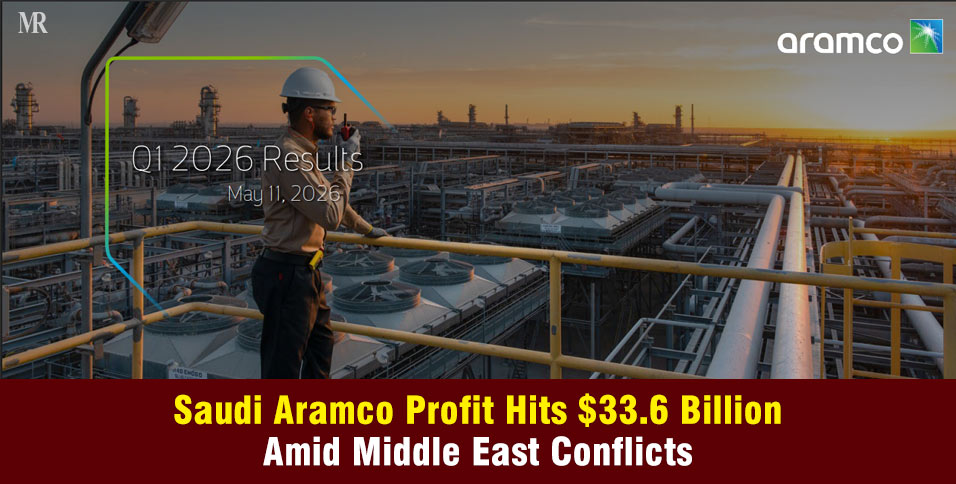
On May 10, 2026, Saudi Aramco reported a first-quarter income of $33.6 billion, marking a 26% increase from the previous year. This jump in Saudi Aramco profit came despite intense geopolitical conflicts in the Middle East that forced the closure of the Strait of Hormuz. Aramco beat analyst expectations by utilizing its 1,200km East-West Pipeline to move oil to the Red Sea, bypassing blocked shipping lanes
Moreover, high global oil prices, with Brent crude reaching about $100 per barrel, further supported these strong Saudi Aramco Earnings.
Financial Highlights for Saudi Aramco Q1 2026
While regional instability created a complex environment, the core figures reflect a highly profitable period for Saudi Aramco.
| Metric | Q1 2026 Value | Q1 2025 Value |
| Adjusted Net Income | $33.6 billion | $26.6 billion |
| Total Revenue | $115.5 billion | $108.2 billion |
| Free Cash Flow | $18.6 billion | $19.2 billion |
| Capital Expenditures | $12.1 billion | $12.5 billion |
| Gearing Ratio | 4.8% | 5.3% |
The Saudi Aramco Q1 Revenue rose by nearly 7% compared to the same period in 2025. Although operating cash flow dipped slightly to $30.7 billion from $31.7 billion, the company remains one of the most profitable entities globally.
How Did Saudi Aramco Bypass the Strait of Hormuz Blockade?
A major factor behind the successful Saudi Aramco results was the strategic use of the East-West Pipeline.
The Strait of Hormuz, a narrow waterway where 20% of global oil typically passes, has been effectively closed since late February due to the US-Iran war.
Saudi Aramco reacted by ramping up its 1,200km pipeline to a maximum capacity of 7.0 million barrels per day. This allowed the company to move crude from its eastern oil fields to the Yanbu terminal on the west coast, ensuring exports reached international customers via the Red Sea.
Saudi Aramco CEO, Amin Nasser, emphasized the importance of this infrastructure, stating: “Our East-West Pipeline has proven itself to be a critical supply artery, helping to mitigate the impact of a global energy shock and providing relief to customers affected by shipping constraints in the Strait of Hormuz”.
Global Energy Supply Losses and Market Impact
The ongoing conflict has removed a massive amount of oil from the global market.
According to Saudi Aramco, the world has been deprived of roughly 1 billion barrels of oil over the past two months. This shortage has triggered a 40% spike in energy prices compared to levels before the fighting began.
- Brent Crude Ticker: Prices reached $103.91 per barrel in early May.
- Supply Shortage: The global energy system is currently under extreme strain due to years of underinvestment and depleted inventories.
- Recovery Timeline: Even if the Strait of Hormuz reopens immediately, Nasser warns it will take several months for the market to rebalance. If shipping remains curtailed for several more weeks, the supply disruption could persist until 2027.
How is Saudi Aramco Sustaining Shareholder Value and Growth?
Despite the regional turmoil, Saudi Aramco continues to reward its investors. The Board declared a base dividend of $21.9 billion for the first quarter of 2026, which represents a 3.5% increase year-on-year. In March 2026, Saudi Aramco also announced their first ever share buyback program worth $3 billion.
Saudi Arabia relies heavily on these payouts to fund domestic projects. The government directly holds more than 80% of Aramco, while the Public Investment Fund (PIF) owns 16%.
In addition to dividends, the company is focused on long-term growth:
- Gas Production: Aramco aims to increase sales gas production capacity by about 80% by 2030.
- Jafurah Project: The Jafurah Gas Plant successfully exported its first shipment of condensate this quarter.
- Oil Capacity: Work continues on the Zuluf and Dammam projects to maintain a maximum sustainable capacity of 12.0 million barrels per day.
- Technology: The company announced plans for a next-generation supercomputer, expected by 2027, to improve discovery and recovery rates.
Saudi Aramco’s Operational Resilience and Flexibility
The Saudi Aramco Q1 Profit was not just a result of high prices, but also of operational agility.
The company achieved a hydrocarbon production rate of 12.6 million barrels of oil equivalent per day (mmboed), up 0.3 mmboed from the first quarter of 2025.
Hydrocarbon production refers to the extraction of oil and natural gas resources, and higher production levels help energy companies increase supply capacity, revenue generation, and market stability during periods of high global demand.
While certain domestic facilities were targeted in infrastructure and oil refinery attacks during the quarter, management stated the impact was not material to the company’s financial position.
Also, supply reliability remained high at 96.3%.
Strategic Moves in Downstream Operations
Saudi Aramco’s downstream segment, which includes refining and petrochemical operations through major oil refineries, saw a significant boost, with adjusted EBIT (Earnings Before Interest and Taxes) rising to $5.0 billion compared to $1.4 billion in the same period last year. A higher EBIT reflects stronger operational performance and improved business efficiency. This was primarily driven by stronger refining margins and trading performance.
During the quarter, Saudi Aramco also moved forward with portfolio optimization. Its subsidiary, SABIC, signed agreements to sell its European petrochemicals and American engineering thermoplastics businesses.
These divestments allow the company to focus on higher-growth markets and more efficient operations.
Future Outlook for Saudi Aramco Profit
The Saudi Aramco profit of $33.6 billion demonstrates the company’s ability to remain highly profitable even during a “global energy shock”.
By leveraging flexible infrastructure like the East-West Pipeline, Aramco has secured its role as a reliable energy provider in a volatile market.
While the 1 billion barrels lost from the market suggest a slow recovery for global inventories, the company’s strong balance sheet and 4.8% gearing ratio provide the stability needed to continue its massive investment program.
Looking ahead, the focus remains on expansion in gas and chemicals to ensure long-term value for the Saudi government and global shareholders.
Maria Isabel Rodrigues