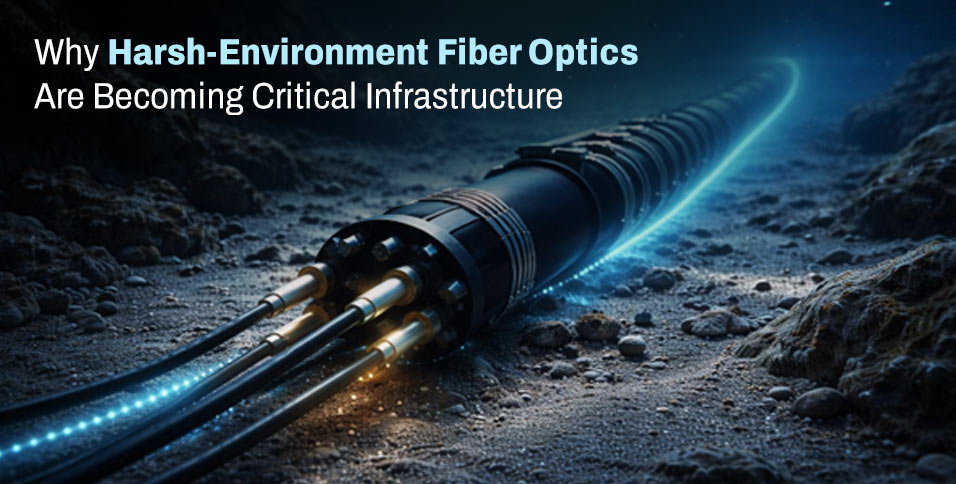
In today’s rapidly evolving digital and industrial landscape, connectivity is no longer confined to offices, cities, or controlled environments. From deep-sea exploration to aerospace systems and defense operations, data must travel reliably through some of the most extreme conditions on Earth—and beyond.
While much of the conversation around fiber optics focuses on speed and bandwidth, a more critical factor is often overlooked: durability in harsh environments. As industries push boundaries, the need for rugged, high-performance fiber optic solutions is quietly becoming a cornerstone of modern infrastructure.
Beyond Bandwidth: The Real Challenge of Fiber Optics
Traditional fiber optic cables are designed for stable environments—data centers, telecom networks, and indoor installations. However, when exposed to mechanical stress, extreme temperatures, pressure, moisture, and abrasion, standard cables can fail quickly.
This is where harsh-environment fiber optics play a crucial role.
Industries such as subsea engineering, offshore energy, aerospace, and defense rely on fiber cables that can withstand:
- high-pressure underwater conditions
- constant motion and mechanical fatigue
- exposure to chemicals and saltwater
- extreme temperature variations
- heavy-duty deployment cycles
Without this level of resilience, system failures can lead to costly downtime, safety risks, and mission-critical failures.
The Rise of Ruggedized Fiber in Mission-Critical Systems
Modern infrastructure is increasingly dependent on real-time data transmission in unpredictable environments. Whether it’s remotely operated vehicles (ROVs) inspecting subsea pipelines or aerospace systems transmitting critical data mid-flight, the reliability of fiber optics is non-negotiable.
Companies like Linden Photonics are leading this shift by developing advanced fiber optic cables specifically engineered for harsh conditions.
Their work in subsea, aerospace, and industrial applications highlights a key trend:
👉 Fiber optics are no longer just a communication tool—they are a structural component of operational reliability.
To explore how these solutions are applied in real-world scenarios, see how advanced subsea and marine cable systems are engineered for extreme durability
Subsea Connectivity: Where Failure Is Not an Option
Underwater environments are among the most challenging for fiber optic systems. High pressure, corrosion, and constant movement create conditions that standard cables simply cannot endure.
In subsea operations, fiber optic cables are used in:
- ROV tether systems
- offshore inspection and maintenance
- underwater research and surveillance
- energy infrastructure monitoring
The performance of these systems depends heavily on cable design. Even minor weaknesses in materials or construction can result in failure.
This is why specialized designs—such as ruggedized fiber optic tethers for ROV applications—are essential. These cables are engineered to maintain signal integrity while withstanding mechanical stress and environmental exposure.
Aerospace and Defense: Smaller, Stronger, Lighter
In aerospace and defense, every component must meet strict performance and weight requirements. Fiber optic cables used in these sectors must be:
- lightweight to reduce overall system load
- highly durable under vibration and stress
- resistant to temperature extremes
- capable of maintaining signal performance under demanding conditions
This has driven innovation toward cables that are smaller, stronger, and lighter—without compromising reliability.
For example, specialized aerospace fiber solutions are now engineered to outperform traditional designs by combining mechanical strength with reduced size and weight.
The Engineering Behind Reliability
What makes harsh-environment fiber optic cables different is not just the material—it’s the engineering approach.
Advanced cable designs incorporate:
- high-strength protective jackets
- optimized strain relief systems
- enhanced flexibility without signal loss
- resistance to abrasion and environmental damage
- long lifecycle performance under repeated stress
Understanding these factors is critical when selecting the right solution. Choosing the wrong cable for a harsh environment can result in frequent failures, higher maintenance costs, and operational inefficiencies.
The Business Case: Reliability Equals ROI
While ruggedized fiber optic cables may involve higher upfront costs, they offer significant long-term benefits:
- reduced maintenance and replacement costs
- fewer system failures and downtime
- improved operational efficiency
- enhanced safety in critical environments
- longer service life
For industries operating in harsh conditions, the true cost of failure far outweighs the initial investment in high-performance cable solutions.
The Future of Infrastructure Is Built on Resilience
As industries continue to expand into more demanding environments, the role of fiber optics will only grow more critical. The focus is shifting from simply transmitting data to ensuring that data can be transmitted reliably, consistently, and under any condition.
Harsh-environment fiber optics are no longer a niche solution—they are becoming a fundamental part of modern infrastructure across sectors.
Organizations that recognize this shift early will be better positioned to build systems that are not only faster, but also stronger, more resilient, and future-ready.
Final Thoughts
The next generation of infrastructure will depend on technologies that can perform where traditional systems fail. Fiber optics, when engineered for harsh environments, offer exactly that capability.
By investing in solutions designed for real-world conditions—not just ideal scenarios—industries can ensure long-term reliability, reduce risk, and support innovation at every level.